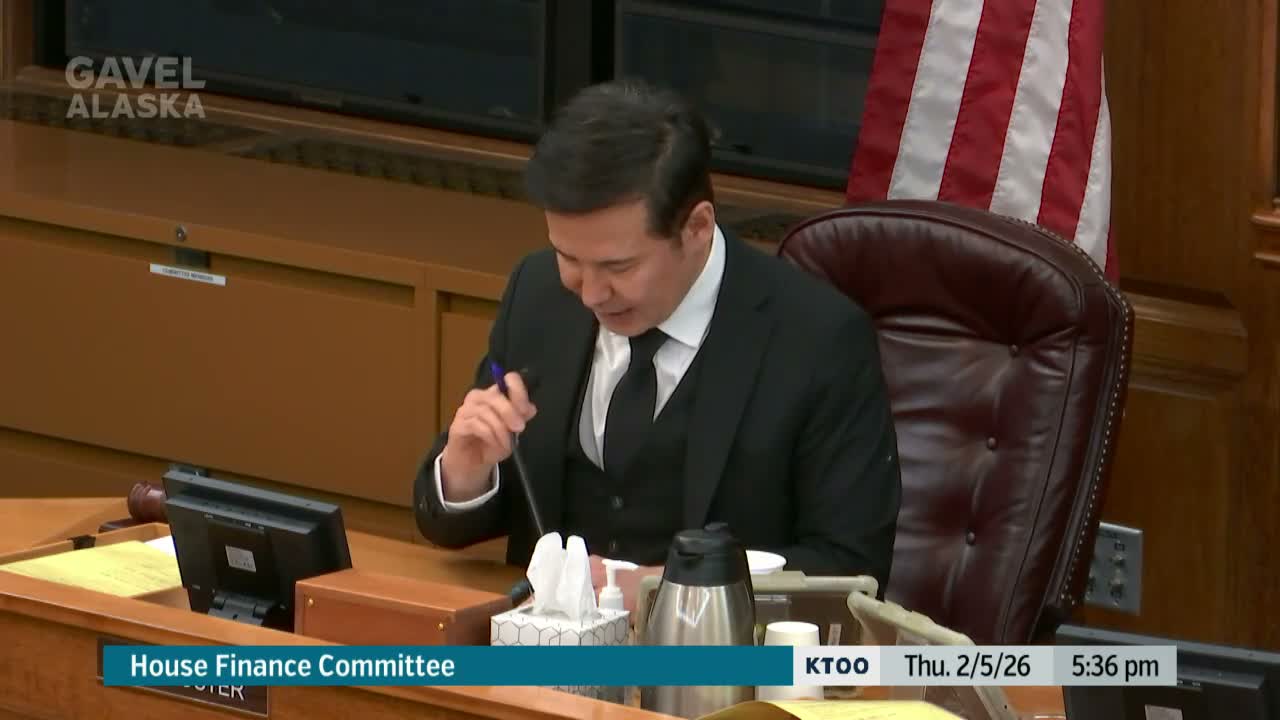
Alaska House Finance Committee Hears Broad Opposition to Governor's Sales-Tax Proposal in HB 284
Loading...
Summary
On Feb. 5 the House Finance Committee heard the sales-and-use tax portion of House Bill 284. Department of Revenue staff outlined a seasonal sales tax (4% Apr—Sep, 2% Oct—Mar). Dozens of municipal leaders and residents warned the proposal would be regressive, harm rural communities and undermine local control.
Juneau —6 Feb. 5, 2026 —6 The Alaska House Finance Committee heard public testimony Thursday on the sales-and-use tax portion of House Bill 284, the governor's omnibus tax package, after Amy Bushnell, legislative liaison for the Department of Revenue, summarized the proposal.
Bushnell told the committee the measure would create a statewide seasonal sales tax that the state would administer and remit back to municipalities, with a 4% rate from April through September and a 2% rate from October through March. She said the bill assumes a broad base with specified exemptions, including jet fuel, health-care services, internet access, construction of real property and business-to-business transactions. "The bill would require sellers to collect and remit the tax to the state," Bushnell said.
Why it matters: The committee limited testimony Thursday to the sales-tax section of HB 284; the bill also includes proposed changes to the corporate income tax and oil-and-gas production tax that the committee will consider separately. Many testifiers framed their opposition around two recurring themes: the regressive nature of sales taxes and the disproportionate impact on rural communities and voters who already rely on local sales-tax revenue to fund essential services.
What people told the committee: Municipal officials from across the state and scores of residents called in. Juneau Mayor Beth Weldon praised the effort to address Alaska's fiscal shortfall but urged protection of municipal authority and "respect [for] decisions local voters have already made." Chris Knoll, mayor of Denali Borough, told the committee that HB 284 "must not undermine local authority or override decisions local voters have already made," arguing the state plan risks subordinating municipal exemptions and caps.
Rural and small-community witnesses described concrete hardship. Julia Stewart, finance director for Haines Borough, said local sales tax funds roughly 30% of general fund services and 45% of police and public works; she said a statewide tax would make it harder for Haines to provide services. Roberta Murphy, tribal administrator for Chevak Native Village, gave a local example of rising costs: "a case of Top Ramen went from $20 to $25," and added that many families in her community already rely on food and heating assistance.
Several speakers urged alternatives to a statewide sales tax. Anchorage callers and municipal officials repeatedly recommended restoring or strengthening oil- and corporate-tax revenue, closing perceived tax-credit loopholes, and creating a progressive income tax rather than a consumption tax. Brian Smith, a teacher in Anchorage, said the Department of Revenue data indicate the state could instead examine roughly $1 billion a year in oil tax credits and other targeted changes before imposing a broad-based sales tax.
Concerns about administration and timing: Testifiers warned the state would need a new bureaucracy to administer a statewide sales tax and that the proposal could disrupt existing municipal collections and the Alaska Remote Seller Sales Tax Commission (ARSSTC) system that many communities use to collect remote-seller revenue. Sam Chenar, a mayor who said his community is an early ARSSTC member, warned that state administration could delay monthly deposits that municipalities rely on for operations.
Committee process and next steps: Committee co-chairs said the panel will return next week to take public testimony on the corporate and oil-and-gas portions of HB 284. The committee recessed and adjourned at 7:35 p.m.; it scheduled another meeting Friday, Feb. 6, at 1:30 p.m. to hear agency budget overviews and to continue its review of the governor's fiscal plan.
The committee did not take any formal votes on HB 284 during Thursday's session.