Alaska subcommittee hears plan to return payroll and accounts‑payable staff to departments
Loading...
Summary
Department of Administration officials told a House Finance subcommittee that 87 shared‑services positions and 40 payroll positions will be returned to state agencies to address duplicated processes and improve timeliness; officials reported a 38% payroll vacancy rate and about 330 outstanding notices of pay problems.
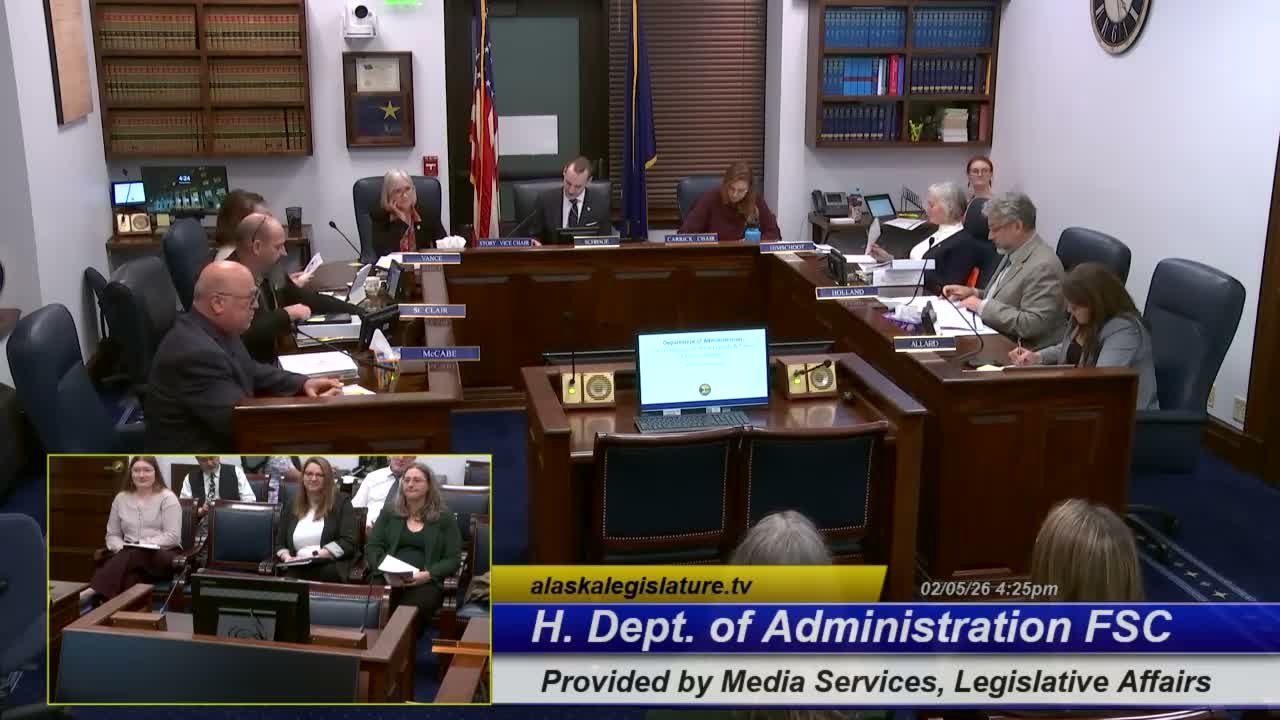
The House Finance Department of Administration Subcommittee on Thursday heard Department of Administration officials outline a plan to return shared‑services and payroll staff to individual state departments, a step department leaders said is meant to reduce duplicated steps and speed transaction processing.
"A total of 87 positions are transferring back to departments," Administrative Services Director Stephanie Bingham told the committee, describing the scheduled deconsolidation of Shared Services of Alaska. Bingham said those 87 roles include 81 permanent full‑time and six non‑permanent positions, and that 76 are filled while 11 are vacant. She said the Division of Finance and the Department of Transportation and Public Facilities would receive the largest shares.
The plan also moves 40 permanent full‑time payroll positions back to departments, Bingham said. "Department of Transportation and Public Facilities receives 17 positions. Department of Corrections receives 8, and Department of Fish and Game will receive 6," she said; of those 40, 27 are filled and 13 are vacant.
Why it matters: committee members pressed officials on whether decentralizing payroll could improve service and accuracy after earlier centralization was intended to standardize processes. Bingham said the change was prompted by feedback — including a September 2025 OMBI survey — in which many departments asked for accounts‑payable and travel functions to return to the offices that originate transactions. "The decentralization aligns the responsibilities and the accountability by placing processes and oversight with the departments that originate and manage those transactions," she said.
Payroll performance and staffing: Elizabeth Donasky, director of the Division of Finance, told legislators payroll has been strained. "Payroll has a 38% vacancy rate," she said, and staff have worked overtime to make sure employees are paid. Bingham told the panel the department received 2,349 notices of pay problems (NOPPs) since 2023, that most have been resolved and that "about 330 of them remain," which the department described as a steady state rather than a backlog.
Committee members pressed for historical data and targets. Representative Kerrick asked whether 330 open NOPPs is higher or lower than past peaks and what an acceptable steady state would be; Donasky said it is difficult to compare to earlier years because NOPPs were previously managed on paper and only recently tracked electronically, and that automated tracking shows a decline overall.
Accountability and follow‑up requests: Representative Ballard asked for a full listing of PCN numbers, vacancy durations and associated salaries; he said vacancies last year appeared large in aggregate and estimated "almost $272,000,000" in related amounts. Bingham accepted the request and the department agreed to supply the data to the committee.
Controls, training and automation: Committee members raised concerns that small, department‑level payroll teams could be vulnerable to single points of failure when staff are absent. Bingham said the Division of Finance will work directly with receiving agencies to cross‑train staff, provide statewide guidance, and maintain centralized oversight during transition. "Departments with 1 or 2 payroll staff will need to assess their internal processes and assign cross‑train staff or supervisors to provide the secondary review of all payroll runs," she said.
The department also described a narrower automation strategy during the deconsolidation. Donasky said the division is developing an AI chatbot hosted on Microsoft Teams to help newer payroll staff interpret bargaining‑unit rules and letters of agreement; she said the chatbot is "underway" and the team hopes it will be available in a couple of months, "hopefully before the end of the year." Officials said a full statewide time‑and‑attendance rollout is larger than the department can manage while decentralizing and will be scaled back.
No votes were taken. The hearing concluded with Bingham pointing to the Alaska Marine Highway System's earlier payroll transfer to the Department of Transportation as a positive example and the committee adjourning at 5:17 p.m. Committee members recorded several follow‑up information requests, including vacancy histories, PCN numbers, and more detail on NOPP trends.
What remains unresolved: the hearing produced requests for empirical comparisons of NOPP volumes over time, a department‑by‑department list of transferred positions with vacancy durations and costs, and a timeline for when receiving departments will refill vacancies or reclassify roles. The department agreed to provide those materials to the committee.