Senate committee hears bill to create statewide system for heart attacks, strokes; questions raised about permanent staff and costs
Loading...
Summary
An introductory hearing on House Bill 27 asked the Department of Health to create a trauma-like system for heart attacks and strokes — including hospital designations, statewide training and a case registry — while senators probed the fiscal note’s request for a permanent staff position and the law’s limited scope.
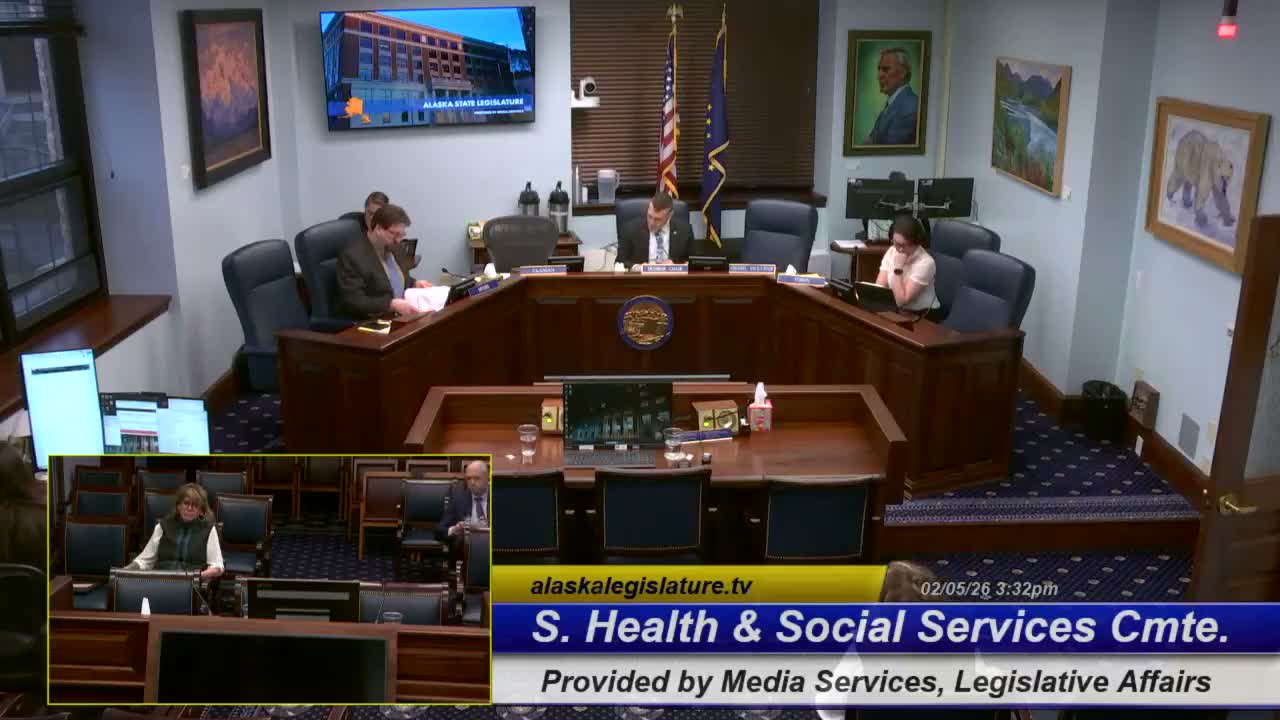
Juneau — The Senate Health and Social Services Committee heard an introductory presentation Feb. 5 on House Bill 27, which would authorize the Alaska Department of Health to develop a coordinated system of care for time-sensitive heart attacks and strokes, create hospital designation criteria tied to nationally recognized standards, and maintain a registry to track cases and outcomes.
Katie Georgiou, chief of staff to Representative Genevieve Mina, told the committee, "The the goal of house bill 27 is to modernize our systems of care and how we... address people who are experiencing heart attacks and strokes and time sensitive emergencies of that type." She said the bill is modeled on Alaska’s long-standing trauma system and would fund statewide training, standardized clinical guidance and improved communications so providers can get patients to the right level of care more quickly.
Dr. Robert Lawrence, chief medical officer for the Alaska Department of Health, said the statutory change would add the term "major emergencies" to existing emergency medical services language and that, for the purposes of the bill, that term is intended to cover "time sensitive emergencies" — specifically two broad categories: cardiac events and strokes. "What all of those share in common is that outcomes are dependent on, in a timely way, getting a patient from the point of crisis to the point of treatment," he said, emphasizing the role of centralized coordination and a registry so EMS agencies and hospitals can learn from each case.
The bill would allow hospitals and clinics to register with the department and attest to the equipment, personnel and capabilities they have, Georgiou said, so there is clarity about which facilities can provide particular interventions and when a higher-level transfer is needed.
Senators focused attention on the bill’s scope and cost. Chair Dunbar and other members asked whether the bill’s definition of "major emergencies" should include other conditions (Sen. Dunbar cited pulmonary embolism as an example). Dr. Lawrence acknowledged many emergencies are time-sensitive but said the proposed statute deliberately limits the new system to heart attacks and strokes to concentrate resources and operational design.
Senator Tobin pressed the sponsor and presenters about the fiscal note’s request for a full-time permanent position in the Department of Health to run and monitor the system. "I'm curious of why that's not a non perm, a temporary position," Tobin said, noting that automation and IT could reduce long-term costs. Georgiou and Wendy Allen, the program manager for Alaska’s trauma system, said data collection and program oversight require ongoing personnel. Allen said some tasks can be automated but "ultimately... there has to be a human being kind of overseeing the whole system," while acknowledging flexibility in how much full-time equivalent (FTE) staffing the department assigns.
Senator Klayman, drawing on EMT experience, asked whether conditions such as pulmonary embolism require different capabilities than stroke or cardiac care. Dr. Lawrence said the clinical presentations vary and that initial steps such as CT imaging determine whether a patient needs higher-level care; he described telemedicine and coordinated transfers as tools that would reduce delays in rural areas.
Senator Myers questioned why a statutory change is necessary if the department already has authority to build systems. Georgiou said the statute signals legislative intent and would ensure the department prioritizes building the system; Dr. Lawrence added that a statutory framework also enables a registry and formal feedback loops that have improved trauma care outcomes.
The committee set the bill aside for further consideration. Chair Dunbar said the committee will reconvene Feb. 10, when Guidehouse will discuss a Medicaid rate review and the panel will hold an introductory hearing on Senator Tobin’s SB 206.
The bill will return for further committee work; no vote or formal action was taken at the Feb. 5 hearing.