House State Affairs adopts committee substitute for ADA bill, continues debate on transparency and thresholds
Loading...
Summary
The Alaska House State Affairs Committee adopted a committee substitute as its working document for House Bill 124, which would subject the Alaska Industrial Development and Export Authority (ADA) to new oversight: increasing a revolving fund cap to $3 billion, raising project thresholds to $100 million, requiring independent feasibility studies for large projects, and clarifying public-records rules. The committee set an amendment deadline for Feb. 11 and will continue deliberations next week.
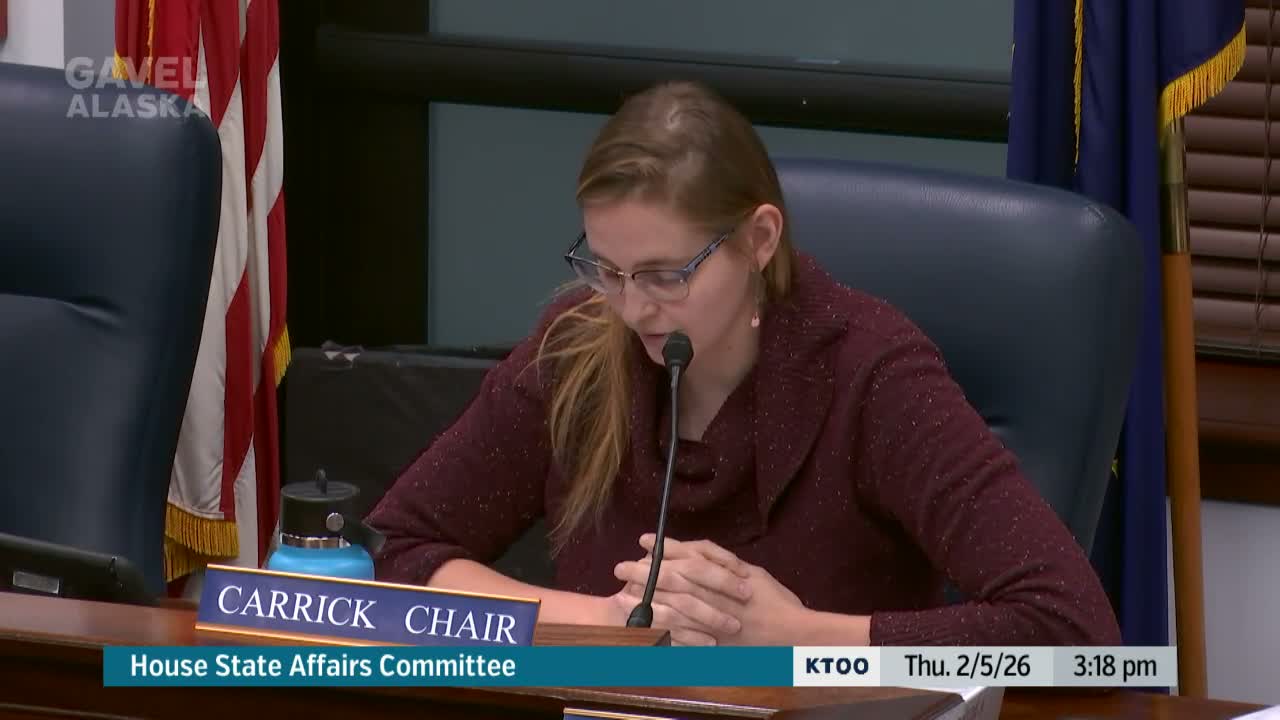
Chair Kerrick told the Alaska House State Affairs Committee on Feb. 5 that she would bring forward a committee substitute for House Bill 124 to balance ADA’s operational flexibility with greater legislative oversight and public engagement. After discussion, the committee adopted the substitute (version N) as its working document by unanimous consent and set an amendment deadline for Wednesday, Feb. 11, at 5 p.m.
The committee substitute would make several substantive changes to the authority’s governance and fiscal rules. Stuart Relay, committee staff, summarized the draft: it removes a board-designated seat for an environmental advocacy representative (section 2); raises the ADA revolving-fund cap from $500 million to $3 billion with an inflation-adjustment mechanism (section 8); raises the project-approval threshold from $10 million to $100 million with an inflation adjustment and requires an independent feasibility study for projects over the threshold, with the feasibility-study contractor approved by the Legislative Budget & Audit Committee (section 9); amends AS 44.88.205 to specify ADA is subject to the Executive Budget Act (section 11); and creates new public-records language permitting ADA to adopt regulations to withhold proprietary information (section 13).
Mark Davis, special counsel to ADA, said he had not had time to perform a full review but warned the substitute could limit ADA’s ability to provide rapid, short-term capital in urgent situations. “If we had to go to the legislature, that’s over $100,000,000, then we would not been able to finance that project,” Davis said, citing a case in which ADA floated short-term notes that enabled a Yukon-Kuskokwim Health Corporation project of roughly $169 million to proceed.
Several committee members pressed for more detail and options. Representative Holland asked for a pipeline of projects so members could see which projects would fall below or above the proposed $100 million threshold. Stuart Relay cited slide 16 from the ADA deck and gave examples of past ADA financings, including the Yukon-Kuskokwim Health Corporation (~$162 million), an Interior gas utility project (~$139 million), Bluecrest Energy (~$32 million), HEX (~$50 million), and the Chief Andrew Isaac Health Center (~$249 million).
Opponents and skeptics raised two principal concerns. Representative McCabe argued the bill risked sending a message that Alaska was not open for business and that subjecting ADA to greater legislative approval or to the Executive Budget Act could blunt its ability to respond quickly to market dislocations. Representative Vance questioned the mechanics of the cap and a provision that would lapse unexpended and unobligated ADA monies to the general fund, warning that such lapses could divert funds set aside for long-term economic development. Chair Kerrick said the cap was intended as a “pause point” to revisit policy if ADA’s valuation approached the ceiling and that public-engagement requirements in the bill would remain unchanged.
The committee did not vote on final passage of HB124; it adopted the committee substitute as its working document to continue deliberations. Chair Kerrick said the body will devote the next Thursday hearing to HB124 amendments and additional discussion.
Next steps: the committee set an amendment deadline of Feb. 11 at 5 p.m. and will continue work on HB124 at the committee’s next meetings.