
House transportation committee presses DOT for Cascade Point capital and lease costs as AMHOB flags funding uncertainty
Get AI-powered insights, summaries, and transcripts
Subscribe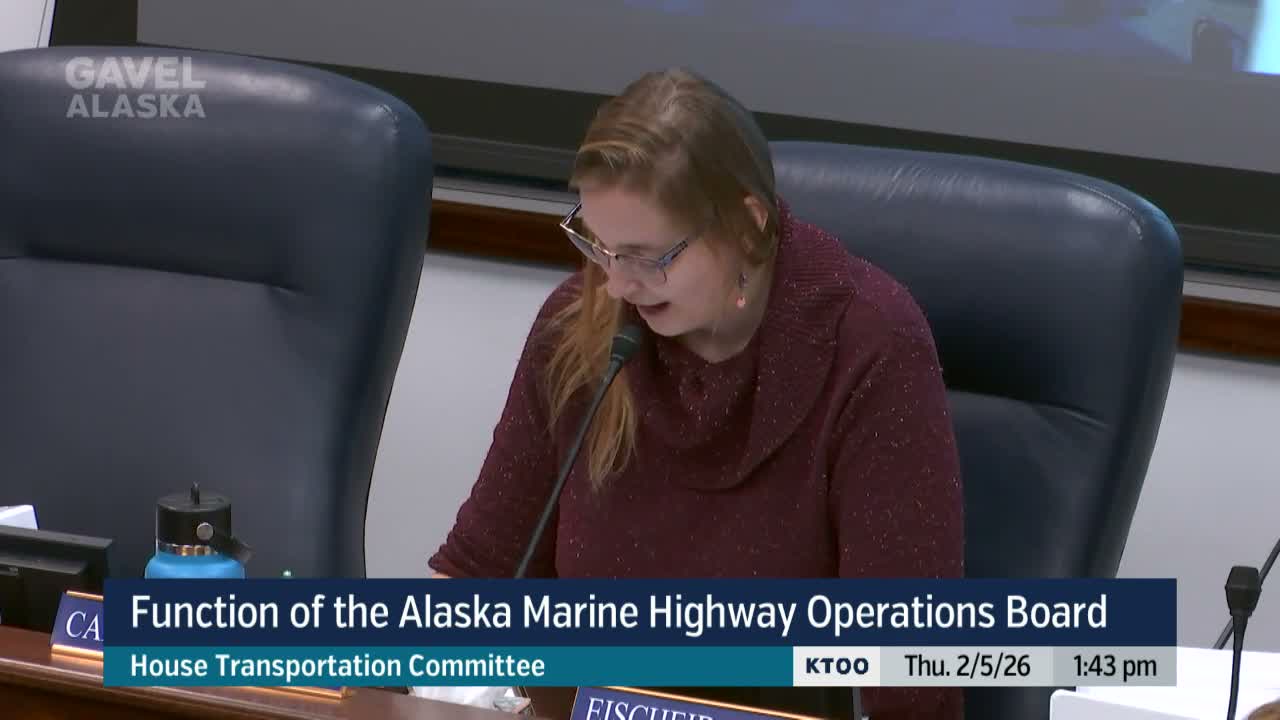
Summary
At a Feb. 5 House Transportation Committee hearing, AMHOB and DOT officials outlined AMHS modernization plans and debated whether Cascade Point’s public plan had been altered; lawmakers demanded written follow-up with capital, O&M and lease-cost detail and noted that an operating analysis omitted capital costs.
Juneau — At a Feb. 5 meeting of the Alaska House Transportation Committee, members pressed Department of Transportation and Public Facilities officials for clearer capital, maintenance and lease-cost numbers for the proposed Cascade Point ferry terminal while Alaska Marine Highway Operations Board leaders warned that federal and other funds remain uncertain.
Juanetta Ayres, chair of the Alaska Marine Highway Operations Board, told the committee that the board has been working since its statutory creation in HB 63 (effective Jan. 1, 2022) to stabilize and modernize the Alaska Marine Highway System and to clarify roles with DOT. She said the board found changes in the public version of the AMHS long-range plan on Cascade Point and requested a business-case study before a firm position: "the Alaska Marine Highway operational status is improving despite a lot of ongoing challenges," Ayres said, and the board "has not taken a position on Cascade Point."
Why it matters: Cascade Point is a high-profile proposal in Southeast Alaska that DOT and AMHOB say could shorten ferry routes and cut operating miles, but the committee sought clearer comparisons that include both the terminal’s capital and ongoing operations, not only studies that examine operating savings.
Key facts
- DOT and AMHOB officials said part of recent operating support for AMHS comes from federal ferry grants that are not guaranteed; Ayres reported conversations with federal staff and said a spring release of some funds was being discussed but not assured.
- Ayres told lawmakers that wording in the publicly posted long-range plan was altered in three places regarding Cascade Point — for example, language shifted from describing a "continuation of the Cascade Point feasibility study" to language stating construction "has begun using existing state appropriations," and lease-payment language was changed. Ayres said those alterations prompted the board to invoke its corrective-review authority under statute.
- Representative Stutes and others asked whether the economic analysis cited by proponents included capital costs. Department staff acknowledged that an operating-focused analysis (the Ed King analysis referenced in committee discussion) did not include capital costs: "In the operating analysis ... that did not include the capital costs," a department official said. The department also said it has shared full project benefit-cost materials with AMHOB dating to 2022.
- AMHS Director Craig Tornga described reliability and maintenance improvements, including a new computer maintenance management system and uptime tracking. "For 2025, we had a 98.55% uptime," Tornga said.
- Committee members asked DOT to follow up in writing with a concise (one- to two-page) breakdown that clearly lists capital construction costs, annual maintenance and operations estimates, and any land-lease costs associated with proposed terminals. Deputy Commissioner Catherine Keith said the department "has the full capital costs of the build out. We've shared those publicly," and agreed to provide additional written detail requested by the committee.
What was decided and next steps
Lawmakers did not take a formal vote. The committee requested written follow-up from DOT that includes combined capital and O&M calculations and lease-cost estimates; the hearing was continued and is scheduled to resume on Tuesday, Feb. 10, at 1:30 p.m. in Room 124.
Context and background
AMHOB was created by HB 63 (2021) and populated by both legislative and executive appointments; the board and DOT have collaborated on a 2045 long-range plan that emphasizes service reliability, fleet and terminal standardization, workforce development and financial projections (including fare-box recovery modeling). AMHOB members said they requested a business-case study for Cascade Point in April 2024 and that the board has asked for more rigorous alternatives analysis before major capital work is assumed.
Reporting note: This article relies on committee testimony and on statements by Juanetta Ayres (AMHOB chair), Craig Tornga (AMHS director), Deputy Commissioner Catherine Keith and members of the House Transportation Committee as recorded in the Feb. 5 committee transcript. The department agreed to provide the follow-up cost information in writing.