
Seafood marketing agency outlines industry volatility, export opportunities and 1.82 ROI on investment
Get AI-powered insights, summaries, and transcripts
Sign Up Free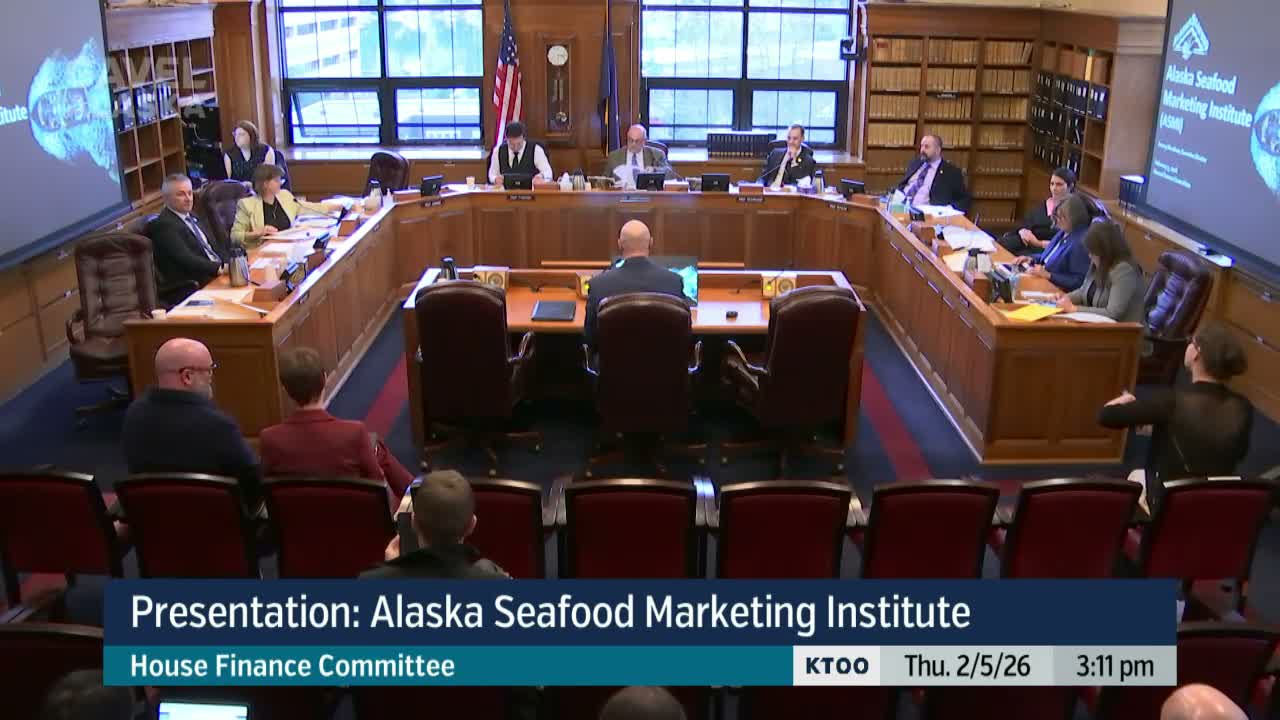
Summary
The Alaska Seafood Marketing Institute reported recent market shocks (2022''2024), described efforts to grow U.S. market share after the Russian import ban, and cited an ROI study showing about $1.82 returned for every $1 of ASMI investment.
The Alaska Seafood Marketing Institute used its Feb. 5 appearance before the House Finance Committee to outline how recent global market developments have affected Alaska's seafood industry and to describe ASMI's marketing strategy and returns. Jeremy Woodrow, ASMI's executive director, detailed budget sources, recent volatility in ex-vessel values and priorities for market expansion.
Woodrow said ASMI's funding mix includes industry assessments (statutory designated program receipts tied to ex-vessel value), federal Market Access Program grants that require overseas spending, and a multiyear $5 million unrestricted general-fund reappropriation from FY25. He noted ASMI's FY26 budget had grown in part due to federal awards and pandemic-era relief but cautioned the industry's revenue base is volatile and tied to ex-vessel values.
On market dynamics, Woodrow recounted 2022's large sockeye returns and elevated ex-vessel prices followed by a sharp global demand downturn and Russian export dumping after Russia's invasion of Ukraine; combined with a large 2023 pink-salmon return, those shocks left processors with inventory and created price pressure. ASMI said the situation drove board decisions to increase short-term spending to move inventory and support processors.
ASMI is pursuing three priorities: 1) capitalize on the U.S. market opportunity created by the Russian seafood import ban, 2) raise awareness of key Alaska species (sockeye, pink, keta, sablefish, pollock) and 3) grow the Alaska Certified Seafood International (CSI) program as a preferred origin certification. Woodrow said the organization has seen renewed buyer interest after the ban and supported HJR 29, a House resolution backing continued import restrictions on Russian seafood.
Woodrow also presented ASMI's ROI figures, reporting that for every dollar from state or industry funding ASMI returns about $1.82 in economic value and that ASMI's 2023 activities contributed an estimated $464 million in economic return on a roughly $20 million program. He cited successful retail and international promotions (including FamilyMart promotions in Japan) as examples of efficient investments.
The committee thanked ASMI and concluded business; lawmakers said staff would consider budget and statutory matters in follow-up deliberations.