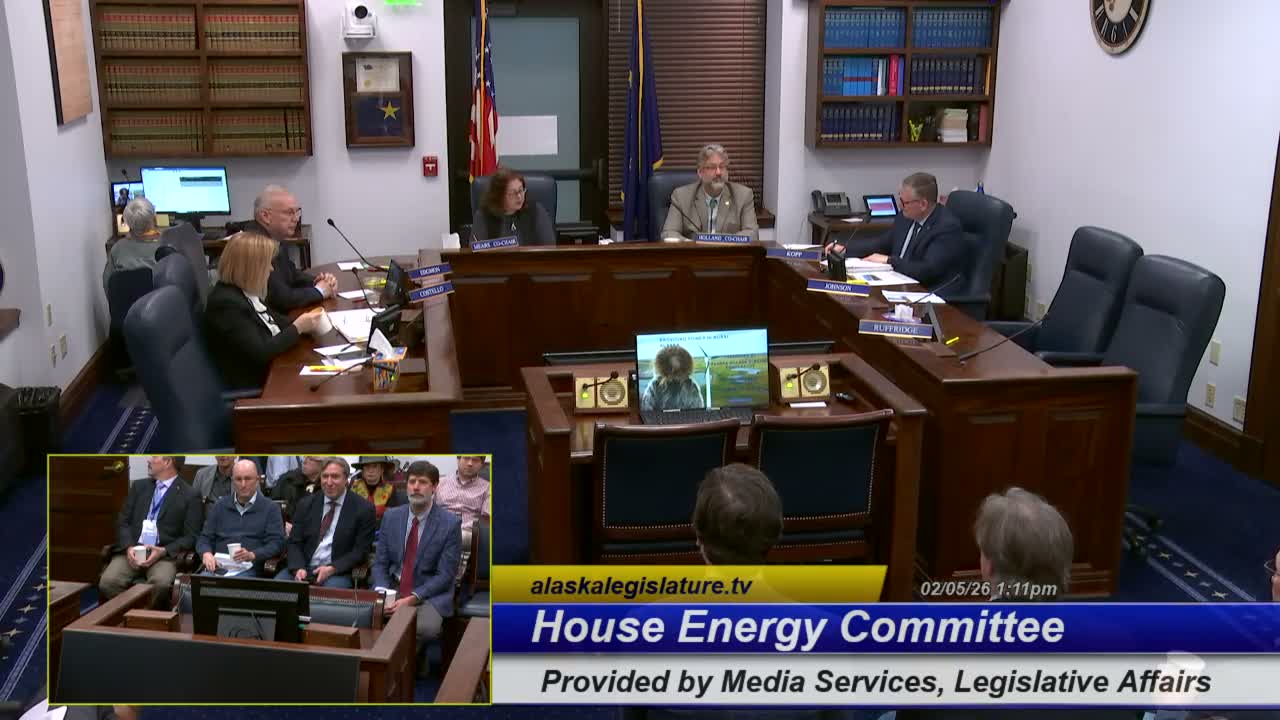
Rural Alaska utilities tell House Energy Committee diesel, workforce and logistics keep villages expensive to power
Loading...
Summary
Four rural electric cooperative CEOs told the Alaska House Energy Committee in Juneau that high fuel and freight costs, aging equipment and workforce shortages keep most village systems dependent on diesel; they urged protecting the Power Cost Equalization fund and funding storage, transmission and workforce training.
Juneau — Leaders of four rural electric cooperatives urged the Alaska House Energy Committee on Feb. 5 to sustain state and federal support for remote power systems as they grapple with soaring fuel costs, aging equipment and difficulty recruiting skilled workers.
Bill Stamm, president and CEO of Alaska Village Electric Cooperative, said AVEC serves 58 communities with 46 power plants and that the logistics of moving people, fuel and parts by barge or plane drive up costs. "People are on the edge of being able to afford heating their homes, buying electricity, and sometimes it's a decision between, food and heat and lights," Stamm said, describing communities where diesel not only fuels generation but also provides heat and transportation.
The cooperative leaders, who appeared as part of an Alaska Power Association conference event in Juneau, described similar challenges: most village generation remains diesel-reliant, fuel is the largest single expense and remote delivery multiplies unit prices. Stamm estimated that AVEC still gets about 95% of its generation from diesel and that only roughly 5% of its energy is from renewables today.
Tom Atkinson, general manager of Kotzebue Electric Association, said KEA can meet about 30% of electricity demand with renewables and storage when systems work, but the utility remains roughly 70% diesel. He described the expense of turbine components and aging diesel units, noting a recent converter replacement cost "about $300,000," and said KEA imported about 1,100,000 gallons of diesel last year for local needs.
Clay Copeland, CEO of Cordova Electric Cooperative and chair of the Alaska Energy Authority board, highlighted run-of-river hydro and equipment upgrades that have reduced fuel use in Cordova. He said AEA has tightened PCE (Power Cost Equalization) administration and that Cordova has benefited from improved processing of community-facility PCE applications.
Will Cheney, CEO of the Dillingham-area cooperative, described a regional fiber middle-mile project and an ongoing hydro feasibility effort his co-op has funded with member capital and grants. He said the cooperative has invested about $6.2 million of member capital and $2.5 million in grants toward the New York (Nuyukuk) hydro feasibility work and is preparing a draft FERC license application.
All four speakers urged continued funding lines that enable rural utilities to add renewables, replace aging diesel units and procure batteries that can store intermittent generation. Atkinson said his community expects a new 4-megawatt battery to provide approximately two hours of islanded operation, allowing resilience during generator outages.
Panelists also pressed for workforce development. Copeland and Atkinson described partnerships with universities, trade schools and the Alaska Center for Energy and Power to train technicians and to reduce reliance on out-of-state or international contractors. Atkinson noted that specialized turbine technicians had to travel from Europe for recent repairs.
Multiple presenters identified state and federal grant programs as critical, including GRIP grants, the Renewable Energy Fund, Denali Commission investments and AEA-administered PCE reimbursements. Copeland said a Denali Commission program will provide funds for bulk fuel tank farm upgrades and that some funds will be managed by AVEC and AEA.
Committee members asked for specifics about PCE. Representative Edgmon noted that a statutory change increased eligibility and that committee staff had estimated the program's annual cost near $48 million; Copeland and panelists said administration has improved and that the program remains a vital subsidy for residential and community accounts, but covers only eligible portions of consumption.
The hearing produced no formal action; instead, panelists left the committee with clear requests: protect the PCE fund, sustain annual funding for the Renewable Energy Fund, enable workforce training and support projects that reduce freight and bulk-fuel vulnerabilities.
The House Energy Committee adjourned at 3:00 p.m. and previewed next week's agenda, including presentations on net metering and electric utility fire prevention bills. No votes or motions were taken at the Feb. 5 meeting.