
DCCED presents $242 million FY2027 request, stresses self-funded programs and small general fund share
Get AI-powered insights, summaries, and transcripts
Sign Up Free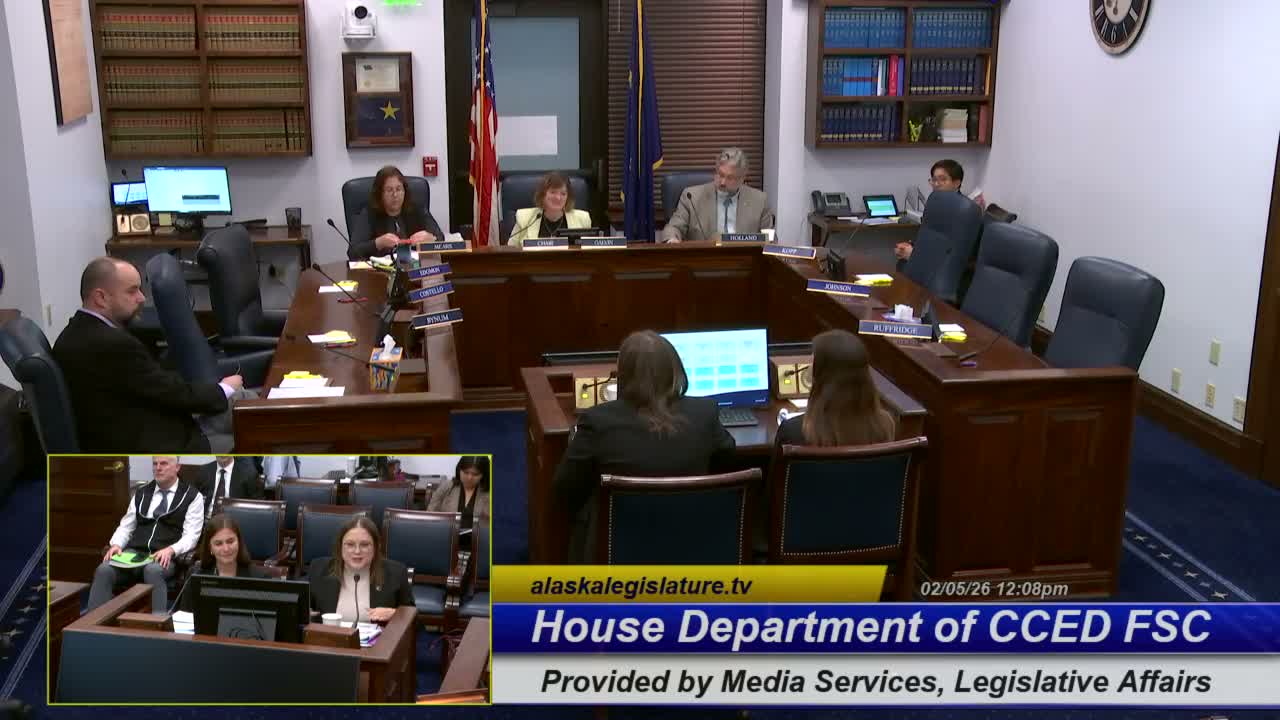
Summary
Department of Commerce, Community and Economic Development officials told a House Finance subcommittee on Feb. 5 that their FY2027 request totals $242 million, that most activity is supported by receipts rather than unrestricted general fund, and that the department contributed roughly $133 million to the general fund in FY2025.
On Feb. 5, Department of Commerce, Community and Economic Development officials presented a $242,000,000 fiscal year 2027 budget request to the House Finance Commerce, Community and Economic Development Subcommittee. Administrative Services Director Hannah Lager led the budget overview and said the department is "primarily funded by... licensing receipts" and other earned receipts, and that unrestricted general fund comprises only a small ‘‘blue sliver’’ of the total.
Lager highlighted the department’s complexity: DCCED houses many divisions and quasi‑corporations and, she said, "we put a 133,000,000 into the general fund" in fiscal year 2025 on top of paying for department operations. Commissioner Julie Sandy, who participated by phone, described the department’s mission as promoting a healthy economy, strong communities and consumer protection and introduced three newly appointed division directors and a new commissioner at the Alaska Oil and Gas Conservation Commission.
Budget movements flagged during the presentation include salary and health adjustments tied to contractual obligations, implementation of an IT classification study that shifts costs into administrative services, and several transfers of vacant positions between divisions to address operational needs. Lager said many divisions are largely self‑supporting through fees, assessments and investment earnings, which explains why general fund amounts in the department’s management plan are relatively small.
Lager walked members through division‑level items with largely technical or status‑quo effects: modest increases to align receipts and expenditures in business licensing, restoration of short‑term positions tied to grant administration, and effort to centralize certain shared services. She also noted that several corporate offices (banking and securities, insurance, investments) are consistent revenue contributors to the general fund and had no significant FY2027 changes.
The subcommittee asked for additional detail on several items, including how restored or new positions would be funded long term and when federal grants administered through the department are expected to move into implementation. Chair closed the session after reiterating follow‑up plans and scheduling further review meetings. The subcommittee is set to resume department budget hearings in early February.