House Finance Committee reviews governor's omnibus tax bill, debate centers on proposed seasonally adjusted sales tax
Loading...
Summary
The House Finance Committee heard Department of Revenue officials introduce House Bill 284, the governor's omnibus tax bill. Most committee discussion focused on a proposed state-administered, seasonally adjusted sales tax (4%/2%), exemptions, nexus rules based on Wayfair, and distributional effects for rural and low-income Alaskans.
Janelle Earls, acting commissioner and administrative services director for the Department of Revenue, opened the Feb. 5 House Finance Committee hearing to introduce House Bill 284 and the department's slide presentation explaining the governor's fiscal plan. "The governor's policy goals are to provide a plan for fiscal stability, limit spending, improve Alaska's long term appeal for families and businesses, ensure a predictable PFD, and require agency operations be reviewed on a regular basis," Earls said.
Acting Tax Director Brandon Spanos told the committee the bill has three primary parts: a seasonally adjusted statewide sales tax, steps toward an eventual elimination of the corporate income tax, and two changes to the oil-and-gas production tax (raising the minimum tax floor and adding a pipeline maintenance fee). "The tax rate would be 4% for half of the year, and 2% for the other half," Spanos said, and the proposal pairs a broad tax base with enumerated exemptions and state-level administration to comply with the U.S. Supreme Court's Wayfair decision.
The department emphasized mechanics and compliance. Spanos described a $100,000 economic-nexus threshold for remote sellers, a seller collection allowance (the lesser of 1% or $75), and a centralized electronic filing and payment system. On the use tax, he said typical enforcement points would include vehicle registration at the DMV for out-of-state purchases; household goods moved to Alaska as part of a household move would be exempt.
Committee members pressed the department on distributional effects, administrative complexity, and enforcement. Representative Staff asked whether the Wayfair transactions test (200+ transactions) appears in the bill; the department said most states use the $100,000 sales threshold instead of a transactions-only test because the latter can be unduly burdensome. Representative Staff and others raised a specific concern about exemptions: purchases made through WIC or SNAP would be exempt, but identical purchases by nonbeneficiaries (for example diapers or formula) would be taxable unless covered by an explicit exemption.
Several lawmakers described potential harms for lower-income residents and rural communities. Representative Galvin said a seasonally adjusted rate is still a year-round tax and asked the department for comparative modeling of nonresident-worker contributions versus what an income tax might raise. Chief Economist Dan Stickel said the department's modeling breaks out revenue from residents, tourists and nonresident workers and offered to provide the committee with those numbers. Representative Jimmy explained how freight and higher local prices in rural Alaska amplify the burden of a flat sales tax on necessities and building materials.
Local-government interaction and equity were recurring themes. Representatives Bynum, Josephson and others asked whether centralized exemptions and definitions would override municipal tax structures and senior exemptions. Spanos said centralized administration and consistent exemptions are standard in Wayfair-compliant systems, and the legislature could alter exemptions if it wished, but that would change the required rate to meet revenue targets.
On enforcement, Spanos pointed to existing statutory penalties. He said general tax penalties would apply to the new tax and referenced the statutory penalty framework (cited in the hearing as "Title 40 three-five"), including failure-to-file and failure-to-pay penalties that accrue monthly up to a statutory cap.
The department and economists also described macroeconomic trade-offs. Stickel said sales taxes tend to be less volatile than oil-and-gas revenues and can improve fiscal sustainability and credit ratings, but modeling must be combined with stakeholder input to capture behavioral responses (for example visitor or industry decisions). The department's fiscal modeling projects a period of lower revenues in the near term with expectations of higher baseline revenue later as new fields and projects ramp up; the administration included a seven-year sunset/zeroing feature on the sales tax rate to allow later legislative review.
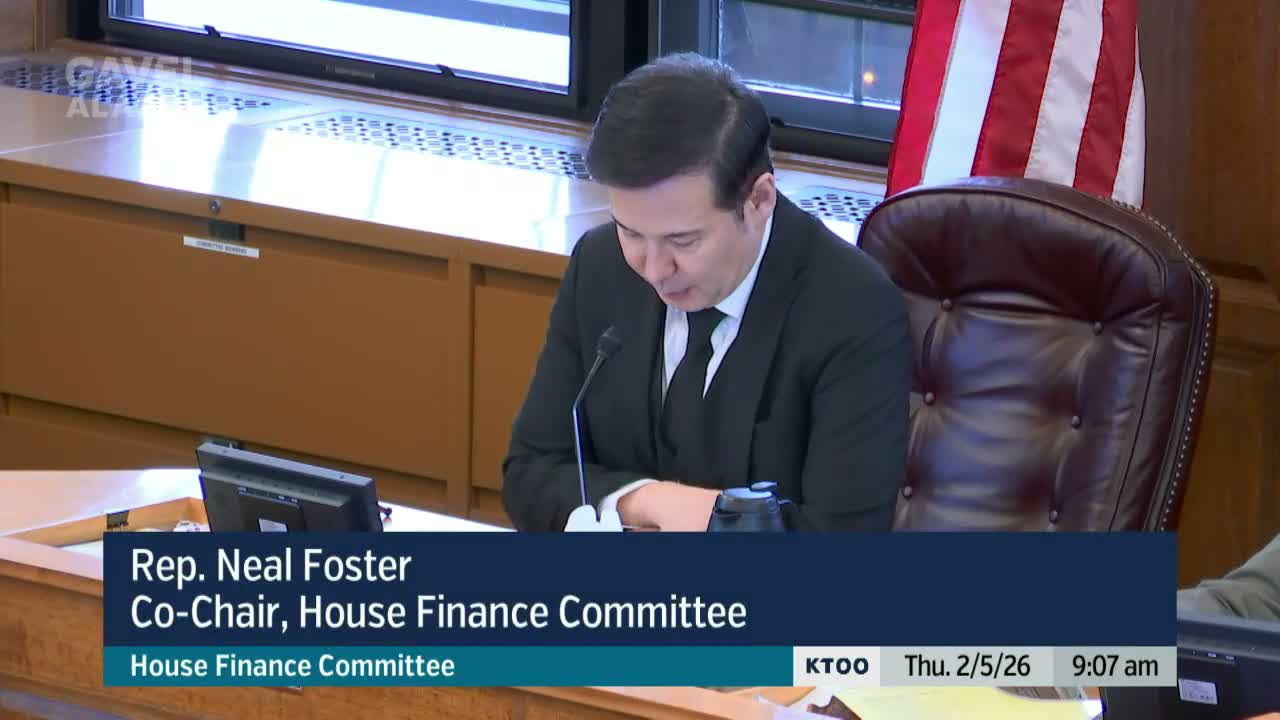
There were no formal committee votes during the session. Co-chair Foster closed the morning session by confirming follow-up presentations from the Alaska Municipal League at 1:30 p.m. and industry witnesses later in the day, and by scheduling public testimony on HB 284 for 5:30 p.m. The committee encouraged members of the public to focus testimony on the sales-tax portion and offered an email address for written comments: house.finance@akleg.gov.
The committee adjourned at 11:06 a.m.