Alaska DPS presents modest FY27 budget as vacancies and aviation costs squeeze operations
Loading...
Summary
The Alaska Department of Public Safety told a House subcommittee the governor's FY27 proposed operating budget is roughly $354 million (about 2% over FY26) but warned that a 14% vacancy rate, rising aviation and equipment costs, and reliance on vacancy savings are stressing operations and hiring capacity.
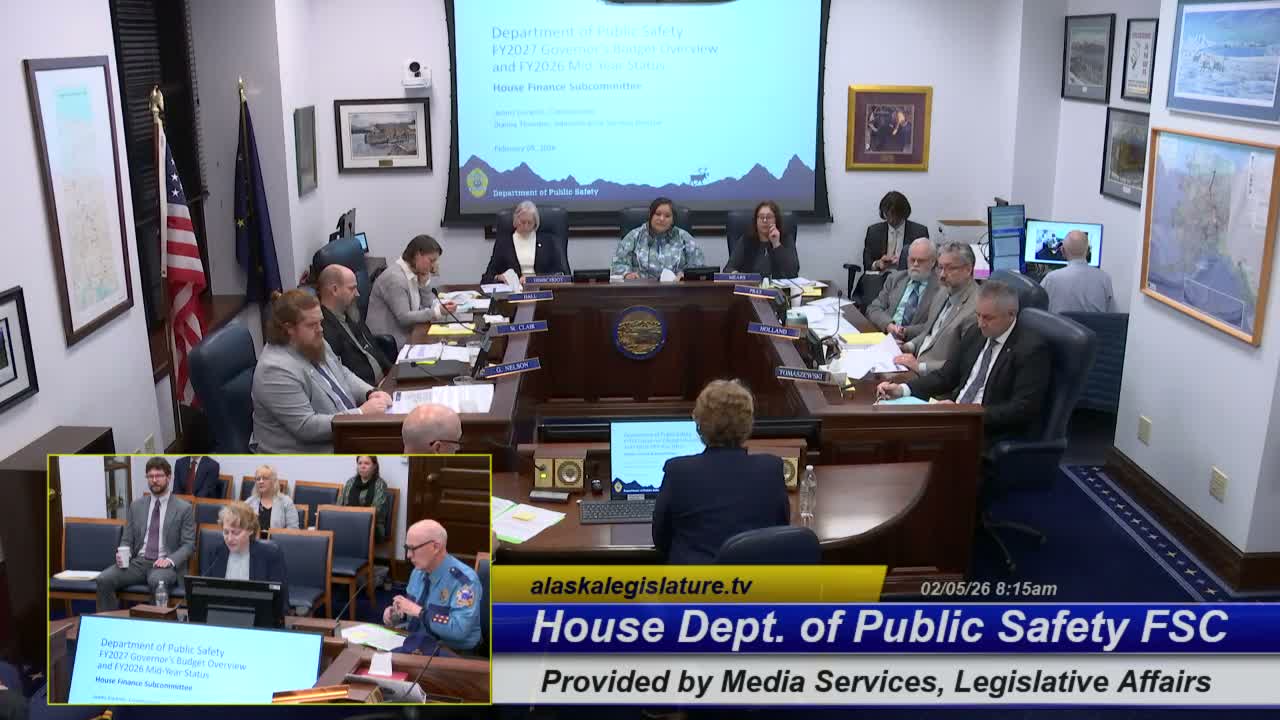
The Alaska Department of Public Safety told the House Department of Public Safety Finance Subcommittee on Feb. 5 that the governor's FY27 proposed operating budget of about $354,000,000 represents modest growth but leaves the department managing persistent staffing gaps and rising operating costs.
"Overall, department spending has tracked closely to the authorized funding levels," Administrative Services Director Diana Thornton said, presenting the FY27 budget and the FY26 midyear status report. She said the proposed FY27 total represents roughly a 2% increase over FY26 and largely sustains existing programs rather than expanding services.
Thornton and Commissioner James Cockrell told lawmakers the department is using short-term tools, including vacancy savings, to cover higher costs in areas such as aviation maintenance, fuel and overtime. Thornton said the department received a $1,000,000 increment in FY26 for overtime but warned that using vacancy funding to cover ongoing costs "is not a sustainable strategy." She offered to provide a follow-up report on the location and fiscal impact of vacancies.
Lawmakers pressed for details on the difference between enacted authority and actual receipts in federal and other funds. Thornton explained that "enacted" authority reflects the larger bucket of funding the department is authorized to accept, while "actuals" reflect what the department actually received, including the timing and multi-year nature of many grants.
Thornton said the department's current vacancy rate is about 14% and that trooper vacancies number approximately 56 statewide. Cockrell and Thornton said recruitment efforts, including a legislatively funded professional recruiter and outreach such as a restarted television series, are yielding more applicants and cadets but that hiring remains a challenge.
The presentation highlighted several program-level adjustments in the governor's request and midyear changes: a $550,000 increase in authority for the Alaska Police Standards Council to support training and reimbursement demands, a $1,000,000 increase in other funds to support six long-term nonpermanent investigator positions in the Alaska Bureau of Investigation (funded by a reimbursable agreement with the Department of Law), and a $26,000 unrestricted general-fund increment to implement outcomes from an IT job-classification study.
Thornton also said changes to the restorative justice fund — revenue withheld from ineligible permanent fund dividends — are driving a $169,000 increment for the Council on Domestic Violence and Sexual Assault (CDVSA) and a $592,000 reduction for the Violent Crimes Compensation Board under its formula.
Looking ahead, Thornton said aviation remains an essential statewide response capability, particularly in rural areas, and noted that aircraft maintenance and fuel costs are placing upward pressure on operations. She added that capital project oversight is being managed without a dedicated project manager, increasing internal workloads.
The subcommittee did not take formal votes during the hearing. Thornton and Cockrell offered to provide additional materials, including vacancy-location detail and staffing‑cost estimates for a fully staffed department, at a later date.