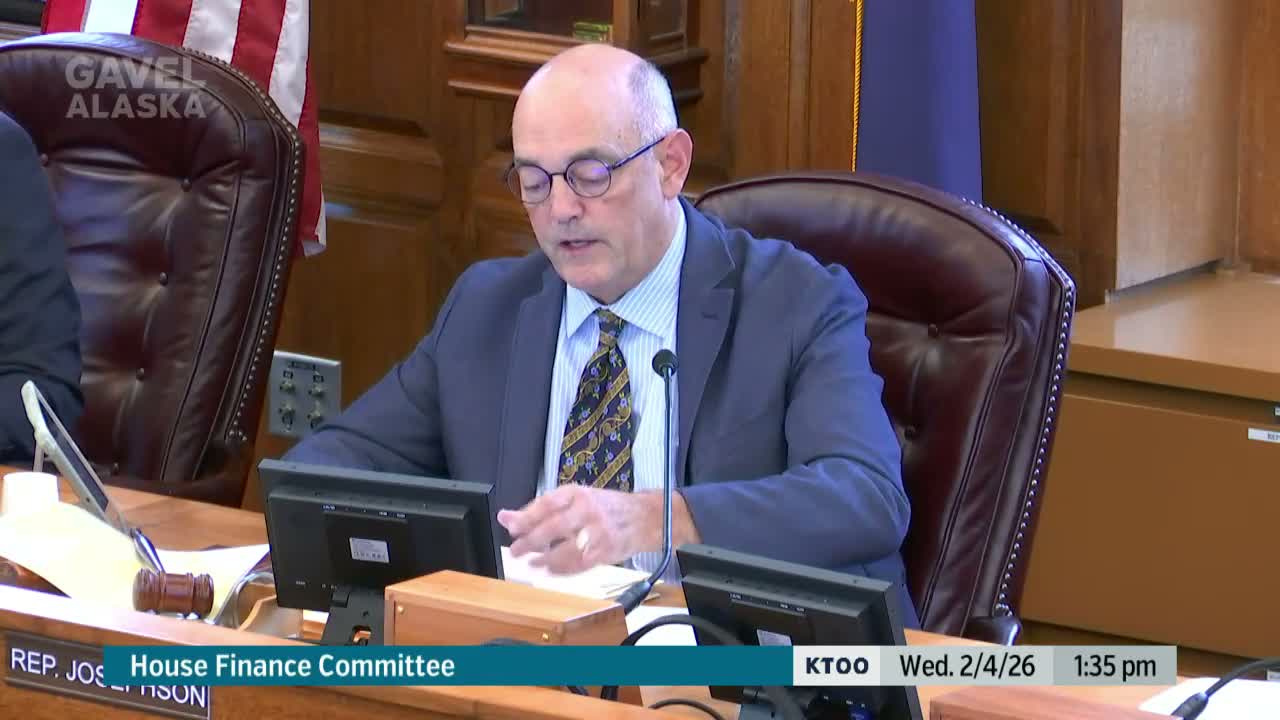
OMB tells House Finance committee Alaska's deficit at $425.9M; governor seeks multiple supplementals including rural health fund authority
Loading...
Summary
Office of Management and Budget Director Lacey Sanders told the House Finance Committee Feb. 4 that the state now faces a $425,900,000 deficit proposed to be drawn from the Constitutional Budget Reserve, and outlined December and February supplemental requests totaling hundreds of millions across operating and capital funds, including a $272 million multi-year federal rural health award appropriation and several disaster- and corrections-related requests.
Lacey Sanders, director of the Office of Management and Budget, told the Alaska House Finance Committee on Feb. 4 that the state's updated fiscal shortfall stands at $425,900,000 and that the governor proposes drawing from the Constitutional Budget Reserve to cover the gap.
Sanders reviewed two supplemental submissions: items released Dec. 11 that included fire-disaster responses and a $40 million deposit into the disaster relief fund, and a Feb. 3 supplemental bill. She summarized the Feb. 3 operating supplemental as including $79,100,000 in unrestricted general funds and $881,000,000 in total funds, and said the combined operating supplementals now total roughly $174,000,000 UGF and $992,000,000 in total funds.
Among the larger operating requests Sanders flagged: $3,300,000 (UGF) as a multi-year appropriation for the Office of Public Advocacy to continue addressing a criminal-case backlog; a $20,000,000 supplemental for the Department of Corrections to cover operational pressures (including overtime and staffing), plus $1,100,000 for community residential center bed contracts and about $2,900,000 for inmate health care tied to an aging incarcerated population.
On health-related supplementals, Sanders asked the committee for multi-year authority to receive and spend a federal Rural Health Transformation award. She described a multi-year approach to align state fiscal years with the federal award and said OMB expects to return with another phased request to cover later award years. She also noted a total request of $21,000,000 to cover rising operational costs for public-assistance eligibility systems (split roughly between state match and federal receipt authority).
Sanders told the committee the Department of Health has identified $272,000,000 in federal receipt authority tied to the rural-health award and that OMB plans a multi-year appropriation across fiscal years 2026'28 to accommodate federal spending timelines. Representative Bynum and other members requested a diagram and additional detail showing how the federal fiscal year and state fiscal year align for the award.
On capital, Sanders said the governor's Dec. 11 submission included $70,100,000 for the Statewide Transportation Improvement Plan and highlighted other capital items: Alaska Energy Authority bulk-fuel upgrades (including $25,000,000 in statutory-designated program receipts), $1,200,000 for AOGCC system work and $6,000,000 in program receipts through DNR for coastal mapping on behalf of Alaska Native communities. She also noted DOT reappropriations to respond to recent weather events and non-FEMA-eligible emergency costs.
Committee members pressed OMB and Health staff on several items. Representatives asked whether prior capital investments in eligibility systems would eliminate future operating pressures; Pam Halloran, assistant commissioner at the Department of Health, said capital work is now shifting to maintenance and operations and identified systems (ARIES, I-Links, IVES, CURRENT and the Alaska Connect portal) that still require ongoing operating funding. Sanders said the department expects to reduce mainframe costs as migrations finish around FY28 but may need continued operating authority in the meantime.
Members also asked about FEMA reimbursement shifts and whether supplemental requests might grow; Sanders said the administration will continue to bring forward supplementals as identified and that amendments are due Feb. 18, which may include additional items.
Next steps: Sanders offered to provide committee staff with updated spreadsheets, the timeline diagram aligning federal and state fiscal years for the rural-health award, and other follow-up materials. The committee set aside the OMB presentation and moved to the Department of Education & Early Development briefing later in the meeting.