
Senate committee hears audit and board testimony on SB 211; bill set aside for further review
Get AI-powered insights, summaries, and transcripts
Subscribe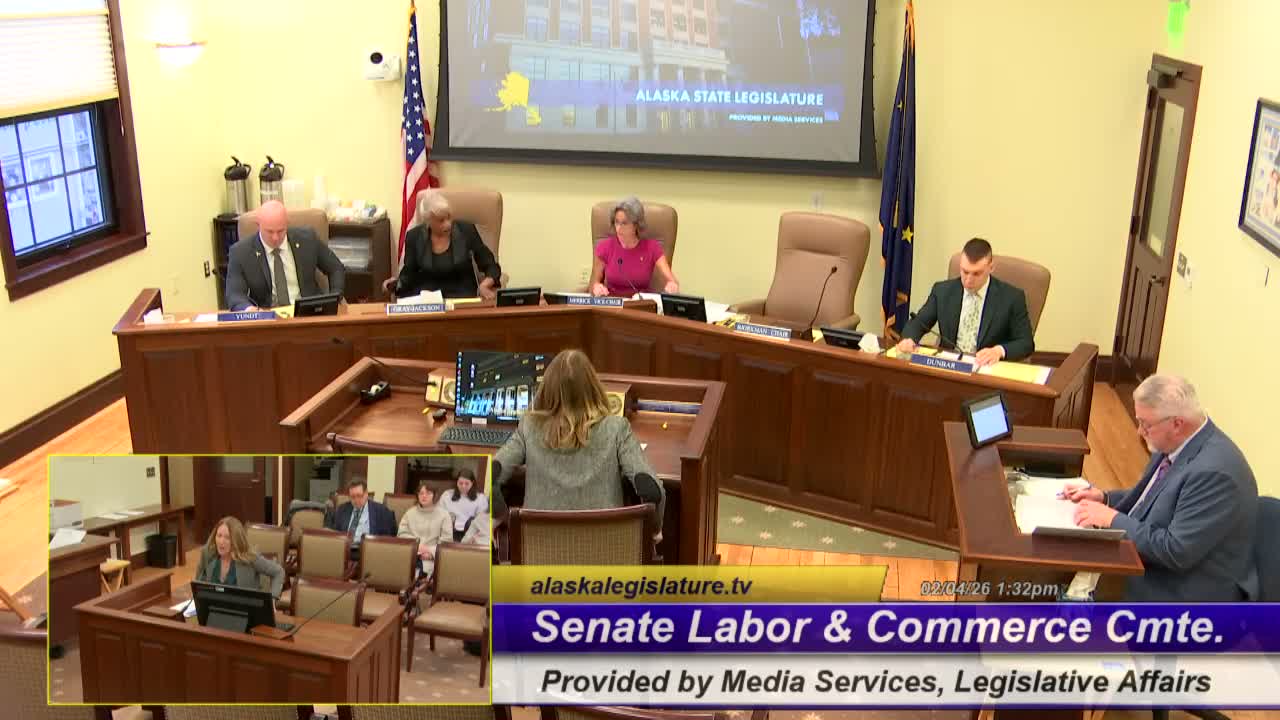
Summary
At a Feb. 4 hearing, the legislative auditor recommended a six-year extension for the Board of Certified Real Estate Appraisers after federal compliance findings; directors and board chairs urged keeping boards in place while the committee set SB 211 aside for further consideration and scheduled follow-up on Friday.
The Senate Labor and Commerce Committee held a second hearing on Senate Bill 211 on Feb. 4, 2026, examining proposals to extend multiple occupational licensing boards. State Legislative Auditor Chris Curtis reviewed a sunset audit of the Board of Certified Real Estate Appraisers and recommended a six-year extension, citing federal Appraisal Subcommittee findings that indicate some state statutes do not align with federal requirements.
The auditor told the committee that the audit found one board seat had been vacant for 56 months as of January 2025 and documented unjustified periods of inactivity in five board-related disciplinary cases, with delays auditors measured between about 165 and 575 days. "We're recommending a 6 year extension for this board," Curtis said, and he listed three recommendations: increase recruitment to fill board vacancies, pursue statutory changes to address federal findings, and improve recruitment and retention of investigators.
Sen. Dunbar pressed Curtis for details on what statutes are out of compliance. Curtis pointed the committee to Exhibit 2 of the audit, saying two primary issues were identified: state reporting requirements for federally regulated appraisal management companies (AMCs) are inconsistent with the AMC rule, and state language on ownership limitations for individuals with prior licensing actions does not match the AMC rule.
Sylvain Raub, director of the Division of Corporations, Business and Professional Licensing, explained the division's fiscal practices, telling the committee that most professional licensing revenue is concentrated in renewal years because licenses run on two-year cycles with staggered expirations. "The overwhelming majority of revenue for our programs is generated during the renewal cycle because more people renew than get a new license," Raub said, and he emphasized that the division carries forward funds and allocates staff time to ensure licensees pay only the costs related to regulating their program.
Invited board members testified in support of retaining their boards. Bradley McConnell, vice chair of the Alaska Board of Psychologists and Psychological Associate Examiners, said the board protects public health and safety, maintains practitioner competency, and ensures accountability; he urged lawmakers to support SB 211. Mae Hayes, chair of the Board of Certified Real Estate Appraisers, told the committee that state boards are federally monitored by the Appraisal Subcommittee and argued the board must remain in place so Alaskans can obtain conventional, FHA and VA loans.
Anne Wells, chair of the Board of Social Work Examiners, did not appear but submitted written testimony that was distributed to the committee.
With no committee action taken, the panel "set this bill aside for further consideration" and announced it will meet again Friday to take up SB 211, SB 225 and SB 198. No vote occurred during the Feb. 4 hearing.
What happens next: The committee will reconvene Friday to continue consideration of SB 211; no timeline for statutory fixes identified in the audit was adopted at this hearing.