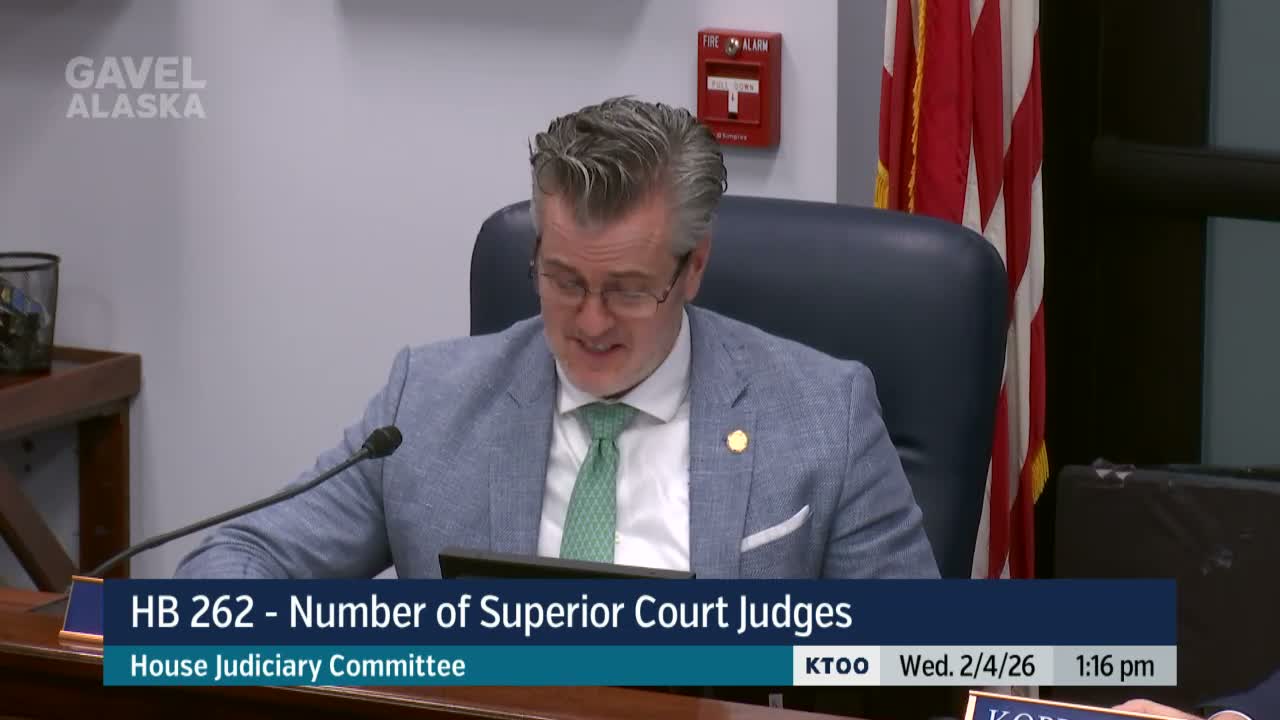
Court system asks Legislature for a fifth Palmer Superior Court judge, citing heavy caseloads
Loading...
Summary
Court counsel told the House Judiciary Committee that House Bill 262 would add one Superior Court judge to the 3rd Judicial District (Palmer) — increasing statewide judges from 45 to 46 — citing Palmer’s per‑judge caseload of 683 in FY25 versus a statewide average of 458 and a 56% rise in filings since 2006.
At a Feb. 4 hearing, Nancy Mead, general counsel for the Alaska Court System, asked the House Judiciary Committee to approve House Bill 262 to add one Superior Court judge, to be based in the 3rd Judicial District and assigned to Palmer.
"House Bill 262 would add an additional superior court judge," Mead told the committee, explaining that statutes set the number of judges and that the Supreme Court requested the change. Under the bill the statewide total would move from 45 to 46 judges and the 3rd Judicial District’s allotment from 28 to 29.
Mead said Palmer’s filings have averaged roughly 2,800 cases annually over the past five years and that, in fiscal year 2025, Palmer’s per‑judge caseload was 683 compared with a statewide average of 458. "So they exceeded it by another third or so," Mead said, and noted Anchorage — the next busiest court — had 544 cases per judge.
Mead described the reasons the court seeks an extra judge: case counts in the Matanuska‑Susitna Valley have risen about 56% since 2006 as population and filings have grown; case complexity has increased because of digital evidence and expert issues; victims’ rights expansions and the higher share of self‑represented litigants (Mead said over 70% of domestic relations cases involve at least one self‑represented party) all add workload and time to case processing.
The court has relied on temporary reassignments, pro tem retired judges and district‑court pro tem appointments to relieve Palmer, Mead said, but those measures create ripple effects across other courthouses and are not sustainable. She added the Palmer Courthouse lacks an extra courtroom and offices, limiting the court’s ability to add more judges without capital work.
Committee members questioned alternatives and fiscal tradeoffs. Representative Vance asked whether the Supreme Court could change district judge numbers by rule; Mead said district judge numbers are set in statute but a subsection allows the Supreme Court to adjust those numbers by rule, and she explained the court sized this legislative request to available facility space and existing capital funding. Representative Copp noted that judges alone do not solve backlogs and emphasized the need for prosecutors, public defenders and support staff. Representative Kopp asked about cost; a committee member referenced a fully loaded cost of "over $1,000,000" for the new judge and Mead confirmed the judiciary’s fiscal note includes four positions (a judicial assistant, law clerk and in‑court clerk for a new superior court judge).
Chair Gray set an amendment deadline for House Bill 262 of Thursday, Feb. 5, 2026 at 5:00 p.m. and said the bill would be set aside until Friday for further consideration.
If enacted, HB262 would require a statutory change to author the additional judge and would be followed by administrative steps to occupy the new judgeship and secure associated staff and facilities.