
Senators press DOC on staffing, overtime and costly incidents as OMB flags $20M DOC shortfall
Get AI-powered insights, summaries, and transcripts
Subscribe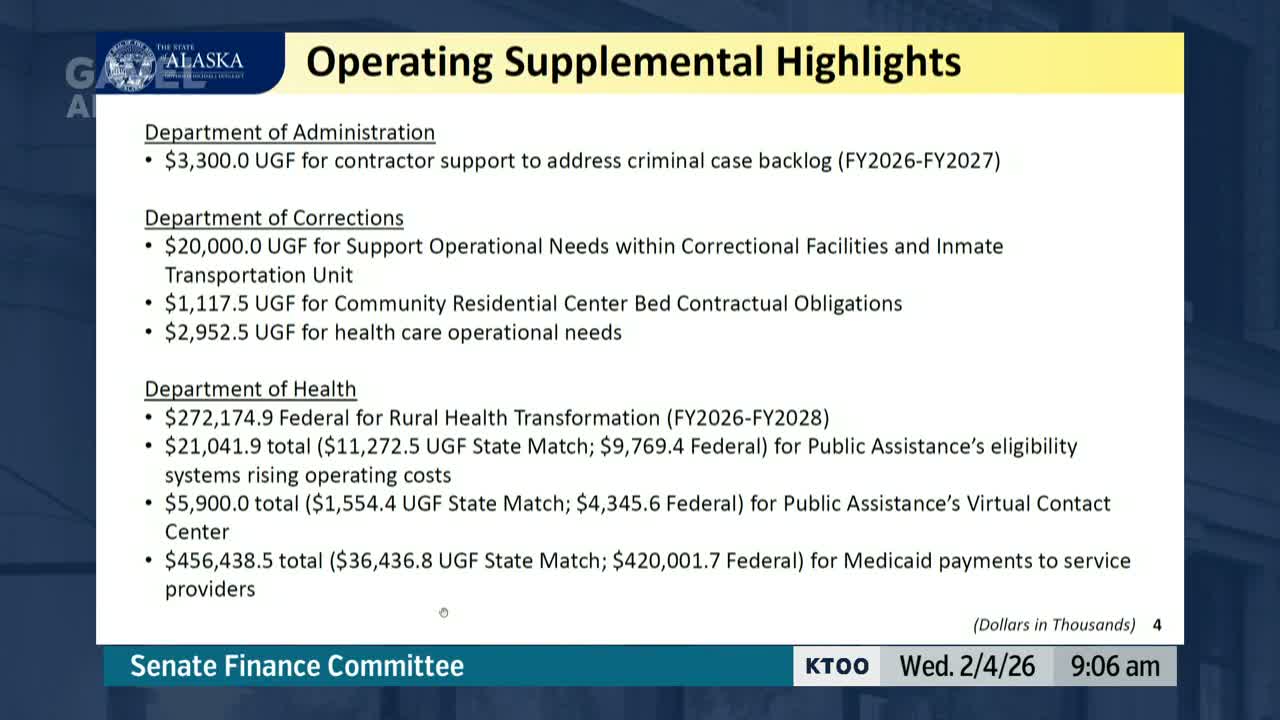
Summary
Committee members questioned Department of Corrections Commissioner Jen Winkelman and OMB about a roughly $20 million FY2026 DOC shortfall, recent costly incidents, overtime practices and the operational and community impacts of sending inmates out of state.
Department of Corrections funding and operational pressures dominated a large portion of the supplemental discussion. OMB told the committee DOC faces approximately $20 million in additional FY2026 costs to close the year in balance after prior reductions; commissioners and senators repeatedly characterized the issue as an ongoing, multi-year problem.
DOC Commissioner Jen Winkelman told the committee the department is implementing operational changes daily to address staffing vacancies and rising costs. She cited a recent incident at Spring Creek Correctional Center that she said cost just under $200,000 and described the population entering DOC custody as increasingly complex medically and behaviorally, which drives medical and staffing expenses.
Senator Stedman suggested revisiting the option of transferring some prisoners out of state to lower operational costs for long-term, hardened inmates, noting previous efforts to return prisoners had at times proved expensive. Winkelman said transfers are used for medical or separation needs and that sending inmates out of state requires an RFP process and careful selection of who would be transferred; she warned that closing facilities or shifting beds affects local economies and public safety and said the administration would welcome legislative conversations on the trade-offs.
Senators pressed for immediate, concrete data. They asked OMB and DOC to provide a 12-month report showing overtime hours and pay by pay-scale bands, the potential savings if lower-paid staff had been used for overtime instead of higher-paid staff, and related impact on retirement calculations when overtime inflates retirement benefits. Winkelman and OMB agreed to provide overtime reports and said some overtime patterns are influenced by collective bargaining agreements and interest arbitration timelines.
Senator Kiel and others asked whether bargaining units and DOC management had been engaged during prior rounds; Sanders said interest arbitration has governed the corrections contract for three years and that DOC leadership is involved in post-arbitration negotiations when the legislature permits negotiation.
Why it matters: corrections is a persistent, high-dollar driver of operating supplementals; legislators signaled willingness to explore policy and contracting changes but demanded timely, disaggregated data before considering structural options such as out-of-state transfers or changes to compensation practices.
The committee requested follow-up briefings and data from DOC and OMB; no formal motion or vote on corrections funding occurred in this session.