
Senate Finance reviews governor's FY2026 supplemental; OMB cites $425.9M shortfall to be covered from CBR
Get AI-powered insights, summaries, and transcripts
Subscribe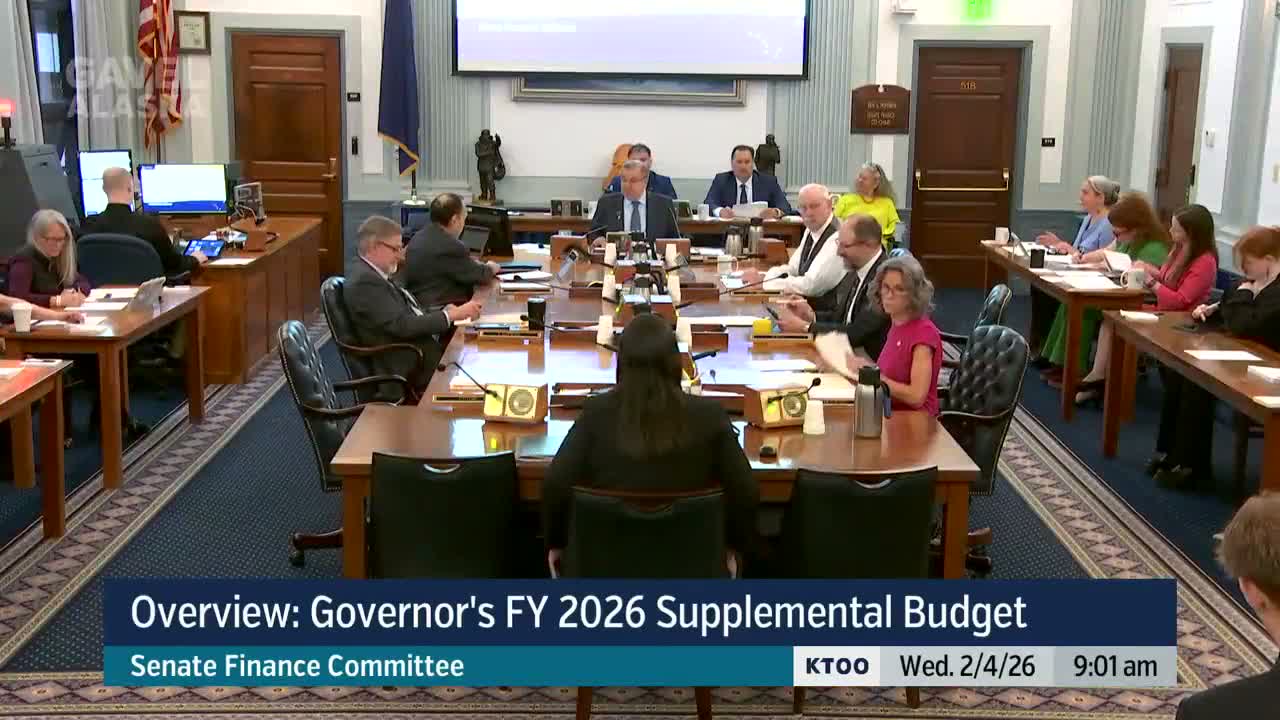
Summary
OMB Director Lacey Sanders told the Senate Finance Committee the governor's FY2026 supplemental, transmitted Feb. 3, would leave a $425,900,000 deficit proposed to be drawn from the Constitutional Budget Reserve and includes operating and capital supplementals affecting Medicaid, rural health transformation funds, and transportation matches.
Lacey Sanders, director of the Office of Management and Budget, presented the governor's FY2026 supplemental budget overview on Feb. 4, telling the Senate Finance Committee the administration's submission combines the enacted FY2026 management plan with supplemental requests submitted Dec. 11 and Feb. 3. Sanders said the combined package leaves a net deficit of $425,900,000 that the administration proposes to draw from the Constitutional Budget Reserve (CBR).
The supplemental submission includes operating requests and capital items. Sanders said the Feb. 3 filing added about $79.1 million in unrestricted general funds and $881 million in total proposed supplementals; across the Dec. 11 and Feb. 3 filings she described $174.1 million in operating general-fund supplementals. Notable operating items include a previously discussed $95 million general-fund request, a $55 million placeholder for a Fire Fund deposit and a $40 million disaster-relief amount from the December filing.
Sanders told senators the largest increases appear in the federal component tied to Medicaid costs within the Department of Health. On Division of Public Assistance work, she said the administration is seeking roughly $21 million to address eligibility-system and related IT costs, composed of about $11.2 million state funds and about $9 million federal funds. Sanders said part of virtual contact-center contract costs have been identified as Medicaid-eligible, reducing the state share to about $5.9 million.
On rural health transformation funding, Sanders said the Legislative Budget and Audit committee previously provided an estimated $200 million of federal receipt authority. For the supplemental, OMB is proposing multi-year federal receipt authority totaling $272 million to cover a first tranche of funding across three fiscal years; she said the administration expects further multi-year appropriations in later years for the full five-year funding period the Department of Health anticipates.
On capital supplementals, Sanders highlighted a $70 million state match request for the State Transportation Improvement Program (STIP), $5 million in federal receipt authority and $25 million in statutory designated program receipts for Alaska Energy Authority bulk-fuel upgrades (grant funding from the Denali Commission and the Alaska Native Tribal Health Consortium), a $1.2 million increase for the Alaska Oil and Gas Conservation Commission, and an $8 million gift to the University of Alaska for the Alaska Museum of the North planetarium.
Chair Senator Hoffman and other members emphasized that accessing the CBR requires a three-quarter vote in each chamber (15 votes in the Senate, 30 in the House) and pressed for broad legislative engagement on the request. Sanders said the supplemental bill was transmitted to the legislature on Monday and the administration intends to work closely with both chambers and with agency experts.
Why it matters: the package combines recurring operating pressures (notably corrections and Medicaid), one-time disaster and capital needs, and major multi-year federal funds for rural health transformation. The committee signaled close oversight of multi-year federal receipt authority and IT spending and asked for supplemental briefings to evaluate how funds will be spent statewide.
The administration said it will provide additional data and OMB and agency staff remain available to answer detailed questions; the committee scheduled follow-up work and will consider the supplemental alongside upcoming FY2027 budget planning.