Get AI Briefings, Transcripts & Alerts on Local & National Government Meetings — Forever.
Alaska health officials outline how federal HR1 will change SNAP and Medicaid implementation
Loading...
Summary
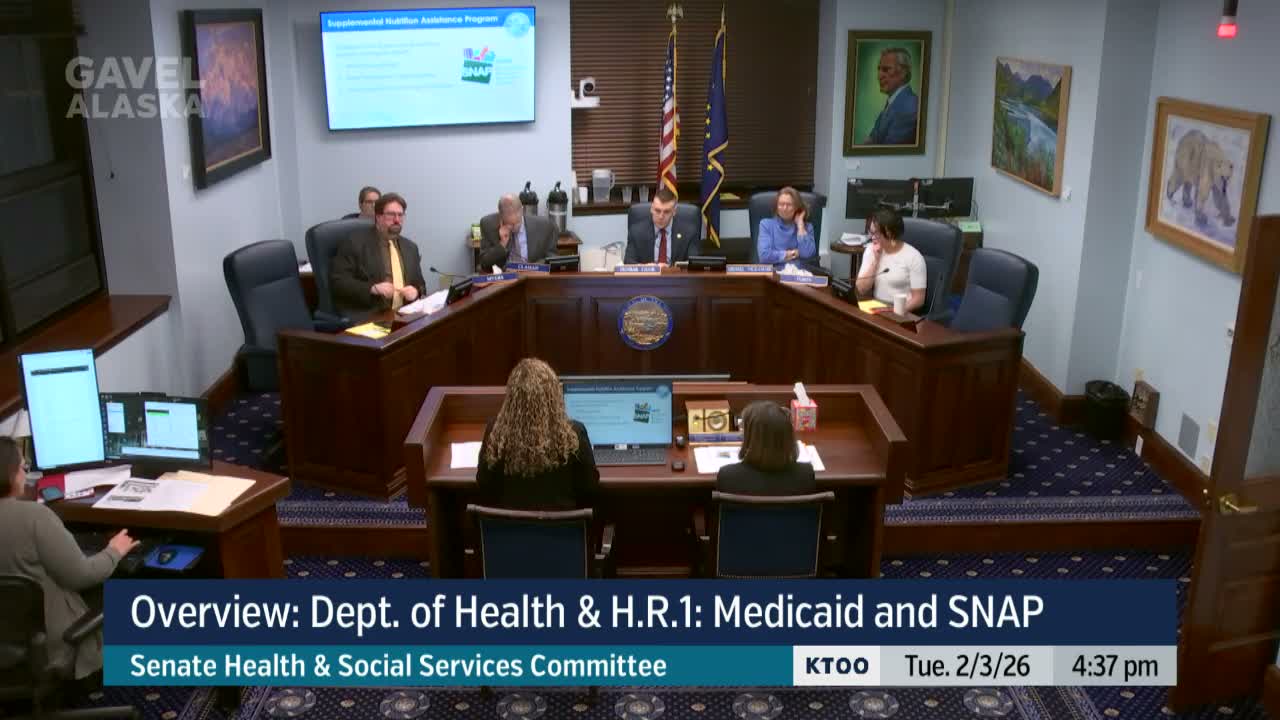
At a Feb. 3 Senate Health and Social Services Committee briefing, Alaska Department of Health officials outlined how HR1 will expand SNAP work requirements, shift administrative costs, and add community‑engagement rules to Medicaid expansion, while emphasizing exemptions, waiver plans and the need for IT and staffing adjustments.
Alaska Department of Health leaders told the Senate Health and Social Services Committee on Feb. 3 that federal HR1 will reshape how the state manages SNAP and Medicaid and will require significant operational work and possible budget adjustments.
Commissioner Heidi Hedberg and Division of Public Assistance Director Deb Etheridge said the law expands SNAP work requirements to people ages 18–64, increases state financial exposure for payment errors beginning in federal fiscal year 2028, and shifts SNAP administrative cost‑sharing toward states (from roughly a 50/50 split to a 75/25 split). Etheridge told the committee the state is working with federal officials on a sample plan and that Alaska has applied for a "good faith" waiver to phase implementation and allow time for IT changes and staff training.
Why it matters: Hedberg and Etheridge said Alaska will need new technology, staffing and verification processes to meet HR1’s increased documentation and redetermination demands. Committee members cited an estimate circulated by the Food Bank of Alaska that the administrative cost shift could amount to roughly $47.5 million a year; Etheridge said the department is preparing a written estimate and disputed large estimates of benefit loss for Alaska, noting multiple exemptions and the pending waiver. "We will follow up with the committee on what the amount is of the administrative cost shift impact," Hedberg said.
Key policy changes described
• SNAP work requirements: HR1 expands the able‑bodied work age to 18–64. States will be penalized if payment error rates exceed 15% starting in FY2028. Alaska’s historical payment error rate fell from roughly 60% to 24%, and officials set a goal of reducing errors below 6% to avoid penalties.
• Administrative cost shift: The federal share for administering SNAP moves to roughly 75% federal / 25% state; Hedberg and Etheridge said the effective federal fiscal year is 2027 for this shift and the department is assessing budget impacts.
• Non‑merit demonstration: Etheridge described an approved USDA Food and Nutrition Service demonstration allowing contractor (non‑merit) staff supplied by Public Consulting Group (PCG) to support the virtual contact center on a limited basis; the state plans to transition to state merit staff as new FTE are hired and systems improve.
• Medicaid eligibility and community engagement: HR1 creates new eligibility verification and community engagement requirements for the Medicaid expansion population. Ricci said those in the expansion group (about 71,000–72,000 Alaskans) may be required to demonstrate 80 hours per month of work or qualifying activities (job training, education, volunteer service) with seasonal income averaging allowed in some cases; redeterminations for that population will move from annually to every six months.
Exemptions, waivers and implementation
Etheridge told senators Alaska obtained a good‑faith waiver and has already exempted Alaska Native and American Indian people in its waiver application. The department listed mandatory exemptions in HR1 (pregnant and postpartum people, medically frail individuals, people with significant disabilities or serious medical conditions, veterans with a total disability rating, Medicare enrollees, caregivers of young children, recent prisoners and former foster youth). Ricci and Etheridge also described optional exemptions the state plans to request (areas with unemployment above specified thresholds, federally declared disasters, inpatient or residential care, and travel for medically necessary care when local services do not exist).
Workload and timeline
Ricci said the eligibility changes become effective Dec. 31, 2026, though states may phase implementation with good‑faith waivers through 2028. The department is evaluating technical requirements, staffing needs, and outreach strategies. Ricci cautioned that the operational burden depends on the extent to which the state can automate verification and redetermination using available data sources.
Next steps
Senators asked for written estimates of the administrative cost shift and for a realistic projection of how many Alaskans may lose benefits under HR1. The department said it will provide follow‑up analyses to the committee and expects additional federal guidance from CMS and USDA in the coming months.
The committee will revisit HR1 impacts in future hearings as the department refines estimates and phasing plans.