
State emergency director briefs Senate on Typhoon Halong response and limits of federal disaster aid
Get AI-powered insights, summaries, and transcripts
Subscribe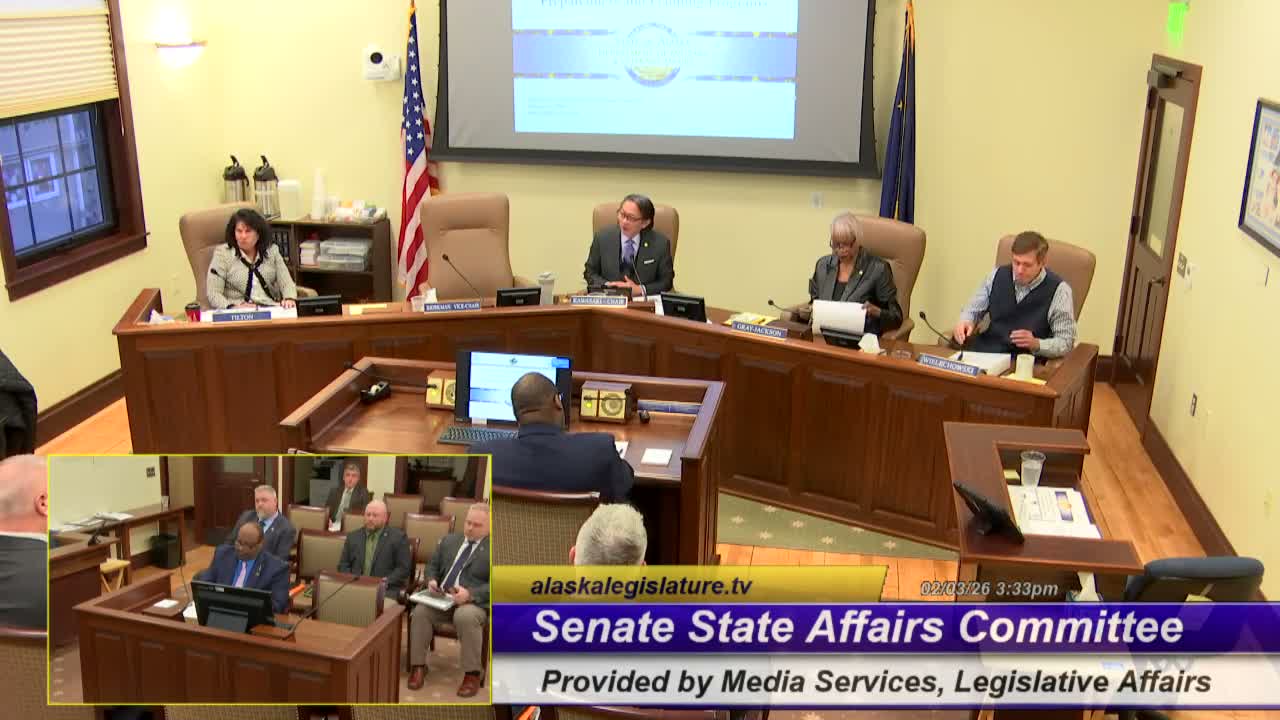
Summary
Brian Fisher, director of the Alaska Division of Homeland Security and Emergency Management, told the Senate State Affairs Committee that FEMA’s usual minimum federal cost share under the Stafford Act is 75% and that the governor’s request for an increased federal share after Typhoon Halong was denied; the state has appealed while FEMA aid and individual assistance are flowing.
Chair Kawasaki convened the Alaska Senate State Affairs Committee on Feb. 3 and invited Brian Fisher, director of the Alaska Division of Homeland Security and Emergency Management, to brief the panel on statewide preparedness and recent disaster response.
Fisher said his division administers preparedness, planning, operations and disaster assistance for the state and noted the division has about 64 permanent staff. He described a suite of local planning tools — emergency operations plans (EOPs) for larger communities and small‑community emergency response plans for communities under roughly 2,000 people — and said those documents focus on sheltering, evacuation and immediate damage assessment.
On federal funding, Fisher told the committee that when the president issues a federal disaster declaration, the Stafford Act and implementing regulations establish a default federal reimbursement of not less than 75% for eligible activities, with a 25% state/local share. He said the governor requested a 100% federal cost share for the first 90 days after Typhoon Halong and subsequently appealed for a 90% federal share; those adjustments reside with the White House and the governor’s request for an increased federal share was denied in a Federal Register notice on Dec. 19. Fisher said the state has submitted an appeal and is awaiting a decision.
Fisher described the scale of the Halong response: about 2,000 people were evacuated from affected communities, more than 200 homes were assessed as destroyed, and at the peak roughly 700 evacuees were in hotels before many moved to longer‑term rentals. He said FEMA had already obligated and delivered tens of millions of dollars in individual assistance (Fisher referenced roughly $32–35 million in initial obligations) and reminded the committee of FEMA statutory maximums for certain categories (he cited federal statutory maxima for individual assistance programs such as up to $44,800 for personal property losses and an additional $44,800 for housing repair or replacement in some categories).
Fisher also warned the committee that several federal mitigation funding streams are in flux: the federal Building Resilient Infrastructure and Communities (BRIC) and pre‑disaster mitigation programs have been paused pending federal review and litigation. He said the pause reduces one source of federal mitigation funding the state uses to build resiliency projects and that Congress and federal agencies are discussing possible retooled programs, but details and timing were not yet known.
Fisher closed by describing the division’s training and outreach role: the state administers FEMA training in Alaska, runs local preparedness exercises, and conducts community outreach (including an earthquake simulator trailer). He said preparedness is a year‑round activity and emphasized continued coordination with local governments, tribal entities and federal partners.
The committee thanked Fisher; questions on the federal review, the timing of appeals and the flow of individual assistance followed before the panel recessed to take up a fire‑season briefing.
Ending: The committee held Fisher’s briefing open for follow‑up and moved on to the Division of Forestry and Fire Protection’s seasonal update. Fisher said the state is awaiting a decision on the governor’s appeal regarding the federal cost‑share adjustment.