Legislative audit finds implementation gaps, staffing shortfalls at Alaska's Office of Children's Services
Get AI-powered insights, summaries, and transcripts
SubscribeSummary
OCS leaders told the House Health and Social Services Committee they have implemented many HB151 requirements but continue to face high turnover, data-system limits, vacancy discrepancies and unresolved audit recommendations; the legislative auditor explained how reallocated budget authority (including a $10 million cyber encumbrance) affected reporting.
Acting Department of Family and Community Services leadership and the director of the Office of Children's Services told the Alaska House Health and Social Services Committee on Feb. 3 that they have implemented many provisions of House Bill 151 but still face major workforce and data challenges that limit the law's impact.
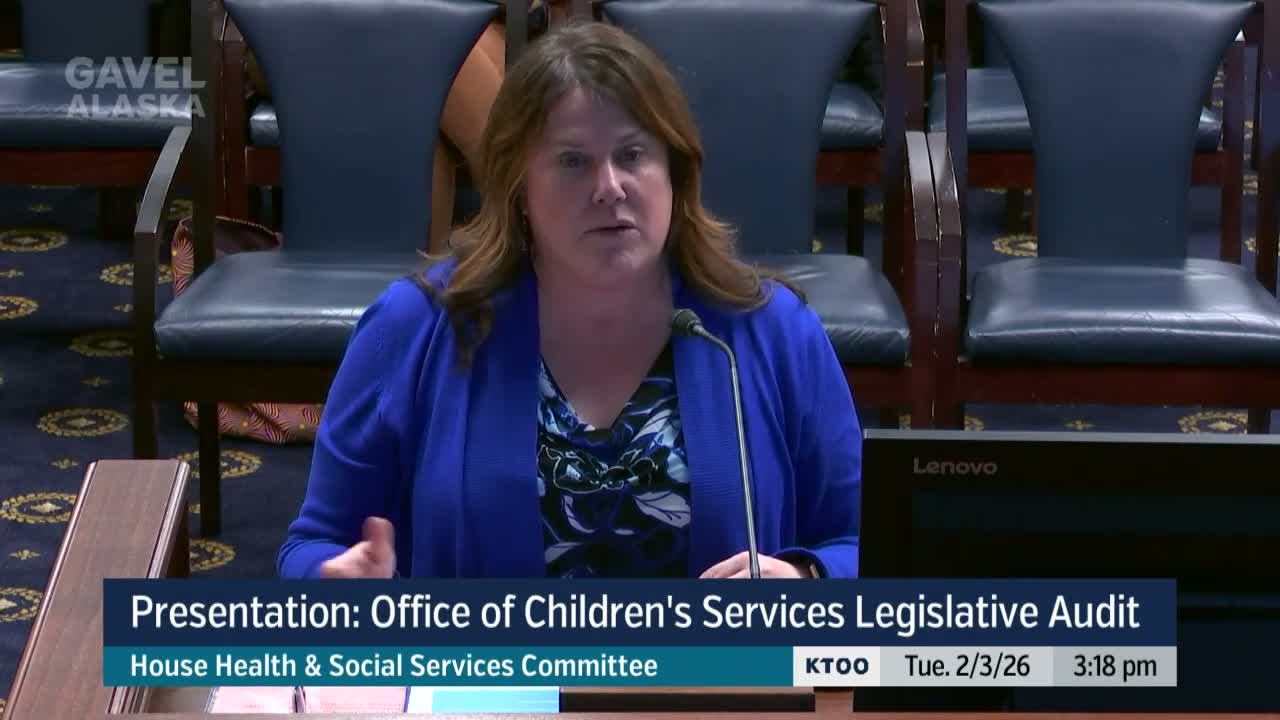
Kim Guay, director of the Office of Children's Services, said OCS has shortened foster licensing processing, updated training and increased some foster-care supports but has not fully implemented several statutory requirements. "We don't close our doors. We don't turn off our phone," Guay told the committee as she described staff continuing to deliver services despite shortages and system limits.
The audit, released in parts by the Legislative Audit Division, concluded that high vacancies and turnover contributed to excess budget authority that was later used for other purposes. Representative Gray and others raised questions about roughly $20.7 million authorized for 110 frontline positions and a separate $10 million encumbrance tied to a possible cyber-attack fine. State Legislative Auditor Chris Curtis said auditors explain the reallocation and that such authority is often used for overtime, contracts and other allowable transfers across appropriations; he added that the cyber encumbrance was established during a reappropriation period and later liquidated without a fine being imposed.
Guay and acting commissioner Tracy Dompling described a range of recruitment and retention efforts. OCS said it ran 84 recruitment events in 2025, expanded a mentor program, shifted to blended (in-person and virtual) training and in 2024 increased the foster-care base rate by 30 percent. Guay also detailed a retention-bonus program implemented during the pandemic: bonuses were paid via letters of agreement with unions and equaled 10 percent of an employee's salary split over two years (6 percent in the first year, 4 percent the second), she said.
But members repeatedly returned to caseloads, measurement and data accuracy. Guay acknowledged discrepancies between OCS reports and auditor figures: the audit cited 93 vacancies while OCS reported 81; Guay said OCS currently shows 99 vacancies and attributed mismatches to an antiquated case-management system (ORCA), primary versus secondary assignments across regions, and the administrative burden of producing accurate exports for auditors. "We have an antiquated 25-year-old system that doesn't accurately count cases," Guay said.
Committee members pressed for concrete next steps. Guay listed seven audit recommendations and reported steps taken: adopting Smartsheet tracking for staffing, piloting a streamlined talent-acquisition process with the Department of Administration, producing realistic job-profile videos, expanding mentors and revising training to include more field-based transfer-of-learning opportunities. Auditor Curtis said much of the audit covered activity through December 2023 and that some corrective work has occurred since then.
Members also discussed the Alaska Child Welfare Compact with tribes, which Guay said performs initial and ongoing relative searches, licensing assistance and safety walkthroughs; she said the compact is funded at about $5 million annually and that the $11 million figure in the audit represented cumulative funding over multiple years. Guay emphasized that many corrective measures are in progress but that sustained improvements will require staffing and community service capacity in rural Alaska, and potentially additional budget resources to raise compensation and reduce vacancies.
The subcommittee took no formal votes on the record. Chair Mina said the committee intends to continue the issue in future subcommittee hearings and work with OCS on follow-up data and materials.
Sources: Testimony and exchanges with OCS Director Kim Guay, Acting Commissioner Tracy Dompling and State Legislative Auditor Chris Curtis at the Alaska House Health and Social Services Committee hearing, Feb. 3, 2026.