Alaska retiree health trusts overfunded after federal Medicare Part D subsidies; pension funds lag
Loading...
Summary
Division of Retirement and Benefits officials told the House Finance Committee that PERS and TERS pensions remain under 80% funded while retiree health trusts are overfunded largely because of Employer Group Waiver Plan (EGWIP) Medicare Part D subsidies introduced in 2018. Actuaries cautioned the subsidies are federal and not guaranteed.
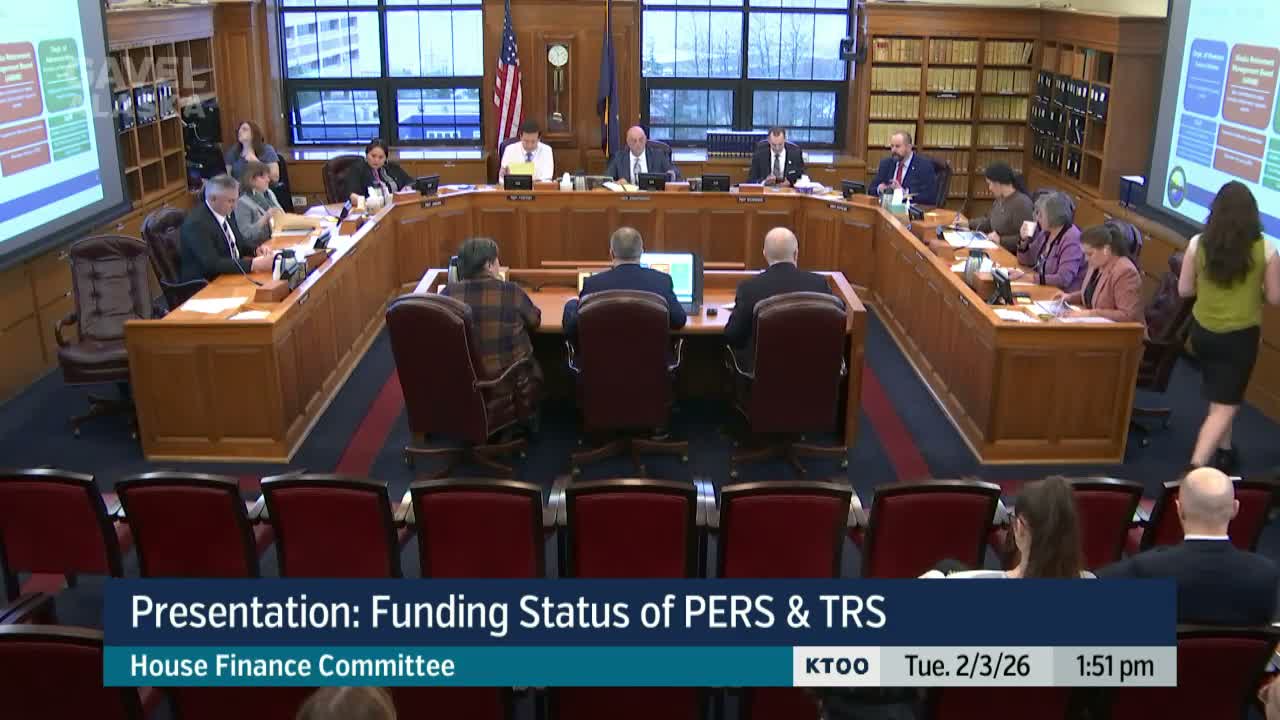
The Alaska Division of Retirement and Benefits told the House Finance Committee on Feb. 3 that the state’s public-employee pension plans and retiree health trusts are following divergent trajectories: pension funds remain materially underfunded while retiree health trusts show sizable surpluses. Department officials and the division’s actuary pinpointed a federal Employer Group Waiver Plan (EGWIP) for Medicare Part D as the primary driver of the health trusts’ overfunded status since about 2018.
Cathy Lee, director of the Division of Retirement and Benefits, and Christopher Noble, the division’s chief financial officer, presented the draft FY2025 valuations. Noble reported the Public Employees’ Retirement System (PERS) pension liability at about $17.3 billion with actuarial assets of roughly $12.2 billion (about 70.3% funded); the Teachers’ Retirement System (TERS) liability was about $8.1 billion with assets near $6.4 billion (about 79.8% funded). By contrast, the division’s actuarial valuations showed the PERS retiree health trust at about 132% and the TERS health trust at about 141%.
“The pension and health care funds are completely separate and may not be used to offset each other,” Noble told the committee, and he said the two-track picture is why the side-by-side chart was for visual purposes only.
Actuarial drivers and federal subsidy role
David Kirschner, principal actuary with Gallagher (on the phone), told lawmakers that rising pension liabilities reflect a series of factors updated in periodic experience studies: changes to longevity assumptions, retirement timing, salary growth (notably public safety pay increases), and higher post-retirement cost-of-living adjustments during recent high-inflation years. He said liability increases are not explained solely by investment-return assumptions.
For the health trusts, Chris Murray, acting chief health official for the division, identified the Employer Group Waiver Plan (EGWIP) as the dominant factor. Murray said when the EGWIP was implemented around 2018 it reduced projected retiree health liabilities by roughly $959 million, particularly by shifting pharmacy costs to a Medicare Part D group arrangement that yields direct subsidies and catastrophic reinsurance.
Murray warned those federal subsidies change year to year and are not guaranteed. When asked what would happen if CMS discontinued the subsidies, he told the committee he did not have immediate numbers but said the loss would be “a significant blow” to the health plans’ funding status and offered to provide modeled scenarios with the division’s actuarial consultants.
Policy levers and projections
Noble walked the committee through projected contribution scenarios to 2039. Under one ARM-board scenario tied to current actuarial assumptions, PERS additional state contributions could drop to zero by 2039 because of assumed amortization. He cautioned that these projections are assumption-dependent and that experience studies (conducted every four years) can and have materially changed liability projections.
Committee members repeatedly pressed for supplemental analyses: side-by-side historical charts comparing employer and state costs, models showing how many catastrophic claims would materially change the health-trust status, and what funding status would look like if EGWIP subsidies were reduced or ended. Division staff and the actuary agreed to provide follow-up modeling and data to the committee.
Why it matters
The committee flagged a practical concern: many local employers (school districts, municipalities) are financially strained and the statutory employer contribution caps (22% for PERS, roughly 12.5% for TERS) mean shifting dynamics in funding or contribution policy could have budgetary impacts on employers and beneficiaries.
Next steps
Committee members asked the division and its actuaries for additional scenario analyses, including the effect of losing EGWIP subsidies, a historical decomposition of drivers behind rising liabilities, and side-by-side employer vs. state cost trends. The division said an experience study is scheduled for March and that the draft FY25 valuations will be submitted to the Alaska Retirement Management Board in March.