Alaska committee weighs requiring community benefits agreements for large energy users as data center interest grows
Loading...
Summary
At a Feb. 3 House Energy Committee hearing, municipal and industry witnesses described community benefits agreements (CBAs) as a tool to protect local communities as large energy users, such as data centers, seek to develop in Alaska; the committee set an amendment deadline for HB 259 and held further work.
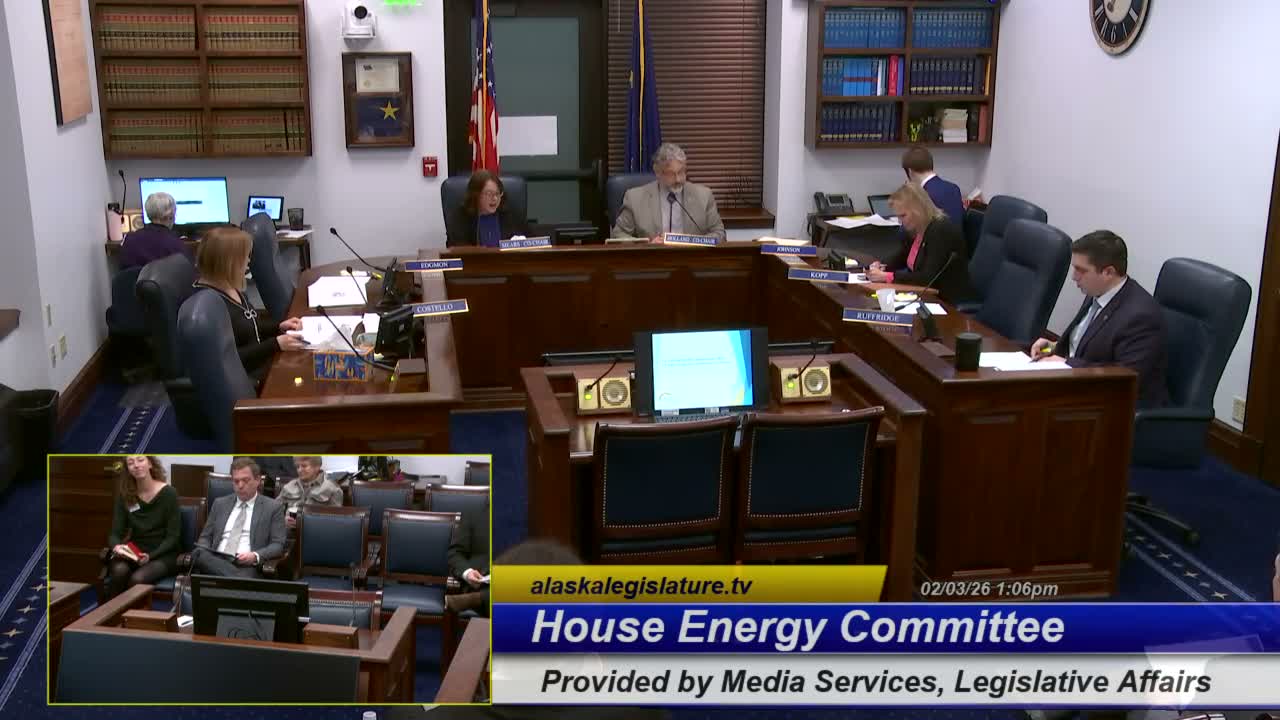
Co-chair Holland and co-chair Mears opened the House Energy Committee's Feb. 3 session by taking invited testimony on HB 259, a bill that would require municipalities to enter community benefits agreements with large energy-using facilities.
Nils Andreasen, executive director of the Alaska Municipal League, told the committee CBAs are a familiar tool elsewhere and can ensure that development yields measurable public benefits. "A community benefits agreement is fairly straightforward," Andreasen said, describing it as "a structured framework" that clarifies expectations between a local government and a private developer. He urged flexibility and proportionality so CBAs scale with project impact and do not unnecessarily burden local governments.
Andreasen outlined common CBA components: workforce development and local-hire commitments, infrastructure investments, considerations for rate impacts and grid resilience, and options for co-investment or payment-in-lieu-of-tax arrangements. He emphasized transparency around costs and performance metrics and warned that without clear expectations projects can face litigation or delays. "CBAs are focused on long term measurable community outcomes," he said, and added that municipalities and tribal governments typically play the central negotiating role.
Industry witnesses framed the opportunity HB 259 is intended to regulate. Ron Duncan, chief executive officer of GCI and GCI Liberty, told the committee that large-scale data centers could represent a once-in-a-generation economic opportunity for Alaska. "Data centers are probably the best potential economic development Alaska has ever seen," Duncan said, arguing the state has many of the inputs data centers seek (energy, water, land, cool climate, fiber) and urged the Legislature to avoid regulatory uncertainty that would slow projects. He said a gas line would especially improve Alaska's competitiveness.
Committee members pressed several concerns: multiple legislators asked whether the bill's phrasing (which requires a municipality to enter an agreement) could overextend local governments, how "community" should be defined, and whether required CBAs might delay projects. Andreasen recommended keeping the primary legal obligation with local governments and tribal entities, using CBAs to codify public benefits while providing AML-led capacity-building and scalable language so smaller communities are not overwhelmed.
Cochair Holland set an amendment deadline for HB 259 of Wednesday, Feb. 11 at 12:00 p.m. and set the bill aside for further work with sponsors and stakeholders. The committee received no public testimony on HB 259 during this session and indicated it will continue to coordinate with utilities, local governments and industry as amendments are developed.
The committee's next steps include review of proposed amendments and additional invited testimony scheduled later in the week from utility and municipal representatives. No vote on HB 259 occurred at the Feb. 3 hearing.