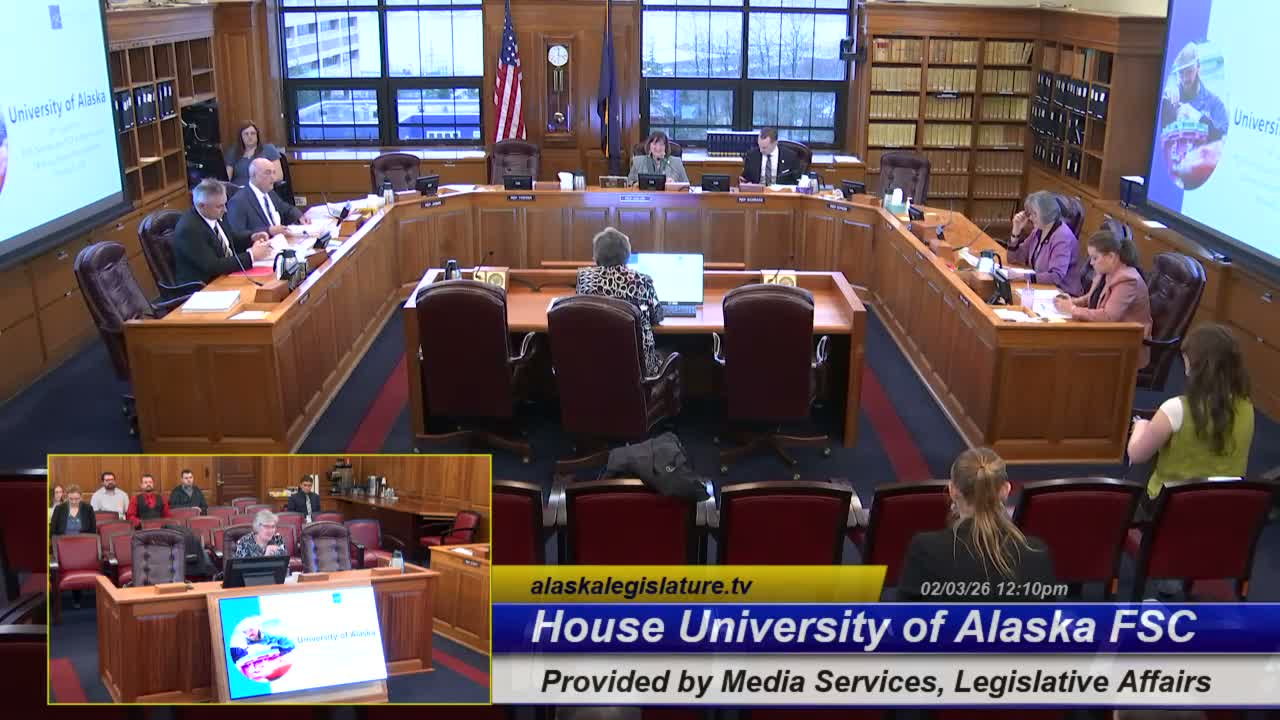
University of Alaska president seeks compensation, deferred-maintenance funding as enrollment rises
Loading...
Summary
University of Alaska System President Pat Pitney told a House Finance subcommittee Feb. 3 that enrollment and research are rebounding but the system needs sustained funding for compensation, cybersecurity, mental health and $60 million in annual capital help toward a $1.11 billion deferred-maintenance backlog.
Juneau — University of Alaska System President Pat Pitney told the House Finance University of Alaska subcommittee on Feb. 3 that the system is seeing renewed enrollment and its largest-ever externally funded research portfolio, but requires steady state support to address pay, deferred maintenance and operational needs.
“80% of the students who graduate from one of our programs stay and work in the state,” Pitney said, arguing that keeping students in Alaska is central to the state’s workforce. She said first-time freshman enrollments are up about 9% and cited a 44.3% increase in degrees shown on presentation slides as signs of momentum.
Pitney outlined the university’s budget priorities for the coming year. The Board of Regents requested roughly $15 million for compensation in the current request (down from about $22.6 million the prior year), while she said the governor’s proposal includes about $6.5 million targeted to union-represented staff. “The governor has put in 6 and a half million, which is specific to the compensation increases for the union staff,” Pitney said.
Pitney warned that the narrower governor funding creates an unintended message to employees amid an active organizing drive: only bargaining-unit increases were included in recent proposals, she said, and that may be perceived as a condition for receiving state funding. She described an organizing vote expected in early March involving roughly 2,100–2,200 employees; if the vote succeeds, contract negotiation would be required before the university could return to the Legislature this session with broader compensation changes.
On capital needs, Pitney described deferred maintenance as the university’s top capital priority and provided a systemwide estimate of about $1,111,700,000. She said the university is requesting $60 million as a tier-one capital request but currently can allocate only about $20 million annually from internal sources plus roughly $30 million for operations and maintenance. “We’re asking for 60,000,000,” she said, adding that full capitalization would likely require about $100 million per year.
The presentation covered programmatic strengths and partnerships: Pitney said a two-year process-technology program at Kenai and Fairbanks is at capacity and reported a five-year average wage of about $135,000 for its graduates, citing industry partners such as ConocoPhillips and Exxon. She also noted growth in aviation and construction-management programs and described a drone program and ongoing collaboration with defense and FAA partners.
Pitney said the university is one of seven finalists for the National Science Foundation’s Innovation Engine competition for a proposed critical-minerals accelerator worth $160 million over 10 years; the award would require a roughly $3 million-per-year match. The NSF site visit was scheduled for Feb. 11.
She also reported an expected federal land-grant expansion that would add roughly 350,000 acres to the university’s existing 150,000-acre grant—bringing the total to nearly 500,000 acres—while noting Department of Natural Resources actions remain pending.
On research funding, Pitney said the university’s externally funded research portfolio is at a high point (about $250 million annually), but described a period of federal-grant uncertainty during which 34 grants were terminated (leaving a $17 million balance) while about 25 frozen grants worth roughly $77.9 million were subsequently reinstated.
Committee members asked for more detail on specific line-item differences in the governor’s proposal and the board’s request; Pitney and staff offered to provide a precise breakout after slides. Representative Bynum asked whether the university is exploring fee structures—such as program-specific surcharges—to address capital needs; Pitney said the university uses student infrastructure fees in some cases and has considered programmatic tuition surcharges (for example, for maritime training) but that fee revenue alone cannot close the funding gap without legislative support.
The subcommittee did not take votes. Chair Representative Elise Galvin set a tentative follow-up meeting for Feb. 16 at 9 a.m., Adams 519, and adjourned the session.
Next steps: staff agreed to provide the committee with a detailed breakdown of the compensation and healthcare components referenced in Pitney’s presentation and to supply further information on student-fee revenue and specific capital-project requests.