
Alaska lawmakers warn oversight gaps in $272 million federal rural health award
Get AI-powered insights, summaries, and transcripts
Subscribe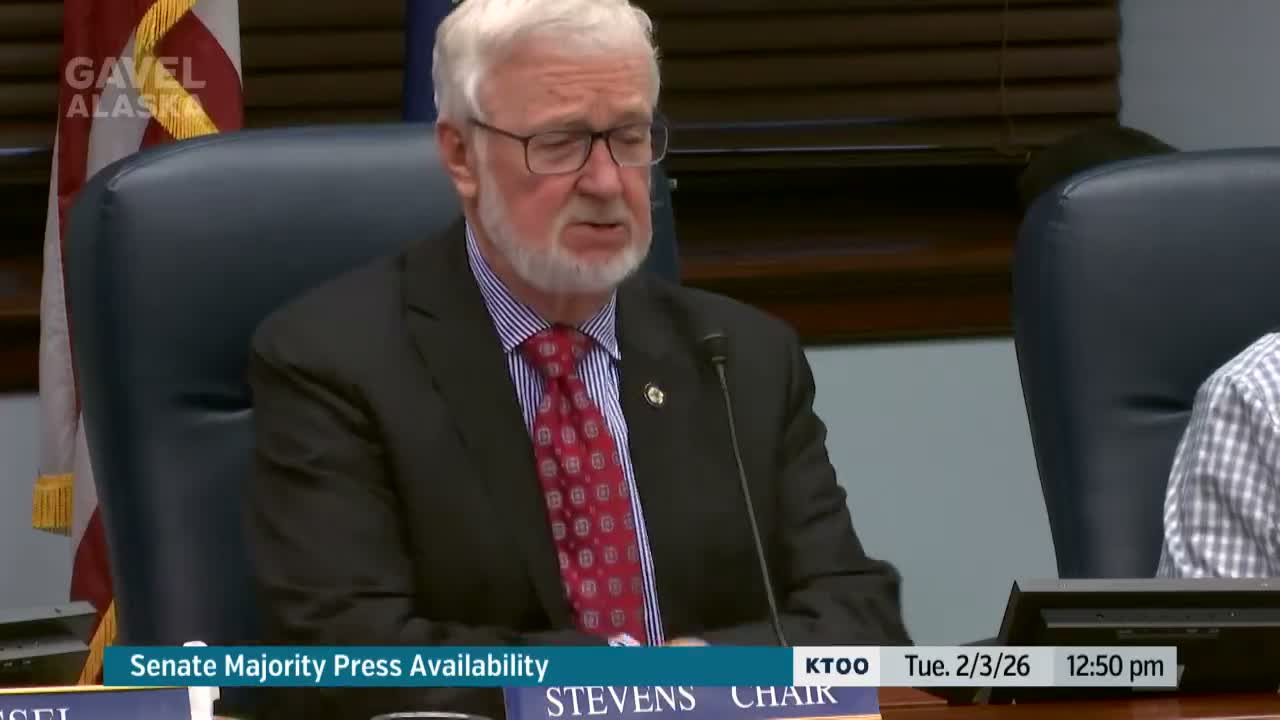
Summary
Legislative leaders said the $272 million federal Rural Health Transformation award could help reshape care in Alaska but raised concerns that most program policy changes were committed by the Department of Health without prior legislative consultation and that key rules and CMS scoring remain opaque.
President Stevens opened the briefing by noting the state’s recent federal award and asking the legislature’s health leaders to explain how it will work. Senator Dunbar, vice chair of the Senate Health and Social Services committee, said the award is large and complex and that legislative oversight so far has been limited.
“Last month the state was awarded $272,000,000 in federal funding,” President Stevens said as he introduced the topic. Senator Dunbar told reporters the award is structured as $272,000,000 per year for five years but that there are strict rules about how Alaska can access the funds and uncertainty about whether the state will receive the full amount.
Dunbar framed the money in the context of recent federal changes: she said HR 1 has already reduced Alaskans’ access to Medicaid and SNAP, cited an 11% decline in ACA enrollment (per the ADN) and an estimated 4,500 to 6,900 SNAP losses (citing the Food Bank of Alaska). She said the Department of Health included a set of policy commitments in Alaska’s federal application and that the department did not always consult legislators before making those commitments. “The Department of Health in their application made certain promises on behalf of Alaska, including on behalf of Alaska's legislature and unfortunately did not sort of consult with the legislators first,” Dunbar said.
Dunbar said the federal program requires several policy changes—she described eight categories of policy change that were promised to the federal government—and that only two of those categories require direct legislative action. She also raised concerns about administration and scoring. “Some of the rules that CMS have put out there about how to access this money and how to keep accessing this money are pretty opaque,” Dunbar said, adding that the point-based scoring system is unclear and that it is not always obvious which policy changes yield which points.
Several senators warned that executive-branch discretion could mean the department makes key spending decisions before the legislature can act. Dunbar said the fund currently appears to be administered through the commissioner of the Department of Health rather than through a formal legislative appropriation process, which reduces immediate legislative control over how funds are used.
Lawmakers also addressed tribal engagement. Dunbar said she and other legislators have met with tribal health representatives and that an advisory council involved in constructing the application included organizations such as ANTHC. She emphasized the program’s limits, telling reporters the funds “cannot be used to backfill Medicaid” and “cannot be used to construct new buildings,” but can support renovations, equipment and new sustainable projects across Alaska.
The Senate health committee has already held one hearing and Dunbar said it is likely to hold several more; the department plans additional committee briefings and meetings with the CMS administrator. Lawmakers said some policy changes sought by the department are relatively uncontroversial while others could prove contentious; there is time to act—the administration has until December 2027 to meet required policy milestones. Dunbar and other senators said they will continue to work with the Department of Health and stakeholders as the state develops a legislative and administrative approach to accessing the funds.
The committee plans additional hearings and committee work on the program this session; legislators said they will press for both clearer scoring guidance from CMS and for a clearer plan that shows how federal funding will translate into sustainable services in rural Alaska.