
Urbana council hears department briefings on drones, Miovision cameras and Placer AI; members press for contracts and retention policies
Get AI-powered insights, summaries, and transcripts
Subscribe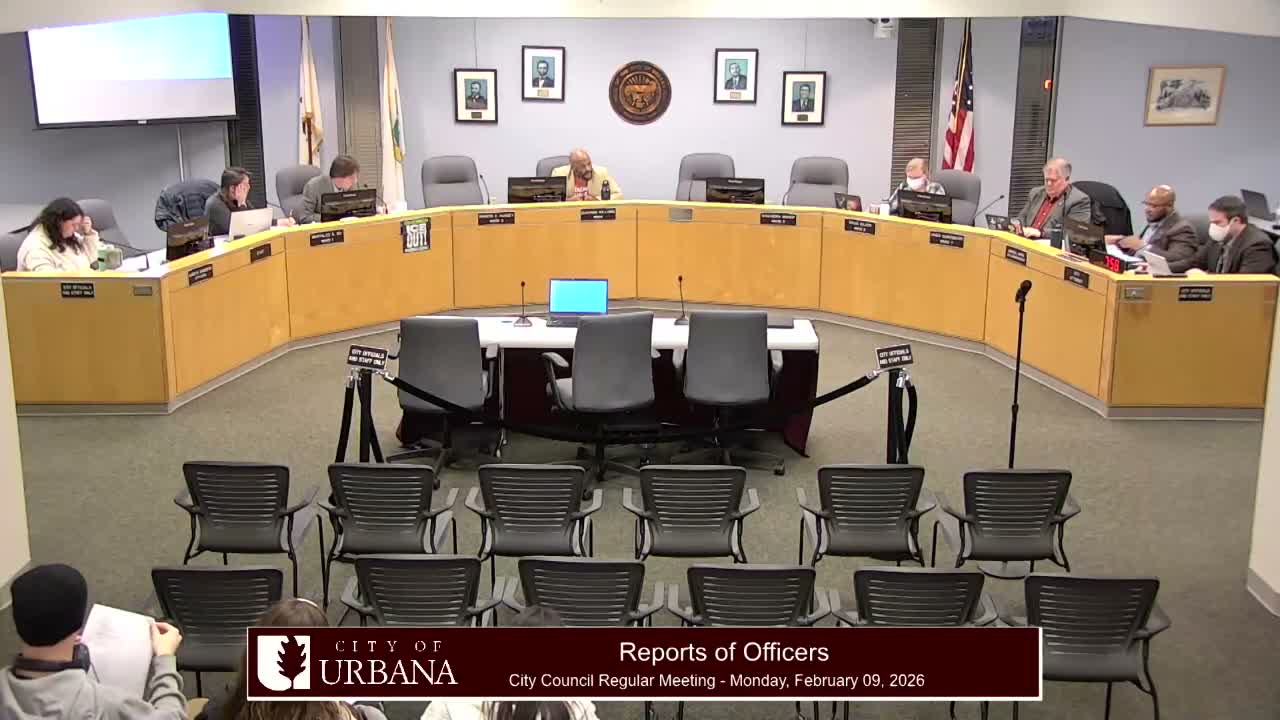
Summary
City departments described potential uses of drones, a Miovision camera system for pedestrian/traffic counts and Placer AI mobile-data products; council members pressed for contract terms, data-retention policies and vendor transparency before adopting any formal use policies.
Council members on Feb. 9 heard presentations from the fire department, public works and city administration about surveillance technologies under review and pressed for clearer vendor contracts and data-retention rules.
The fire department told the council it has no operational drones but described them as a potential public-safety tool for incident size-up, technical rescues and hazardous-materials responses. "Currently, the Urbana Fire Department does not have an operational drone," the department representative said, adding that a drone could have helped in a June rescue at the Florida Avenue residence hall.
Public works described limited prior use of drone footage provided by outside partners for grant site observations and project promotion, and explained the city’s use of a Miovision camera system for short-term pedestrian and traffic counts. The public works representative said the typical deployment is "about 12 hours at a time" with the city uploading recorded video to the vendor's cloud for analysis and the vendor returning counts and analytics.
Administrator White relayed answers from Placer AI about how its mobile-device data are collected and processed: "Placer AI observes the actual devices," he said, adding the company derives location from device-level signals rather than cellular towers and reports aggregated results only when data come from at least 50 devices (k-anonymity).
Council members repeatedly questioned the limits of those assurances. "If they say they obscure it, that doesn't necessarily mean they don't have it," said Councilmember James Quisenberry, noting concern about undisclosed third-party data partners and whether users really have a practical opt-out. Mary Ellis asked whether Placer AI would honor a 'right to be forgotten' as in GDPR and whether that protection would apply to U.S. residents.
Members also asked about data accuracy when samples exclude people without smartphones or who opt out of tracking, and requested the city obtain vendor user agreements, retention/destruction policies and evidence of how demographic and accuracy claims are derived. Public works said it will provide contract and user-agreement language, and Administrator White offered to bring additional Placer AI details back to the council.
The presentations did not result in formal council action on vendor contracts or policy language; council members framed the exercise as informational and as the type of discussion that will precede drafting or adopting a surveillance-technology policy.
The council requested follow-up information on vendor partners, data-retention and destruction timelines, accuracy metrics and any contractual privacy guarantees. The administration and public works staff committed to producing the requested documents for a future meeting.