Get Full Government Meeting Transcripts, Videos, & Alerts Forever!
Get email alerts on the Agritourism Regulation topic
No spam. Unsubscribe anytime.
Loudoun committee narrows zoning rules for events, clarifies agritourism definitions
Summary
After hours of public comment, Loudoun County’s Transportation and Land Use Committee directed staff to clarify private‑party vs. special‑event rules, create a verification process for bona fide agricultural operations, and develop use‑specific standards for wineries, breweries and distilleries. Several motions passed in split votes; others were unanimous.
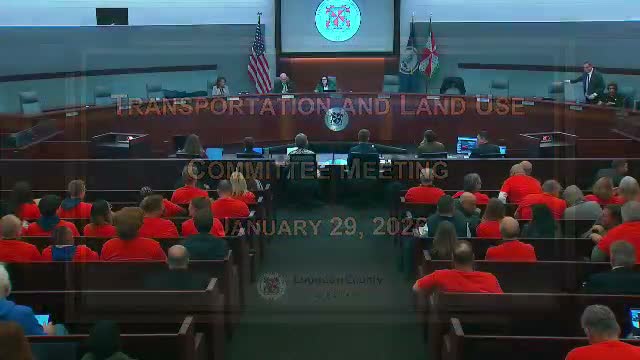
The Transportation and Land Use Committee on Jan. 29 steered a package of policy directions aimed at clarifying how Loudoun County regulates agritourism, lodging-related private parties and ABC‑licensed beverage producers.
The committee, after about two hours of public input from business owners and residents, approved staff recommendations to retain existing private‑party and temporary special‑event permissions while adding clearer definitions to prevent misuse of lodging permits as a loophole for large ticketed events. Chair Randall said the changes are intended to protect public safety and make permitting clearer for both industry and neighbors.
Why it matters: Western Loudoun’s rural economy includes farm wineries, limited breweries and distilleries that rely on on‑site events and tastings to sell product and sustain farm operations. Supporters told the committee the events ecosystem backs restaurants, rental companies and lodging — small businesses that could be harmed if the county imposes new, restrictive standards. Opponents argued the county needs sharper legal definitions and a verification process to prevent agricultural exemptions from being used to host large public assemblies in structures never built for them.
Public comment and data: Business owners told the committee that event activity is essential to agritourism and cited industry numbers. Amy Cross Monroe said county wineries and breweries produced about $23.68 million in direct receipts and $1.8 million in transient occupancy tax. Nate Walsh, a Virginia Wine Board member, told the committee county data show only 17 of 1,195 zoning enforcement cases over a 2½‑year period involved wineries, breweries or event centers, a roughly 1% share he said did not indicate widespread problems.
Safety and enforcement: Building and fire officials reiterated that zoning approvals and building‑code occupancy are separate. Wally Rinaldi, a building official, warned: “Once you get over 50 people… once you get beyond 50 people it's an assembly use,” which requires a building‑permit review and an occupancy permit. Staff and supervisors discussed that most enforcement is complaint‑driven and the county lacks a routine, proactive compliance program; the board approved an inventory to better track when uses have changed.
Legal context: County attorney Jason Hobby summarized relevant Virginia law and advised that agritourism protections apply to bona fide agricultural operations — they do not automatically attach to ABC‑licensed production uses. “An ABC use is not automatically subject to agritourism protections and also, is not automatically an agricultural operation,” he said, noting state statutes that distinguish production and processing activities.
What passed: The committee approved a set of directions to staff, including: - Retain existing private‑party and special‑event permissions but add clarifying language to distinguish them (main motion passed 3–2). - Direct staff to draft language allowing lodging uses to host up to 25 annual parties above daily guest limits while enforcing existing noise, lighting and traffic rules (passed 5–0). - Require lodging uses to provide proof of operation (examples: transient occupancy filings or occupancy permits) before hosting private parties (passed 5–0). - Separate agritourism into an accessory use tied to an agricultural operation and add definitions and use‑specific standards consistent with state law (various related motions passed 3–2 to 5–0 depending on the item). - Direct staff to create a verification process for bona fide agricultural production that can be used to qualify for farm building/structure exemptions (passed 3–2). - Establish limited distillery as a separate principal use with tailored standards aligned where appropriate with limited brewery and farm/commercial winery standards (passed unanimously). - Ask staff to develop a consistent ordinance framework and format for use‑specific standards for commercial wineries, limited breweries and distilleries; include possible standards for setbacks, hours, noise, lighting, parking, roads/access and buffering (passed 3–2). - Revise parking ratios to account for outdoor tasting areas and allow field (unimproved) parking to accommodate overflow when properly documented (passed 5–0). - Standardize guest activity hours for lodging and ABC uses in line with other motions (committee adopted a 7 a.m. to 11 p.m. Friday–Sunday, 7 a.m. to 10 p.m. other days approach during the meeting adjustments).
What was not approved: A proposal to set a new 50‑foot minimum setback for outdoor tasting areas at bed‑and‑breakfast/lodging uses failed to receive a second and was not adopted. The committee discussed nonconforming‑use risk and potential impacts on existing venues before declining to proceed.
Next steps: Staff will draft ordinance text and implementation details reflecting the committee’s directions, including the agricultural verification process and the use‑specific standards framework. Those drafts will return to the Board of Supervisors and then to Planning Commission/technical review as part of the formal ZOAM/CPAM process.
Representative quotes from the meeting: “An event is never just one business,” said Macy Schilling, a Loudoun event business owner, urging the board not to adopt rules that would ‘‘quietly dismantle’’ local agritourism. Nate Walsh cautioned the committee that complaints involving ABC uses are a small fraction of all zoning complaints: “Per the most recent TELOC meeting… 17 of 1,195 zoning enforcement cases involved wineries, breweries, or event centers.” Wally Rinaldi, the building official, warned of safety thresholds: “Once you get over 50 people… once you get beyond 50 people it's an assembly use.” And Jason Hobby, the county attorney, advised the board of the statutory limit: “An ABC use is not automatically subject to agritourism protections and also, is not automatically an agricultural operation.”
What to watch: Staff’s forthcoming ordinance language and the verification criteria for bona fide agricultural production will determine how many existing ABC production sites can claim agritourism protections or farm building exemptions. Those drafts will matter for farm‑based businesses that rely on events and for neighbors who want enforceable limits on noise, lighting and traffic.
Ending note: Committee members repeatedly emphasized the next steps are to have staff return with specific draft language — the votes on Jan. 29 were policy directions, not final ordinance text. The board also approved an inventory and asked for clearer processing steps so enforcement and public‑safety concerns can be addressed in subsequent reviews.