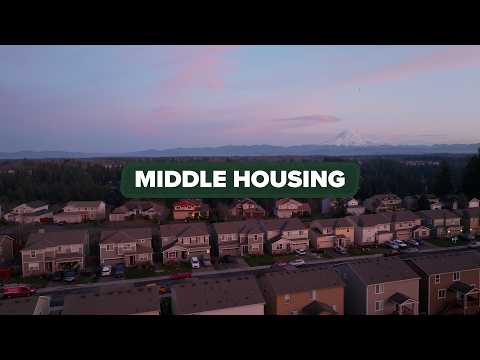
Puyallup adopts temporary rules to allow 'middle housing' citywide under state law
Loading...
Summary
The city adopted temporary regulations effective July 1, 2025, to allow middle housing across most residential zones to comply with a 2023 Washington law aiming for 1,000,000 new homes by 2044; planning staff will draft permanent rules.
Puyallup has adopted temporary regulations, effective July 1, 2025, to allow ‘‘middle housing’’ across most residential zones as the city moves to comply with a 2023 Washington state law that aims to add 1,000,000 homes by 2044, S1 said.
Middle housing, S1 said, refers to housing types similar in scale to single-family homes that place two or more homes on a single property. "Middle housing includes duplexes, townhomes, courtyard apartments, and cottage housing," S1 said, adding that these forms are ‘‘not high rise buildings’’ and are intended to blend into existing neighborhoods.
Under the state requirement described in the presentation, cities must allow at least six of nine approved middle-housing types and permit at least two such homes on any residential lot citywide. The city must allow four homes per lot where a property lies within a quarter-mile walking distance of the Puyallup Sounder Station or when one of the homes is designated as affordable, S1 said.
S1 told listeners that the city council adopted temporary regulations to comply with the law and that the temporary rules allow middle housing in all residential zones with limited exceptions in certain valley volcanic hazard areas. "To comply with state law, the city council adopted temporary regulations that took effect 07/01/2025," S1 said.
City planning staff and the planning commission are now working on permanent regulations, S1 said. The presenter emphasized that single-family homes remain allowed in low-density residential zones and that any new developments will still be subject to existing zoning requirements, including height limits, setbacks and lot-coverage rules.
Officials framed the change as incremental: neighborhoods are expected to evolve gradually as property owners choose to redevelop, while most existing single-family homes will remain unchanged. S1 said middle housing can expand housing choices for young families, empty nesters and seniors and provide opportunities for rental income and alternate paths to homeownership.
The city cited community input—meetings, surveys and open houses—as part of shaping the temporary rules. Planning staff will continue outreach while drafting permanent regulations to replace the temporary measures.