Get Full Government Meeting Transcripts, Videos, & Alerts Forever!
Get email alerts on the Utilities Infrastructure topic
No spam. Unsubscribe anytime.
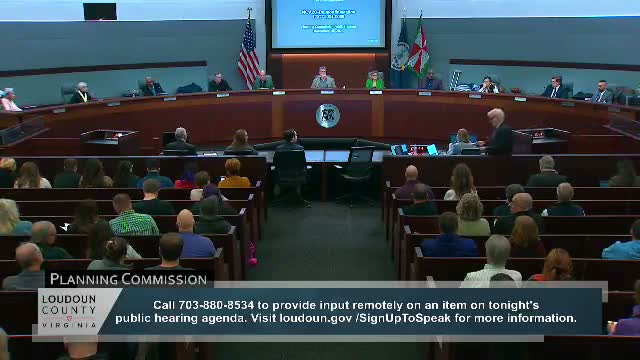
Commissioners send Novak Demos substation permit to work session amid screening concerns
Summary
The Planning Commission on Dec. 18 voted unanimously to send the Novak Demos Substation commission permit to a work session after staff and commissioners flagged screening, wall height and pedestrian‑connection questions; the applicant said it would consider raising the proposed 12‑foot screen wall.
Erin Fisher, a planner with Loudoun County Department of Planning and Zoning, presented the Novak Demos Substation commission permit for a 26‑acre parcel in the Little River District and explained the site would place electrical equipment up to 35 feet high near homes and a daycare on Arcola Mills Drive. Fisher told the commission that proposed screening consists of a 12‑foot concrete wall plus an enhanced planting buffer; she said staff recommended the applicant consider higher screening because the proposed wall ‘‘doesn’t cross those line of sight lines’’ to fully block equipment views from neighborhood properties.
Commissioners asked about alternatives, such as berming, a taller wall, facade treatments or a gas‑insulated substation (GIS). Staff said the commission can recommend enhanced screening but cannot require the applicant to change substation technology; the applicant’s counsel, Gifford Hampshire, said the team had already evaluated raising the wall and ‘‘we’ve looked at the concept of raising the wall already... from 12 to 15 feet’’ and would be willing to discuss additional screening measures at a work session.
Emily Johnson of the Piedmont Environmental Council urged a site‑specific assessment and suggested a GIS substation could reduce visual impact; she also noted site constraints including floodplain and tree conservation areas.
Commissioner Jasper moved to forward the application to a work session to continue discussion of screening and character/extent; the motion was seconded and carried 9–0. Staff and the applicant were asked to bring additional materials for the work session, including alternative screening options and sidewalk/shared‑use path connections.