Get Full Government Meeting Transcripts, Videos, & Alerts Forever!
Get email alerts on the Airport Noise Mitigation topic
No spam. Unsubscribe anytime.
Loudoun supervisors endorse two Dulles runway noise recommendations, reject consolidated RNAV tracks
Summary
After a lengthy public process, the Board endorsed NADP-1 noise-abatement departures and a nighttime runway-heading procedure for Dulles Runway 30, but declined to approve a proposal to consolidate RNAV standard instrument departures into concentrated daytime tracks, citing concerns about concentrated impacts on particular neighborhoods.
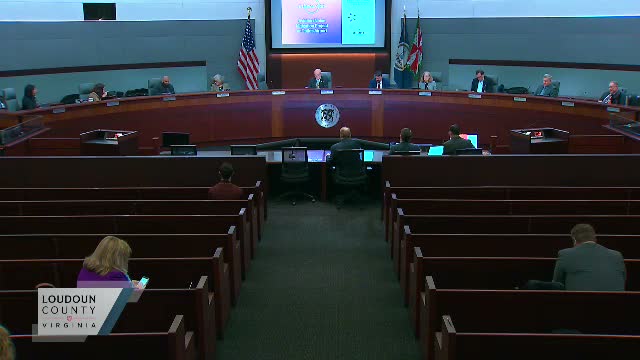
The Loudoun County Board of Supervisors on Nov. 18 endorsed two of three community-driven recommendations for reducing aircraft noise from departures on Washington Dulles International Airport Runway 30, and declined the third recommendation after robust public comment and Board debate.
Staff and consultant Vionaire presented a three-part package recommended by a multi-community design group: (1) adopt a Noise Abatement Departure Procedure (NADP-1) so aircraft climb faster and reduce low-altitude noise near the airport, (2) implement a nighttime runway-heading/noise track (aircraft remain on runway heading until 3,000 feet between 11 p.m. and 7 a.m., weather and traffic permitting), and (3) consolidate multiple RNAV departures into a smaller number of predictable tracks that keep aircraft over industrial and commercial areas where feasible.
The Board voted unanimously (9-0) to endorse NADP-1 and the nighttime heading procedure, finding both would reduce near-airport low-altitude noise and give the county a consolidated, FAA-recognized community package to transmit for further regional and FAA review. Several supervisors emphasized those two steps would measurably lower perceived noise (consultants reported modeled reductions of roughly 2'9 dB in affected places) and would allow the county to reengage the FAA and airlines with data rather than questions.
Direct endorsement of consolidated RNAV transitions (the third recommendation) failed after several supervisors objected that it would concentrate daytime departures repeatedly over a small set of neighborhoods, including some areas with unbuilt housing where residents would have limited notice. Those supervisors said they were unwilling to send a package that would create a predictable, concentrated noise stream without additional outreach and verification that NADP-1 alone would sufficiently mitigate noise exposure. The vote on the RNAV consolidation failed with multiple no votes recorded.
Staff said next steps are to transmit the board-endorsed recommendations to the regional project group and then to the FAA for environmental review and airline operational analysis. The Board directed staff to provide a status update during the first quarter of 2026.
Quotes from the meeting included a community representative in support: "This improves safety... it improves efficiency and it is in the best interest of the airport," and a supervisor noting, "If these planes are even a little higher, it makes a big difference to the naked ear."