Subcommittee hears competing bills to keep data‑center transmission costs off household bills
Get AI-powered insights, summaries, and transcripts
SubscribeSummary
A Virginia House subcommittee considered several bills that would direct the State Corporation Commission to review or limit how transmission and generation costs tied to data centers are assigned; supporters said the measures protect ratepayers, while industry and some utilities said the SCC already has tools to address the issue.
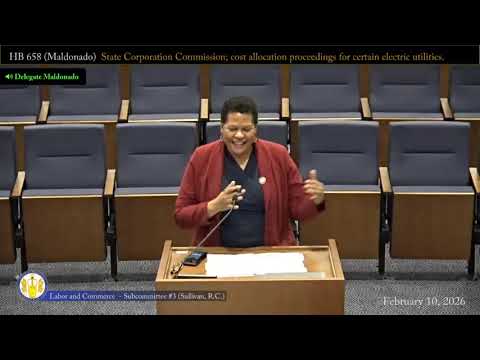
Delegate Maldonado opened the session on HB 658 by asking the State Corporation Commission to examine whether families and small businesses are subsidizing electric infrastructure built primarily to serve data centers. "This bill directs the state corporation commission to examine whether residential and small commercial customers are subsidizing electric infrastructure built primarily to serve data centers," he said during his presentation.
Supporters — residents, environmental groups and electric cooperatives — told the committee that the last Dominion rate case left a gap in cost allocation for projects that primarily serve data centers. Bridal Hayes, a Lynchburg resident, said households already facing high electric bills should not be asked to pay more: "Having these kinds of regulations would make sure that our already exorbitant electric bills are not further increased," she testified.
Environmental and consumer groups framed their support around fairness and transparency. Laura Gonzales of Clean Virginia said the SCC staff has long asked for action on cost allocation for transmission projects that serve only data centers and urged the committee not to delay further. Representatives of the Piedmont Environmental Council, Virginia League of Conservation Voters, NRDC and several other conservation organizations reiterated those points.
Industry and utility witnesses urged caution or opposed the measures. Nicole Riley of the Data Center Coalition said the industry is committed to paying for the power it uses and argued the SCC already has authority to ensure fair allocation, citing recent rate‑case action that established a "high load customer" rate class. Dominion representatives also opposed the bill, saying the commission will address many of these issues in upcoming filings and proceedings.
The committee took formal action on HB 658, voting to lay the bill on the table by a recorded vote of 6 to 0.
Several other bills addressing data‑center impacts were discussed in the same hearing. Delegate Simons’ HB 591 — framed as a policy statement on responsible data‑center growth and direction for regulators — drew broad support from conservation groups and was reported from the committee as amended by a vote of 4 to 2. Delegate Thomas’ HB 155, which would require SCC certificates of operation for very large energy users (25 MW+) to ensure projects do not harm rates or reliability, also drew extensive testimony; the subcommittee later voted to table that bill by a recorded vote of 6 to 0. Delegate McAuliffe’s HB 503, which would direct SCC guidance that costs substantially related to data‑center service should not be included in rates, was discussed and the committee agreed to continue work and carry that bill over to 2027 for additional consideration.
Why it matters: Several bills seek to address similar concerns — who pays for transmission and generation tied to rapid data‑center growth — but they approach the problem differently: some request additional SCC analysis and options, others would add statutory guidance or certification requirements before large facilities proceed. Supporters say the measures protect ratepayers and improve transparency; opponents warn of regulatory uncertainty and potential harm to economic development.
What’s next: The committee took mixed actions — tabling some bills, reporting others with amendments, and carrying one over — so additional hearings and amendments are likely before any final legislative action.