Get Full Government Meeting Transcripts, Videos, & Alerts Forever!
Get email alerts on the Social Services 211 topic
No spam. Unsubscribe anytime.
2-1-1 Connecting Point reports 15,019 calls in 2025 and highlights housing and unmet needs in Nevada County
Summary
2-1-1 Connecting Point told the Board it handled 15,019 calls in 2025 (635 coordinated-entry calls), referred 18,697 resources, and identified housing, family support and health care as top needs; presenters flagged a 7.1% unmet-need rate and described PSPS, coordinated entry and a new reentry program.
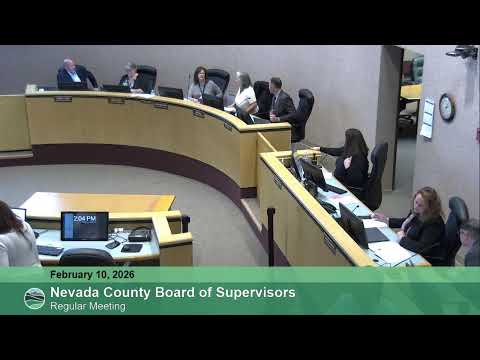
At the Feb. 10 Board of Supervisors meeting, 2-1-1 Connecting Point staff presented a data-driven overview of the nonprofit’s services, demand and gaps in Nevada County.
Carissa Cyr, a county senior management analyst, introduced the program. Lindsay Gordon and Tim Giuliani of 2-1-1 reported that in calendar year 2025 the call center handled 15,019 calls and recorded 18,697 resource referrals; 635 calls related to coordinated entry for people experiencing homelessness. Presenters said housing remained the most common need, followed by family and community support, health care and food assistance, and that 7.1% of callers had an unmet need (for example, rental assistance programs that had exhausted monthly funds).
The presentation highlighted the PSPS (public-safety power shutoff) partnership with PG&E: 2-1-1 performs pre-event care coordination for residents who are electricity-dependent, provides active responses during shutoffs (hotel placements, transportation and food deliveries), and manages after-hours adult protective services reporting for the county. 2-1-1 also described a new reentry program, funded through Pathways/CalAIM, to support justice-involved residents transitioning from incarceration.
Board members asked for more granular data by supervisorial district and for ongoing reporting of reasons why needs go unmet; 2-1-1 staff agreed to provide district-level breakdowns and said they can include unmet-needs details in quarterly reports. The presentation concluded with staff offering to share heat maps and to coordinate more closely with social services to plug gaps.
Key figures reported: 15,019 total calls in 2025; 635 coordinated-entry calls; 18,697 resources referred; 7.1% callers with unmet needs.