
Senate Judiciary debates Article V faithful-delegate rewrite; amendment fails, bill rolled for two weeks
Get AI-powered insights, summaries, and transcripts
Subscribe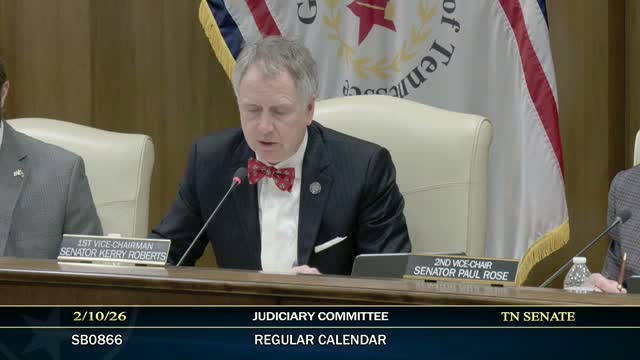
Summary
Senate Bill 15-67, a proposed rewrite of Tennessee's Article V faithful-delegate statute to prescribe selection, instruction and oversight of commissioners for a possible Article V amending convention, drew extended testimony and questioning. An offered amendment failed on a 3-5 roll call and the sponsor rolled the bill for two weeks for further work.
Senate Bill 15-67, which would amend Tennessee Code Title 3 Chapter 18 to set selection requirements, instructions and enforcement mechanisms for commissioners to an Article V amending convention, drew a lengthy and at times contentious committee session on Feb. 11.
Sponsor Senator Roberts described the measure as an update to existing law intended to fill gaps about who would serve as commissioners, what instructions they would receive and what oversight exists if a commissioner exceeded their instructions. The committee recessed to hear two three-minute supporters: Ramona DeSalvo, state director for Convention of States legislative action in Tennessee, and Jay Walling, a co-state grassroots coordinator for Convention of States. Both urged the committee to approve the updates and described proposed requirements such as an odd-numbered delegation, residency minimums, roll-call voting and restrictions on commissioners changing amendment text.
Committee members raised constitutional and practical concerns. Senators asked how the General Assembly could recall and replace a commissioner quickly enough to counter a vote taken at a convention, how enforcement would work, whether the statute would give legislators a judicial function by authorizing referrals for prosecution and whether criminal penalties for voting outside instruction would be constitutional given separation-of-powers concerns. The supporters pointed to an existing class E felony in state law for knowingly voting outside instruction and cited Chiafalo v. United States (2020) — a U.S. Supreme Court case upholding state authority to enforce elector obligations — as precedent that states can punish faithless agents.
The committee voted on an amendment (drafting code 13-114) by roll call; the tally was 3 ayes and 5 noes, so the amendment failed. Chairman Roberts then requested a committee roll and the bill was rolled for two weeks to give sponsors time to address questions and produce clarifying language.
Why it matters: The measure governs how Tennessee would participate in a rare interstate process with national implications. The debate centered on how to balance legislative instruction and oversight with commissioners' deliberative responsibilities and constitutional limits.
What happens next: Sponsor requested two weeks; the committee will reconvene on the bill after further drafting and stakeholder input.