
Issaquah reviews MetroFlex performance and weighs circulator or private microtransit options
Get AI-powered insights, summaries, and transcripts
Sign Up Free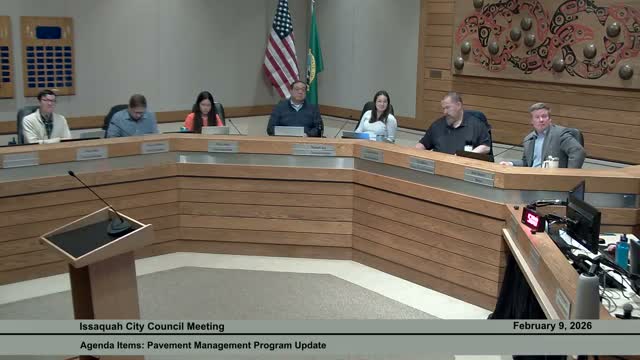
Summary
Administration presented MetroFlex performance metrics (Issaquah's share plus King County yields a total cost per ride over $40, average wait ~23 minutes, 55% shared trips) and proposed exploring alternatives — a city-run circulator, Circuit, or renegotiated MetroFlex service — with council asking for route-level cost comparisons and Burlington/Bellevue experience.
Andrea Leonard, deputy city administrator, returned to council on Feb. 9 to revisit MetroFlex and microtransit options after council's fall concerns about cost-effectiveness.
Leonard reported that Issaquah pays for one van and driver while King County covers other infrastructure; King County's cost per ride is "a little over $20," she said, and Issaquah's share results in a total cost per ride of "over $40." The administration also reported 55% of trips are shared and an average wait time of roughly 23 minutes; staff noted limitations in data on rider demographics and fare-reduced trips.
Options presented included: (1) continue to work with Metro to change service parameters and hours; (2) a city-run circulator (fixed-route shuttle) estimated as a lower-cost, more predictable option in initial modeling; and (3) Circuit, a private provider with an electric vehicle fleet in other cities. Staff said Circuit indicated flexibility in using purchased service hours for fixed routes or point-to-point options; Uber and Lyft did not submit proposals in time for the meeting.
Council members split on priorities: some urged continuing MetroFlex with better outreach and a focus on equity and last-mile access for seniors and riders without cars; others favored exploring a fixed-route circulator or Circuit's model to get more predictable headways and potentially lower per-ride costs. Several members asked staff to provide route-level assumptions, comparisons with bus operating cost per boarding, the Bellevue experience with Circuit, and refined cost estimates before council chooses a path.
Next steps: staff will return with more detailed cost modeling and usage data (including the effects of a recent MetroFlex service-area change), pursue additional vendor proposals and community outreach, and present refined options later this year.