Get Full Government Meeting Transcripts, Videos, & Alerts Forever!
Get email alerts on the Safe Streets topic
No spam. Unsubscribe anytime.
Eagle Pass MPO hears Safe Streets for All kickoff, consultant shows five‑year collision trends
Summary
Consultants briefed the Eagle Pass MPO on a federally funded Safe Streets for All safety action plan, presenting Jan. 2021–Dec. 2025 collision data, identifying high‑injury corridors and scheduling community meetings to develop engineering and non‑engineering countermeasures.
Nayan Amin, a consultant with TJKM Consulting Group, told the Eagle Pass Metropolitan Planning Organization policy board on Feb. 10 that the city’s federally funded Safe Streets for All project will prioritize ‘‘the human life and safety above speed, convenience, or property’’ as it develops safety countermeasures.
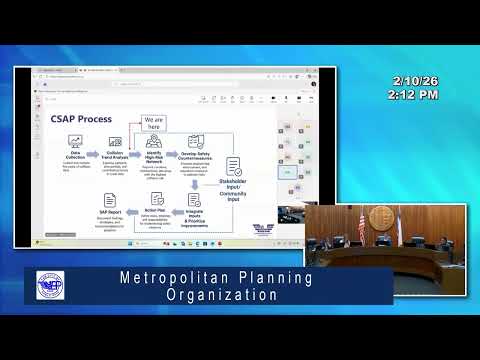
Amin, presenting the project kickoff and collision analysis, said the team compiled crash reports from January 2021 through December 2025 to identify high‑injury corridors and inform a package of engineering and non‑engineering strategies. ‘‘We need to treat traffic deaths and serious injuries as preventable and accommodate that in the design of the roadways,’’ he said.
The consultant summarized the five‑year dataset for City‑managed streets as showing 279 injury collisions, with roughly 6 percent classified as serious injuries and 23 percent as minor injuries. Pedestrian and bicycle injury counts on city roadways were reported as 14 and 5, respectively; on state highways, the team identified 19 pedestrian and 12 bicycle injury collisions. Amin said ‘‘automobiles were involved in the vast majority’’ of injury collisions and that right‑of‑way violations and distracted driving were the leading violation categories in the dataset.
Amin also described collision typology and timing: broadside (right‑angle) collisions represented nearly half of recorded crashes at intersections or along segments, and a large majority occurred in daylight and clear weather. He said the data show a decline in total injury collisions between 2021 and 2025, but urged using locally specific solutions because ‘‘one solution doesn’t fit all.’’
MPO staff noted the city had received grant funding to develop the plan and that the analysis will be used to prioritize corridors and communities at highest risk. Amin told the board the project will include community engagement such as pop‑up events held in January and two community meetings scheduled for the 17th and 18th (dates presented by the consultant), in addition to a technical advisory committee meeting.
Next steps, as described to the board, include finalizing the high‑injury network, drafting countermeasures and non‑engineering strategies, identifying candidate city projects, and presenting a recommended safety action plan to the city council for adoption. The presentation was informational; board members had no substantive questions during the meeting.
The MPO’s consultant‑led analysis and planned outreach aim to satisfy federal guidance that requires jurisdictions to have an adopted safety plan to be eligible for several federal funding sources, including Highway Safety Improvement Program and Safe Routes to School programs.