Committee clears bill clarifying rules for small plug‑in solar devices, adopts amendment
Loading...
Summary
House Bill 4060, amended and advanced 8‑0, would clarify that small plug‑in solar devices (not exceeding 1.2 kW and plugging into a 120‑volt outlet) that meet national safety standards and anti‑islanding requirements are not to be treated as incorrect grid connections; the OCC may still adopt narrowly tailored rules.
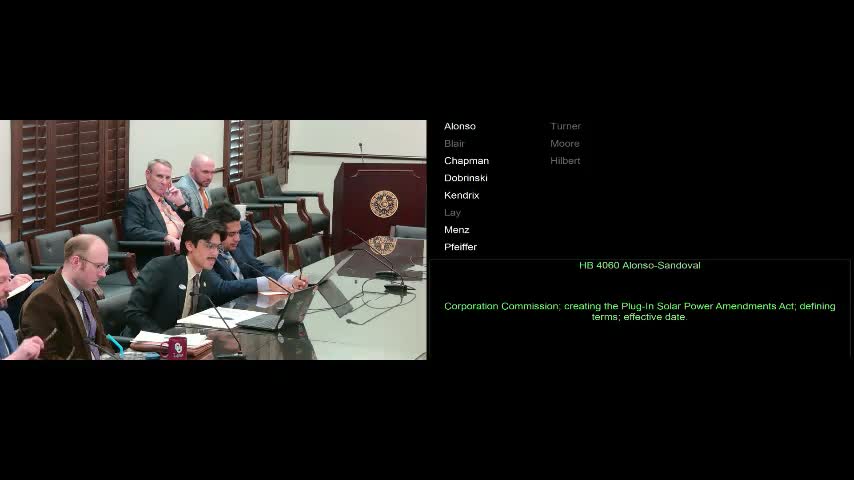
Representative Alonzo presented House Bill 4060, saying the measure "is essentially behind the meter for small scale solar generation devices." An amendment was offered and adopted that removes section 9, which had addressed regulations on homeownership.
Alonzo explained the bill’s scope: the measure would clarify that devices that "don't generate more than 1.2 kilowatts, connects to a standard 120 volt electric outlet, and complies with national safety standards including anti islanding" should not be considered incorrect connections and therefore would not be required to comply with complex interconnection statutes, tariffs or Corporation Commission requirements.
Representative Kendrick asked whether the proposal could allow backfeeding that would create hazards for line workers; Alonzo responded that inverters are mandated to include safety mechanisms so energy generated does not go back into the grid, preventing hazards to line workers. Kendrick also noted his support for section 7’s language allowing the Corporation Commission to adopt administrative rules "solely as necessary to items 1 through 4."
Representative Piper questioned why statutory clarification is needed now and what prevents individuals from installing such devices today. Alonzo said the bill is intended to remove uncertainty and signal that these plug‑in devices should be treated more like appliances than grid‑connected generators, encouraging adoption and reducing overburdensome regulation.
The committee adopted a motion and recorded an 8 yea, 0 nay vote. Staff recorded individual "Turner aye" and "Lay aye" on the roll; the chair reported the bill as passed out of committee.
The committee record does not include a fiscal analysis or an OCC representative speaking to operational impacts. The bill, as amended, focuses on clarifying legal treatment and preserving limited OCC rulemaking authority to adopt narrowly tailored administrative rules.