Get email alerts on the Committee Language Reviews topic
No spam. Unsubscribe anytime.
Committee clears language changes for several bills, flags affordability metric wording
Summary
The committee conducted brief language reviews of LD 2153 (departmental transfer), LD 1964 (seller/installer disclosure) and LD 1949 (energy fairness); staff clarified GEA timing for LD 2153 and the committee revised LD 1949's affordability metric to assess the impact of electricity bills on overall energy burden.
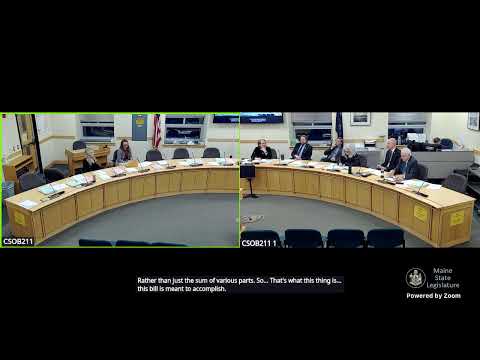
At the start of the shortened session, the Energy Utilities & Technology Committee reviewed three brief language items.
On LD 2153, staff said the amendment transfers responsibilities from the governor's energy office to the Department of Energy Resources. Staff clarified how the Government Evaluation Act (GEA) timing applies to the department (initiated in odd years with the evaluation in the following even year). The committee discussed whether to move the statutory GEA trigger date and ultimately left the statutory timing at 2027.
LD 1964, which would require standard written disclosures from sellers and installers of generation resources and make changes to other consumer disclosures, was reported out unanimously; staff said the PUC and Department of Energy Resources can absorb any minor additional costs within existing budgets.
On LD 1949 (energy fairness), staff and witnesses flagged that the phrase "energy burden" is broader than electricity bills because it can include heating oil and gasoline. Deirdre Schneider of the Maine Public Utilities Commission advised the committee that adding the word "and" created drafting problems and recommended focusing the directed metric on the impact of electricity bills on overall energy burden. The committee agreed to that clarified drafting: the PUC is directed to develop a metric to "assess the impact of electricity bills on overall energy burdens."
AI generated
The text on this page is AI generated. Summaries, highlights, analysis, and video transcripts are all produced from the original source material.
AI can make mistakes, so if you spot one, and we will fix it for everyone.
Note: the source content is unaltered by us. Any content source we link to, be it a video, an audio recording, or a document, is presented exactly as its publisher released it. That publisher is usually a government body, sometimes an individual official or another organisation.