
Manatee County weighs steep property‑tax cuts as staff plans workshops and quick survey
Get AI-powered insights, summaries, and transcripts
Subscribe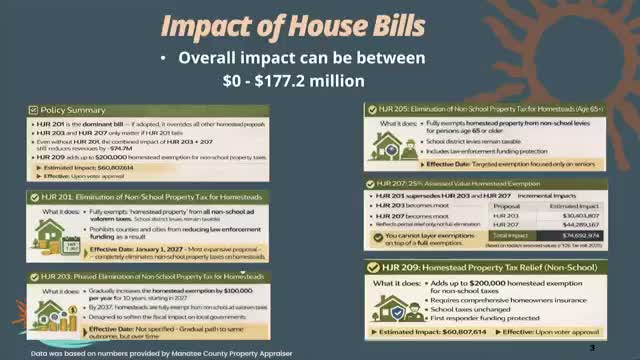
Summary
County staff warned the commission that proposed state-driven property-tax relief could shave tens to hundreds of millions from county revenue; commissioners backed a program of short public workshops and a later scientific survey to map tradeoffs, while staff detailed specific service reductions that a larger cut would force.
Manatee County officials spent the bulk of a work session explaining how a wave of state‑level and ballot-driven proposals could sharply reduce county property‑tax revenue and force hard choices about services.
Claudia Campos, interim chief financial officer, told the Board of County Commissioners the county’s general‑fund revenues were budgeted at $645,260,000 for FY 2026, and that property taxes account for roughly $327,350,000 of that total. Using the adopted FY‑26 figures, staff modeled a range of possible millage reductions: a 0.05‑mill cut would lower revenue by about $3.7 million; a 0.5‑mill cut would reduce revenue by about $37.4 million. Campos said a 0.5‑mill scenario would translate into reductions equivalent to hundreds of positions across departments and would force cuts to services if other county millages were not adjusted.
Deputy Administrator Corey Studi urged the board to plan for the worst and outlined specific service changes that could be on the table at larger reductions: reduced library hours (for example, cutting from seven to five days in some scenarios), scaled‑back animal‑welfare programs, cuts to nonprofit agreements, reduced maintenance and property management, and longer wait times for call‑center services.
Commissioners pressed staff for options that let the public make prioritized tradeoffs rather than broad yes/no questions. "If a disproportionate share of the public say that's the cut, well then we have to listen to the public," one commissioner said, calling for a “Chinese‑menu” approach that shows voters what savings follow from specific reductions (for example, the tax savings tied to eliminating Sunday library hours).
The board supported a two‑track public engagement approach: short, district‑based workshops this spring to collect immediate, qualitative feedback, and a follow‑up statistically representative survey (random‑digit‑dial phone polling) that would take longer to administer and likely return results after the current budget cycle. To lead the workshops the county engaged Results First and will pair their outreach with online tools (Mentimeter) and short explainer video materials created by county communications staff to help residents understand millage math.
Chair and staff emphasized the limits on local control: several commissioners reminded the board that state action — including possible elimination of homestead exemptions — could create far larger, recurring budget shortfalls that local trimming cannot fully offset without new revenue sources.