Get Full Government Meeting Transcripts, Videos, & Alerts Forever!
Get email alerts on the Municipal Legislation topic
No spam. Unsubscribe anytime.
Tipp City presents three ordinances: fee increases, staffing reclassifications and sewer code clarification
Summary
Council introduced three ordinances in first reading: (A) fee-schedule updates raising select fees including the blasting permit from $50 to $500, and fees for veterans and pavers; (B) organizational-chart changes creating utility/finance positions for succession planning; (C) a clarification to sewer-capacity fee tables tied to the Tri Cities wastewater plant.
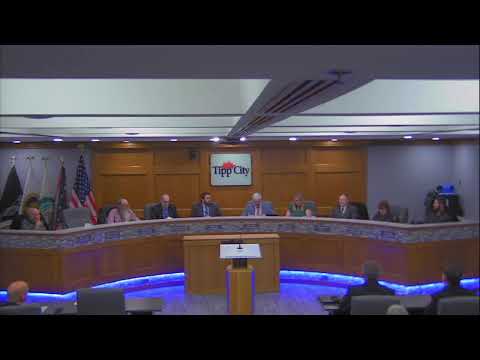
Tipp City Council introduced three ordinances on Jan. 20 that the city described as housekeeping and succession-planning measures as well as a clarification to ensure consistent application of recently adopted sewer fees.
Ordinance A would amend the fee schedule to add a veterans banner program fee, update fees for veteran memorial pavers and dog-park pavers, and increase the permanent blasting fee. "...increasing the blasting fee, from, $50 application fee to a $500 permit fee," Mister Knight/Mac said when explaining the item.
Ordinance B would update the city organizational chart and codified ordinances (chapter 37 exhibit A) to create or reclassify positions — finance specialist, income tax specialist, utility billing specialist, and lead utility billing specialist — to implement a succession plan after Stacy Brown's anticipated retirement from the utility billing office. Staff said the lead utility billing specialist role allows promotion and a full year of training and knowledge transfer prior to assuming the supervisor role.
Ordinance C would amend section 52.06 of the Tipp City Code to clarify sewer rights and regulations and correct ambiguities in the fee table that supports sewer-capacity fees tied to construction of the Tri Cities wastewater plant. Staff told council the revision "simply clarifies that fee table to eliminate confusion and ensure consistent application going forward."
Each ordinance was introduced for first reading and a sponsor was noted; no final votes or adoptions occurred at the meeting. Staff and council framed the measures as administrative updates and succession planning rather than new policy directions.
What happens next: Each ordinance remains at first reading; council may schedule further review, public hearings, or second readings as required by the city code.