
TCOLE advisory panel begins drafting rules for polygraph proficiency certificate; sets 400‑hour baseline and subcommittees
Get AI-powered insights, summaries, and transcripts
Subscribe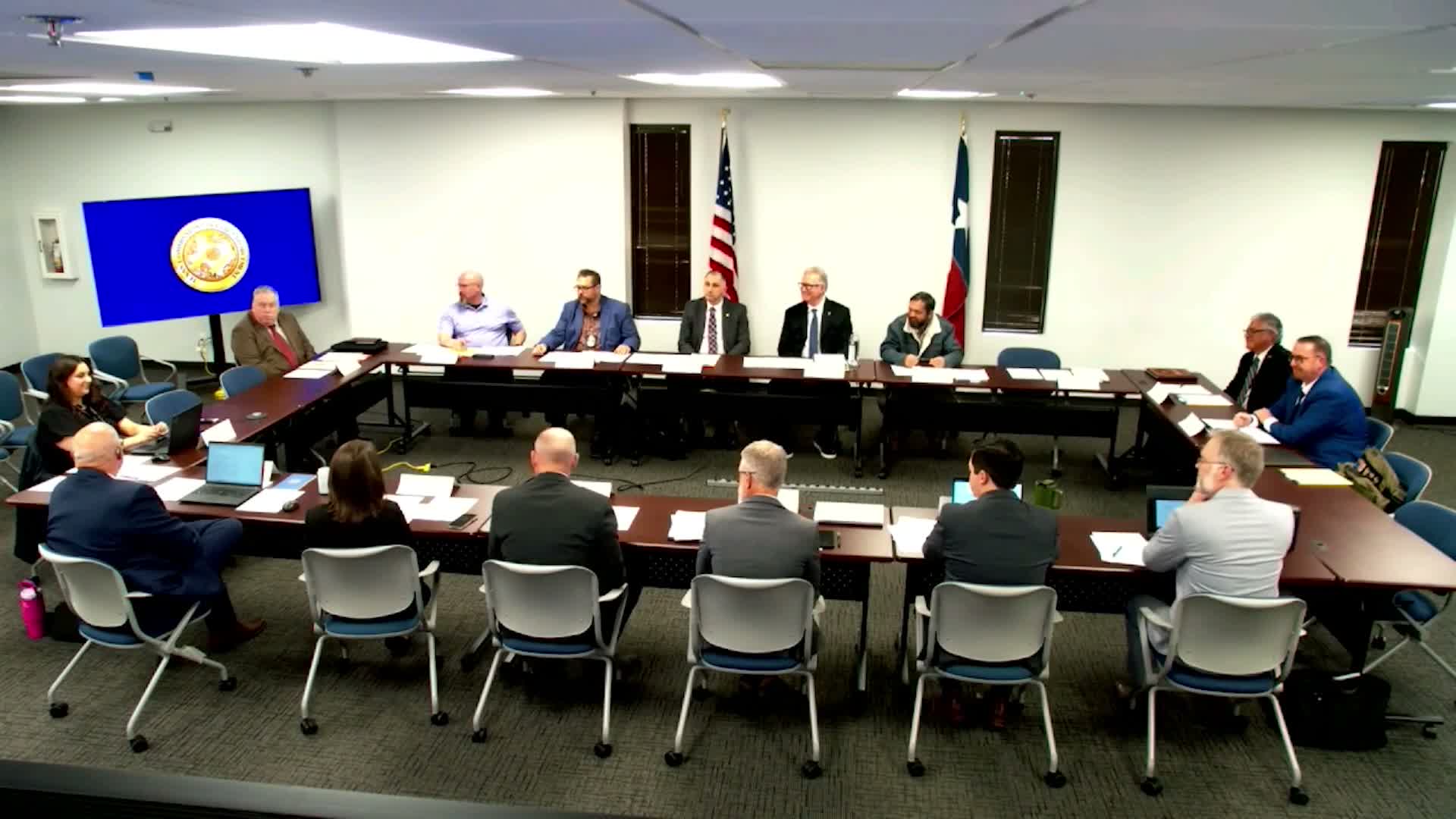
Summary
The Texas Commission on Law Enforcement advisory committee met to start rulemaking for a new proficiency certificate for polygraph examiners. Members backed a 400‑hour training baseline, debated testing models and screening‑test accuracy, formed subcommittees and scheduled a follow‑up for March 9.
The Texas Commission on Law Enforcement convened an advisory committee to begin rulemaking for a new proficiency certificate for peace officers who administer polygraph examinations, focusing initial work on minimum training, testing models and who should be eligible for certification.
Greg Stevens, executive director of the Texas Commission on Law Enforcement, told the group the statute directed the agency to use advisory committees ‘‘to help craft new rules’’ rather than imposing standards from Austin. The committee’s immediate charge is to define minimum training, testing and eligibility for a commission‑issued certificate that differs from a professional license.
Committee members coalesced around using existing guidance as a starting point. ‘‘DPS has our own school, which we do 400 hours of TCO credit for,’’ said David Dixon, a DPS polygraph examiner and presiding committee member. Multiple members said a 400‑hour minimum course is a practical baseline that can be drafted broadly so the TCOLE rule need not be rewritten every time an accreditor updates curriculum.
The group debated two testing models: a TCOLE‑owned state exam administered at commission sites, or recognition of external accreditation and approved providers that administer their own tests but meet TCOLE standards. Colin Grissom, who leads licensing and education at TCOLE, described options including publishing an instructor resource guide (IRG) and accepting accredited provider testing as meeting the statute’s examination requirement.
Members also raised research and accuracy concerns specific to screening‑style polygraph tests. Pat O’Bourke, a polygraph school director and former APA board member, cited meta‑analytic studies and the National Academies’ 2003 report to warn that screening tests ‘‘don’t support screening tests’’ in the same way single‑issue, event‑specific tests are supported by research. He recommended successive‑hurdle testing and safeguards so agencies do not over‑rely on screening results.
The committee discussed grandfathering and reciprocity for current practitioners and out‑of‑state examiners. Staff said the rule can recognize prior accredited training and create an application process for practitioners who meet the newly established standard rather than require universal retesting.
To make progress within the statutory timeline, the panel agreed to split into subcommittees to draft concrete language. Proposed workstreams include: (1) defining the training content and minimum hours; (2) setting testing and examination procedures; (3) specifying who may receive the certificate and how grandfathering/reciprocity is handled; and (4) continuing‑education requirements to maintain certification. Staff advised subcommittees to avoid walking quorums and to route materials through TCOLE staff for distribution to comply with open‑meetings rules.
By motion, the committee scheduled its next meeting for March 9 at 1 p.m. as a hybrid session. Staff will circulate draft minutes and coordinate subcommittee meetings and materials.
What happens next: Subcommittees will draft recommended language on training content, testing models, eligibility and continuing education for the full committee to review at the next meeting. The committee also identified a six‑month legislative/implementation timeline to deliver initial recommendations to TCOLE staff.