
Sierra Madre council directs staff to test Uber voucher pilot, allocates interim Prop A funds
Get AI-powered insights, summaries, and transcripts
Sign Up Free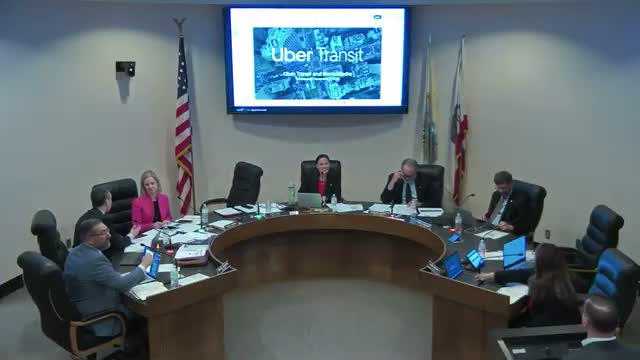
Summary
After hearing Uber Transit present customizable voucher programs for general mobility and seniors, the council told staff to pursue a limited pilot and directed an initial Prop A allocation (Council set aside $100,000 for a pilot) to test vouchers, geofences and senior call‑in options while the transportation subcommittee refines locations and eligibility.
The City Council on Feb. 10 directed staff to explore a limited on‑demand mobility pilot with Uber Transit after a detailed presentation on voucher and geofence options.
Matthew d Toronto of Uber Transit outlined voucher options allowing a resident to pay a small co‑pay while the city covers the remainder up to a set limit. "One idea...is a general mobility voucher where a rider would pay a $2 co‑pay and the city cover the balance of up to $15," he said as an example of the customization available to towns like Sierra Madre.
Council members requested clarity on eligibility verification, senior access for people without smartphones, budget limits and how the program would be monitored to avoid overspending. Uber staff described tools including Uber Vouchers and Uber Central (a call‑in and administrator tool) and said vouchers are charged only for trips taken; unused voucher balances are not carried forward. The company also said it can provide reporting and heat maps to help right‑size the program.
Council directed the transportation subcommittee and staff to develop a short list of geofenced destinations and distribution approaches and to work with Uber on implementation timing; Council later approved an initial Prop A funding allocation of $100,000 to start a pilot and directed staff to come back with program parameters and cost projections. Staff estimated a 30–60 day implementation window if the Council moves quickly and the vendor provides implementation support.
Council members emphasized the pilot should prioritize equity and senior access (SMS call‑in and Uber Central) and be bounded by a firm appropriation to avoid open‑ended costs. The pilot is framed as an interim service while the city continues to seek longer‑term transit solutions through RFPs and subcommittee work.