Henniker advances four warrant articles to ballot, including budget and teacher contract cost items
Loading...
Summary
At the first session of Henniker School District’s annual meeting, moderators and presenters advanced four warrant articles — covering board salaries, a trust-fund transfer to special education, the operating budget, and teacher contract cost items — to the official ballot on March 10, with discussion focused on special-education costs and budget drivers.
Henniker’s first-session annual meeting advanced four warrant articles to the official ballot on March 10, without taking final votes tonight, the moderator said.
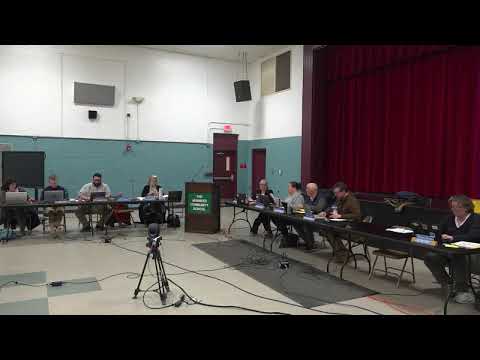
Moderator Cordell Johnston opened the annual meeting under the SB2 official-ballot referendum process and explained that the meeting could debate and amend articles but not take final article votes. He said Article 4 — the collective-bargaining cost items — cannot be amended under state law and will appear on the ballot as printed.
The meeting moved Articles 1 through 4 onto the ballot. Article 1, to set school-board salaries and compensation for officers as printed in the budget, was moved and seconded and carried forward without discussion. Article 2 would discontinue the Henniker Technology Equipment expendable trust and transfer the balance into the Educationally Handicapped (special-education) expendable trust. A presenter described the technology fund as established in 2007 for large capital needs and said patterns of technology spending have flattened, while special-education costs remain unpredictable. “This would move approximately $71,000 to add to that trust fund,” the presenter said. The presenter added the special-education trust currently has a balance of about $217,000.
Public commenters asked how other capital needs are covered and whether money could be returned to taxpayers. Brian Schober asked whether other trust funds exist for large capital items such as a boiler; a business-office representative said a buildings-maintenance expendable trust holds about $114,000 and that trust funds are held separately from the operating budget. Allison Rose asked whether discontinued trust funds could be returned to taxpayers; the board clarified the warrant as written moves the money to the general fund and then into the special-education trust rather than issuing refunds to taxpayers.
Article 3 lays out the operating budget the district will ask voters to approve. The presenter described the district’s current budget figure and said the proposed budget represents an increase driven largely by personnel and special-education costs. Key drivers listed included salary and benefit changes, a shared out-of-district special-education coordinator (Henniker’s share 25 percent), a transportation-contract increase and a projected rise in out-of-district special-education tuition. The presenter cited the district’s October 1 enrollment and a cost-per-pupil comparison: the state elementary average cited was $23,005.33 and Henniker’s cost per pupil was cited as $21,008.71. The presenter said the proposed budget increase is roughly $323,351, about 2.98 percent above the current budget, and that the default budget calculation would be $11,055,780.
Article 4 would approve cost items in a two-year collective-bargaining agreement with the Henniker Teachers Association. Presenters said the first year’s cost items total $230,828 and the second year’s $165,512, driven by grid-step increases (3 percent in early steps; 4 percent in later steps), longevity additions and targeted pay adjustments for difficult-to-fill roles such as nurses. Presenters described projected average increases of 6.4 percent in year one and 4.4 percent in year two across the bargaining unit.
After debate and public comment, each article as amended (if amended) will be placed on the official ballot for voter decision on March 10. The meeting adopted a district mailer with article language to be distributed jointly with neighboring districts’ mailings.