
NES, Metro departments outline steps after Winter Storm Fern as council demands clearer communications and review
Get AI-powered insights, summaries, and transcripts
Subscribe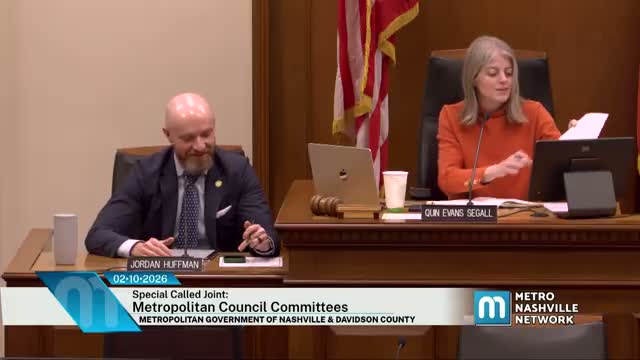
Summary
NES and Metro agencies told a joint council committee they are pursuing communication fixes, customer relief measures and an independent after-action review after an ice storm that left more than 230,000 customers without power; council members urged faster outreach to medically vulnerable residents and transparency on recovery costs.
NASHVILLE — At a specially called joint meeting of the Metro Council's Transportation & Infrastructure and Public Health & Safety committees, leaders from Nashville Electric Service (NES) and Metro departments described the damage and recovery steps after Winter Storm Fern and answered extended questioning from council members about communications and support for medically vulnerable residents.
NES officials said the storm struck the distribution system hardest and drove peak outages affecting more than 230,000 customers across roughly 294 square miles of their 685-square-mile territory. The utility's preliminary damage estimate ranges between $110 million and $140 million, and NES said much of the cost will be labor to replace damaged poles and equipment, including about 800 broken poles reported during the response.
To ease customer hardship, NES announced several immediate measures: suspension of disconnects and late fees through June (company policy implemented by the utility), unlimited payment-arrangement options through December 2026, and a $1 million board donation to the mayor's relief fund. NES also said the board has asked for an independent after-action review to be completed on an accelerated timeline, with stage-gate reporting that could include 30-day check-ins and a target to finish in about 90 days.
"At peak, more than 230,000 of our customers were without power," NES staff told council members, noting the scale challenged standard assessment and communications practices. NES leaders described four immediate pillars of work: strengthen emergency management leadership; overhaul outage communications and outage maps; refine estimated restoration-time practices; and evaluate resiliency measures including an undergrounding feasibility study and expanded vegetation management.
Council members pressed for specifics: how NES will identify and proactively contact people on its "critical referral" list (residents whose medical equipment depends on electricity); why some nursing homes were missing from the utility's priority lists; how meter-pinging and circuit-level notifications created misleading texts to customers; and how many linemen and contractor crews were mobilized and when.
NES technical staff acknowledged limits to the meter-communication system during the storm. They explained that when communications were degraded, meters could not reliably report status back to the system head-end and some outage-notification tools tied to circuits (not parcel-level meters) sent messages that a circuit was restored even when individual service points still lacked full power.
NES said it will expand targeted outreach for customers on the critical referral list and strengthen coordination with the Office of Emergency Management (OEM) to deliver generators, wellness checks and shelter assistance to medically vulnerable residents in wide-area outages.
Council members also sought transparency on contracts and spending related to recovery and communications. NES acknowledged some communications contracts and mutual-aid arrangements used in the response and said it would provide additional documentation about vendor selection and any lobbying or PR contracts tied to the recovery.
On financing, NES said it plans to pursue a reimbursement resolution with the council to bridge expenditures prior to FEMA reimbursements and described options such as bond issuances, commercial paper or other instruments to replenish cash reserves without accelerating rate increases for customers.
The board and NES leadership framed the meeting as one step in a continuing process. "We acknowledge where we failed to meet some customer expectations around communications," NES said. The independent review and planned operational changes were presented as the next steps. The board member present said the review will be independent and will examine board and management decisions and be made public.
The council requested more interactive, district-level outage data for members so they can better do welfare checks and help constituents in the field. NES said it would explore ways to provide time-stamped outage lists and map tools to council offices going forward.
What's next: NES will pursue the independent after-action review, accelerate targeted outreach for critical customers, begin the undergrounding feasibility study, refine its outage communications system and return to the council with vendor and contract disclosures and updates on the board's reimbursement resolution request.