
LSC podcast: experts say surge in debt-collection suits exploits unrepresented defendants and urge court and legislative fixes
Get AI-powered insights, summaries, and transcripts
Subscribe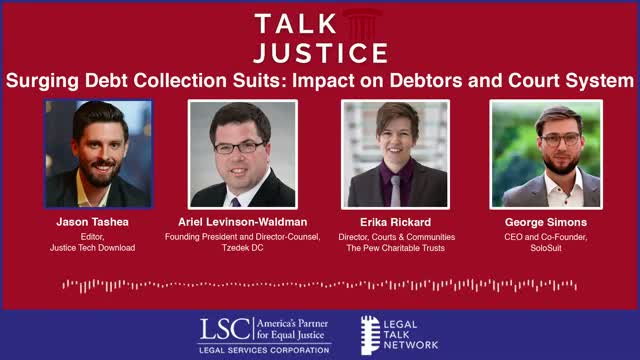
Summary
On a Legal Services Corporation podcast recorded March 22, experts said the sharp rise in debt-collection lawsuits — often brought by repeat plaintiffs against unrepresented defendants — produces defaults and economic harm and recommended reforms such as eliminating defendant filing fees, requiring proof before default judgments, and limiting collector contacts.
Jason Tache, host of the Legal Services Corporation’s Talk Justice podcast, opened the March 22 episode by describing a growth in consumer debt suits that he and guests framed as a nationwide access-to-justice problem. "Every year, hundreds of thousands of people are sued for consumer debt in America’s courts," Tache said, noting research that debt suits rose from roughly one in nine civil cases to one in four between 1993 and 2013.
Erica Rickard, project director for civil legal system modernization at the Pew Charitable Trusts, said debt collection lawsuits are now the single most common civil case type and that many defendants do not participate. "We have a repeat actor on one side and an empty chair on the other," Rickard said, describing how default judgments have become common because defendants lack notice or representation.
Ariel and Bridal Levinson Waldman, who work with low-income residents in Washington, D.C., described disproportionate effects on Black and Latino communities. Ariel said wealth disparities and structural policy choices have made debt suits a racial justice issue, and Bridal Levinson Waldman said the combination of corporate collection practices and lack of court safeguards extracts wealth from communities of color.
George Simons, founder and CEO of SoloSuit, described the typical case SoloSuit helps: unsecured credit, such as credit-card and medical debt. Simons said SoloSuit’s approach — helping people file an answer so a case does not default — flips typical outcomes: where defaults historically produce about a 90% loss rate for defendants, SoloSuit reported a more favorable outcome rate once an answer is filed. "Usually, about 90% of people lose their lawsuit, oftentimes by default. Without SoloSuit, we help people — we have over a 70% win rate in a lot of states," Simons said.
Panelists identified several procedural and policy changes they said would reduce unjust defaults. Simons recommended eliminating filing fees for defendants in debt cases (he said about 25% of states charge such fees and cited a $450 filing fee example in California), placing the court’s mailing address on summons forms so defendants know where to respond, and exposing court data via a public API so third parties can build access tools. Rickard urged courts and legislatures to require basic documentation — proof of amount, account, and ownership — before issuing default judgments.
The podcast also discussed regulatory and technological context: panelists cited the Consumer Financial Protection Bureau as the lead federal regulator in the space and debated the limits of online dispute resolution after a recent Markup article found Utah’s ODR system increased defaults for some plaintiffs. Guests said the Utah example illustrated how technology layered onto poor procedural design can worsen outcomes if notice and procedural safeguards are not rebuilt to match new digital processes.
The episode closed with an appeal to track and share reforms. "We are starting to see steps in Utah and in other states," Rickard said, pointing to reforms in jurisdictions including Texas, Maryland, Washington state and Colorado. Tache asked the guests to return to report on which interventions succeed.
The Legal Services Corporation disclaimer aired at the end, noting guest views are their own and the podcast is for informational purposes only.