
Committee recommends creation of Kingsbury Place tornado-recovery CID; residents to self-assess for infrastructure work
Get AI-powered insights, summaries, and transcripts
Sign Up Free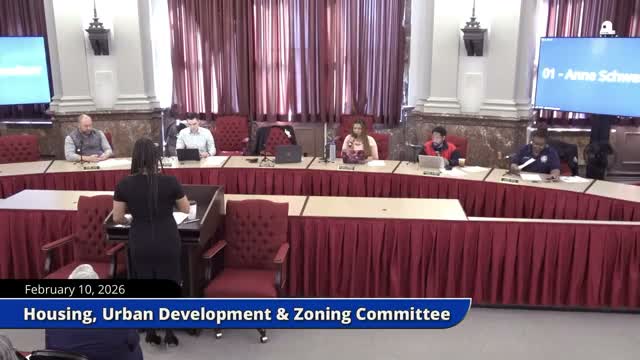
Summary
The committee gave a due-pass recommendation to board bill 128 to establish a Kingsbury Place Community Improvement District to fund up to $6 million in repairs after a tornado; residents said 49 of 61 households signed the petition and proposed a three-tier plan prioritizing water and sewer replacement.
The Housing, Urban Development and Zoning Committee voted to send board bill 128 to the full Board of Aldermen with a due-pass recommendation after hearing neighborhood testimony about recovery plans for Kingsbury Place, a private street heavily damaged in a recent tornado.
Sponsor Alderman Claire Hubbard introduced the petition and asked the committee to adopt Amendment No. 1 (a fiscal note). The clerk and committee acknowledged the fiscal note, and the committee adopted the amendment by unanimous consent. The sponsor described 270 days of ongoing recovery work and introduced neighborhood representatives and counsel to explain the CID plan.
Bill Donius, speaking for neighbors, said the petition has strong neighborhood support, reporting that 49 of 61 homeowners returned petitions in favor — roughly 80 percent. Resident Jermall Seward described his family’s displacement after a 100‑year-old tree fell on his house and said the CID would allow coordinated recovery and revitalization.
Longtime resident Steve Stoeggel described the structure and financing the petitioners propose. Citing Chapter 67 of state law as authority for self-assessment, Stoeggel said the neighborhood plans a three‑tier approach: tier 1 to rebuild water and sewer infrastructure, tier 2 to address deferred maintenance (curbs, sidewalks, gutters) and tier 3 to restore streetscape features (trees, gas lamps). He told the committee the proposal would not request city money; instead the neighborhood has identified two financing sources — approximately $4,000,000 from a local bank and $2,000,000 in a Small Business Administration disaster loan — and proposed a construction cap “not to exceed $6,000,000.” Stoeggel estimated the underground infrastructure work could run about $35,000 per house.
Committee members praised the neighborhood’s organization, noted that Kingsbury Place is a private street where residents normally shoulder maintenance responsibilities, and asked technical questions about scope and priorities. Maren Fjord (a resident) clarified that home repairs are part of the neighborhood plan and that underground work was prioritized so above‑ground improvements would be durable.
After discussion, the sponsor asked for a do-pass recommendation; the committee moved and passed board bill 128 out of committee with a due-pass recommendation. The clerk recorded one written testimony in opposition to the CID in the committee file. Chair Hubbard also announced that the city’s STLRecovers personal-property assistance application deadline has been extended to Feb. 28 and urged residents to apply.
The transcript includes petition figures, the neighborhood’s financing plan and the committee’s adoption of the fiscal note followed by a due-pass recommendation. Written opposition was noted but not read into the record.