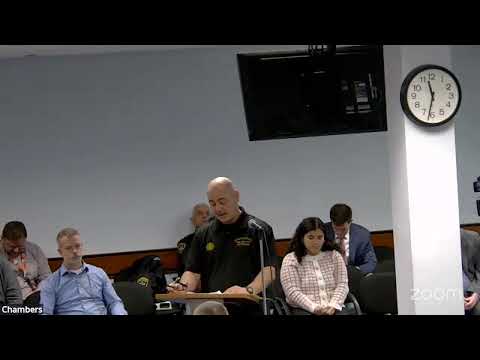
Madison County board adopts slate of committee resolutions, including labor agreement and video-conferencing policy
Loading...
Summary
The Madison County Board of Supervisors adopted multiple committee resolutions across government operations, finance, planning and public safety — including a CSEA white-collar agreement and a new policy for video conferencing — during a regularly scheduled meeting. Vote tallies were recorded by roll call as announced by the clerk.
The Madison County Board of Supervisors on a single meeting day approved a package of committee resolutions covering government operations, finance, planning and criminal justice, including a labor agreement with the CSEA white-collar unit and a new policy allowing the use of video conferencing in public meetings.
Pete Walrod, chair of the Government Operations Committee, introduced three resolutions recognizing NACO graduates and authorizing an agreement with CivicPlus, and moved them for adoption; the clerk recorded the roll call and announced "1,402 votes in favor." Kyle Reager, chair of Finance, Ways and Means, then presented resolutions 4–11 covering property accounting adjustments, budget modifications, a grant from the New York State Division of Criminal Justice Services, and contracts for local nonprofits; Reager moved the resolutions and the clerk again announced passage by roll call.
Planning matters were summarized by Vice Chair Matt Roberts, who described nine planning resolutions (12–20) including $120,000 appropriated to the Partnership for Community Development, appointments to regional boards, stream maintenance funding, watershed funding reallocation to the Madison County Soil and Water Conservation District and an additional $300,000 for a microenterprise grant fund for small startups. Roberts moved that package and the board adopted the resolutions by roll call.
Rex Bossberg, chair of the Criminal Justice and Public Safety Committee, moved resolutions 21–23, which included financial support for local EMS providers and an arrangement to support a school special patrol officer; the board approved those resolutions by roll call.
On the regular agenda, the board approved Resolution 24 authorizing the chairman to sign contracts with not-for-profit organizations for 2026. The clerk read a roll-call summary during that vote that included a recorded notation read aloud as "+1 votes in favor, 152 in abstentions, and 15 no votes," and the resolution was announced as passed. Resolution 25 declared several county items surplus (including a John Deere roadside mower and a Bobcat compact track loader) and was carried by voice vote. Resolution 26, adopting video conferencing policies and procedures for public meetings, was introduced by Walrod and adopted by roll call; the clerk announced "1,402 votes in favor."
A resolution authorizing the chairman to enter into an agreement with the CSEA white-collar unit — pulled earlier for separate consideration — was presented and adopted by roll call; the clerk announced "1,402 votes" and declared the resolution passed.
The board did not record extended debate on most items; committee chairs summarized purposes and asked for adoption. Where roll-call tallies were read aloud, the clerk's readouts were used as the official record.
The board adjourned after a second public-comment period that included appeals on veterans tax exemptions and a separate community request related to a county facility in Casanova.