Get Full Government Meeting Transcripts, Videos, & Alerts Forever!
Get email alerts on the Short Term Rentals topic
No spam. Unsubscribe anytime.
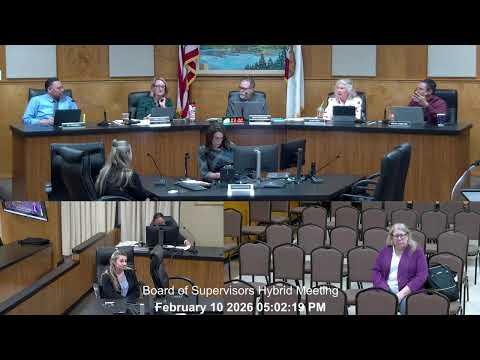
Lake County supervisors direct staff to form ad hoc on short‑term rentals; low‑impact camping to be handled separately
Summary
At its meeting, the Lake County Board of Supervisors directed staff to form an ad hoc committee to draft short‑term rental rules and agreed to handle low‑impact camping under AB 518 on a separate, faster track, with public outreach and coordination on timing given staff capacity constraints.
The Lake County Board of Supervisors directed staff on short‑term rentals and low‑impact camping at a public meeting, instructing the community development department to assemble an ad hoc committee to draft regulations for whole‑house vacation rentals and to pursue a separate, expedited review of low‑impact camping options authorized by state law.
Mireya Turner, Lake County’s community development director, told the board the county code currently allows only bed‑and‑breakfast uses and lacks an option for whole‑house short‑term rentals. She said staff reviewed about 11 jurisdictions’ short‑term rental policies and found common regulatory tools — principal‑residence limits, permit terms ranging from one to seven years, minimal signage, and parking restrictions to prevent neighborhood impacts — and recommended an ad hoc committee to develop local rules.
“People were coming to us asking how to do it right,” Turner said, arguing the committee should include representatives of the Tourism Improvement District, the local chamber of commerce, fire chiefs, a housing specialist, a business association, a short‑term rental owner, an HOA representative and a public member.
Why it matters
The discussion balances two community priorities: creating consistent, enforceable standards for visitor accommodations and limiting any loss of long‑term housing stock. Several supervisors said they supported moving forward but expressed concern about staff capacity and other priorities, including pending fiscal updates and the Lake County 2050 general plan public‑review period.
What the board decided and next steps
The board agreed — by consensus rather than a roll‑call vote — to separate the two topics. It directed staff to establish an ad hoc committee to develop short‑term rental regulations and to convene a stakeholder meeting or meetings to review the state’s low‑impact camping framework (Assembly Bill 518). Turner said low‑impact camping would likely return sooner because the statute provides a straightforward baseline; short‑term rental work will proceed through the ad hoc with more public outreach.
Public comment and stakeholder input
Lisa Wilson, representing the Lake County Chamber of Commerce, urged adoption of AB 518 and volunteered to represent the chamber on the ad hoc, also asking that meetings start no later than October 2026. Cassandra Prenvassalakis, government and community relations at Hipcamp, offered her organization as a resource and said Hipcamp helped draft the state law alongside groups including the California Farm Bureau Federation and rural county partners. Resident Angela Emeril warned the board to consider homeowners’ association (CC&R) rules and insurance gaps for short‑term rental use, noting standard homeowner policies can exclude short‑term rental activity.
Key details from staff and public testimony
- Low‑impact camping (AB 518): jurisdictions are allowed to authorize up to nine campsites on qualifying parcels; parcels must be at least two acres; no more than four of the sites may be occupied by RVs; the law is optional for counties to adopt and allows local additional restrictions. (This summary reflects staff remarks and the statutory framework presented at the meeting.)
- Short‑term rental options under consideration: principal‑residence vs. whole‑house permissions, permit durations (1–7 years in sample ordinances), limits tied to parking or housing stock, and local outreach to set either a cap by percentage of housing stock or community‑specific rules.
Board concerns and constraints
Supervisors noted competing priorities and constrained staff capacity; several said they preferred not to set a firm deadline but wanted the projects added to the work plan with realistic timing. The board asked staff to coordinate the short‑term rental ad hoc with the Treasurer/Tax Collector’s transient occupancy tax work so land‑use and taxation issues align.
What comes next
Staff will return with a proposed ad hoc membership and a timeline for both tracks. The board did not take a formal roll‑call vote to adopt an ordinance at the meeting; it provided direction for staff to proceed and to return with draft language and recommendations for subsequent board consideration.