Red Hook board adopts higher sewer fees after contentious public hearing
Loading...
Summary
Following a public hearing with several residents decrying cost increases, the Village of Red Hook trustees adopted new sewer operating fees and adjusted capital EDU assessments; the operating charge is set at $162 per benefit unit per quarter, and trustees said annual reassessments will follow.
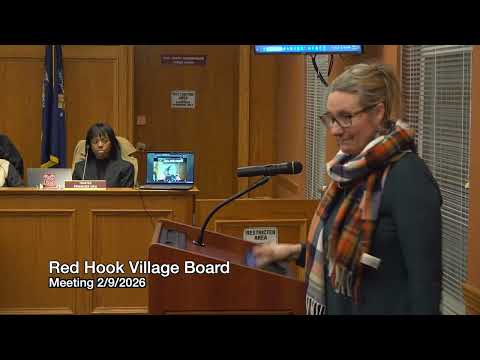
The Village of Red Hook Board of Trustees voted Feb. 9 to adopt updated sewer use fees and revise capital equivalent dwelling unit (EDU) assessments after a public hearing in which residents described steep bills and operational problems.
The trustees approved a resolution adopting an operating and maintenance (O&M) charge of $162 per benefit unit per quarter and adopting a revised capital‑EDU schedule, effective with the March 2026 billing cycle. The board recorded the outcome as a passing resolution (tally reported as 3 yes, 1 no, 1 abstention).
The increase followed public comment in which multiple residents and business owners said the sewer system had failed to deliver promised benefits and had produced outsized costs. "This whole sewer system was supposed to be put in place to avoid water contamination," said Vicky Logan, a village property owner, who told the board she and her husband faced rising bills and environmental worries and criticized how the system had been approved. Denise Seerman, another resident, said she had paid thousands for driveway and yard repairs associated with construction and questioned whether the proposed fee would benefit her personally. Bruce Troy, a business owner, said the rising costs were “another hit to the bottom line” for long‑standing local businesses.
The board and staff explained the two parts of the proposal: an O&M fee based on recent water usage (benefit units determined from the last four billing periods) and a separate capital charge apportioned on a capital‑only EDU basis to reflect debt service and existing improvements. The mayor said the O&M methodology (one benefit unit equals 150 gallons per day or portion thereof) is a standard way to set user charges and that the updated benefit units corrected earlier faulty data and better reflect current water use.
Multiple trustees and members of the public pressed for alternatives to blunt the immediate impact on households, including spreading costs more broadly or seeking tax‑based credits. Trustees said New York law limits how user fees can be allocated and that the village must recover the system's operating costs from those who use it; they also discussed exploring whether property‑tax mechanisms or other relief could legally provide mitigation. Board members said the village will reassess benefit units annually so that users whose consumption has fallen can see charges reduced in future cycles.
The board noted recent operational improvements, including new staffing and steps to address prior noncompliance events at the wastewater treatment facilities. Officials said the village is pursuing capital projects — notably enlarging the equalization tank — and has applied for grant funding to support needed upgrades.
The sewer fee resolution cites village code sections governing benefit units and water‑use‑based charges; the clerk and village engineer will publish the adopted fee schedule (exhibit A) and related property‑level charts on the village website. Residents seeking a review of their EDU assignment were told they should contact village staff for clarification. The board kept the record open for the procedural steps required by law and confirmed the fees will appear on the March billing cycle.
The board and staff urged residents with billing or odor complaints to report specifics (date/time/location) so operations staff can investigate. The trustees said they will continue to look for lawful ways to mitigate financial hardship while meeting their legal obligation to fund sewer operations and debt service.