
WFRC seeks member input on RTP prioritization: connectivity and safety top ranked for active transportation
Get AI-powered insights, summaries, and transcripts
Subscribe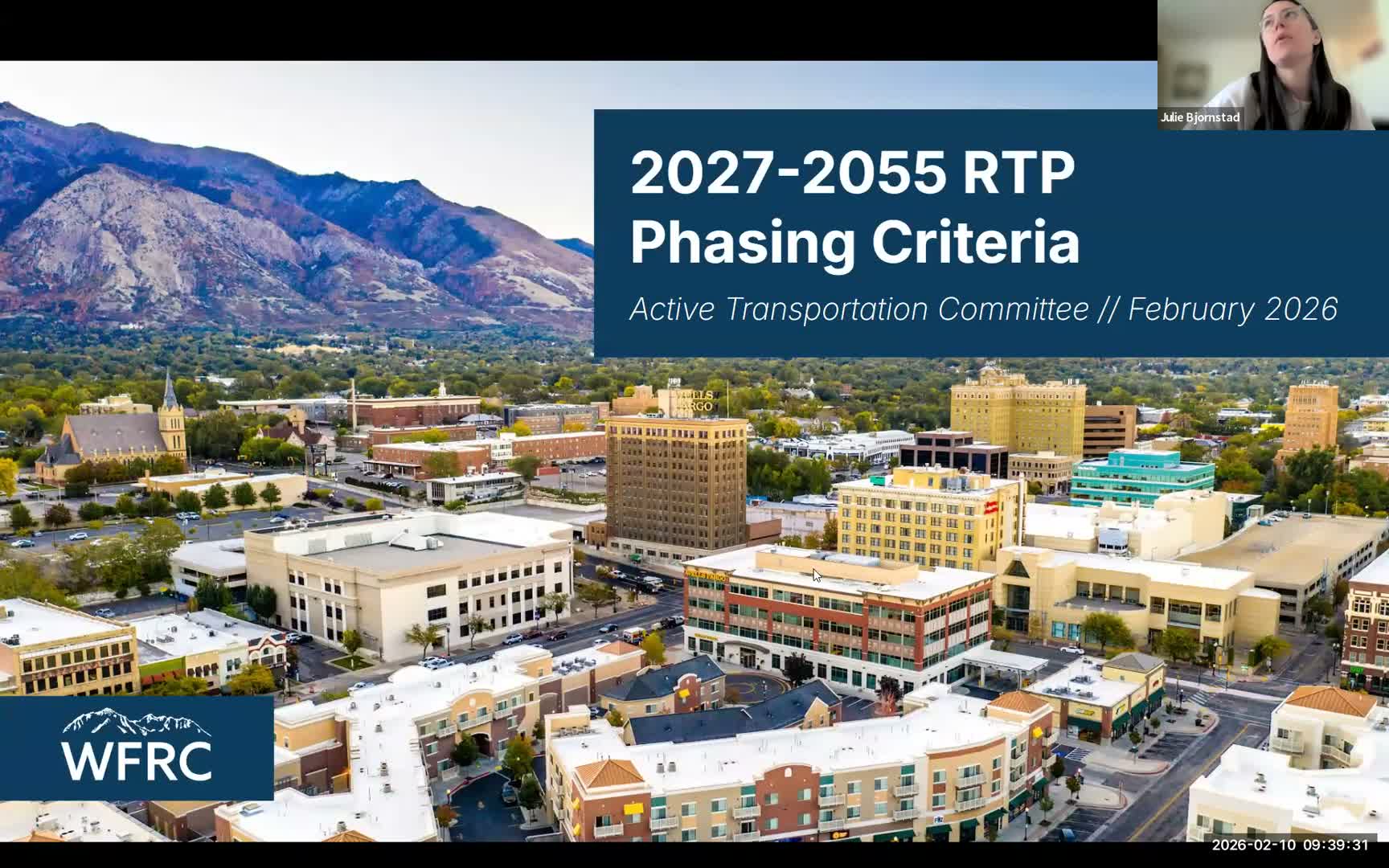
Summary
WFRC staff presented draft prioritization criteria for the Regional Transportation Plan and asked committee members to rank criteria; members raised questions about balancing large roadway projects with active transportation and about how much funding is actually directed to walking and biking.
On Feb. 10, Julie Bjornstead, deputy director of long‑range planning (as presented in the meeting), walked the Active Transportation Committee through the needs‑based phasing and weighting approach WFRC will use to prioritize projects in the next Regional Transportation Plan (RTP) update.
"The regional transportation plan gets updated every 4 years... we adopted the current 2023 RTP in May 2023 and will need to adopt this RTP by May 2027," Julie said, describing a two‑step phasing approach: first assign a needs‑based phase (roughly 10‑year buckets) using technical criteria tied to the Wasatch Choice vision goals, then compare needs to expected funding using a financial model.
The active‑transportation criteria Julie presented are organized by Wasatch Choice goals: livable and healthy communities (access to vision centers and physical activity benefits); access to economic and educational opportunities (including lower‑income areas); manageable and reliable traffic/emissions (fiscal and right‑of‑way feasibility); quality transportation choices (network connectivity and potential mode shift); safe and user‑friendly streets (comfort and safety); and advancing previous investments (alignment with Beehive Bikeways or existing studies).
Committee members raised several questions during the discussion. Mike (identified in the meeting as a participant) asked how WFRC balances large roadway projects with active transportation goals when roadway projects can worsen walkability if not designed to context. Julie said the RTP uses a context‑sensitive Great Streets framework to account for whether road projects improve or detract from centers, and that multimodal reviews are done for corridors with multiple project types.
Another member asked whether the RTP sets a mode‑split allocation (for example, an even 33/33/33 split between roads, transit and active transportation). Julie replied that revenue sources have statutory constraints and the RTP does not impose arbitrary modal splits; funding tends to reflect statutory restrictions and programmed investments, which historically have resulted in vastly greater spending on roads than on walking and biking. She showed prior plan figures illustrating large disparities between road spending (hundreds of billions in need) and active transportation allocations.
WFRC asked members to rank the criteria via Slido; staff said the poll results and feedback from technical advisory committees will inform weighting. Julie asked committee members to send any additional feedback so staff can incorporate it before phasing evaluations begin in a couple of months.
The committee did not vote on the criteria; WFRC sought input to refine scoring and weighting ahead of project phasing and STIP programming.