
OIG: Data gaps limit Seattle’s ability to judge impact of public drug-use ordinance
Get AI-powered insights, summaries, and transcripts
Subscribe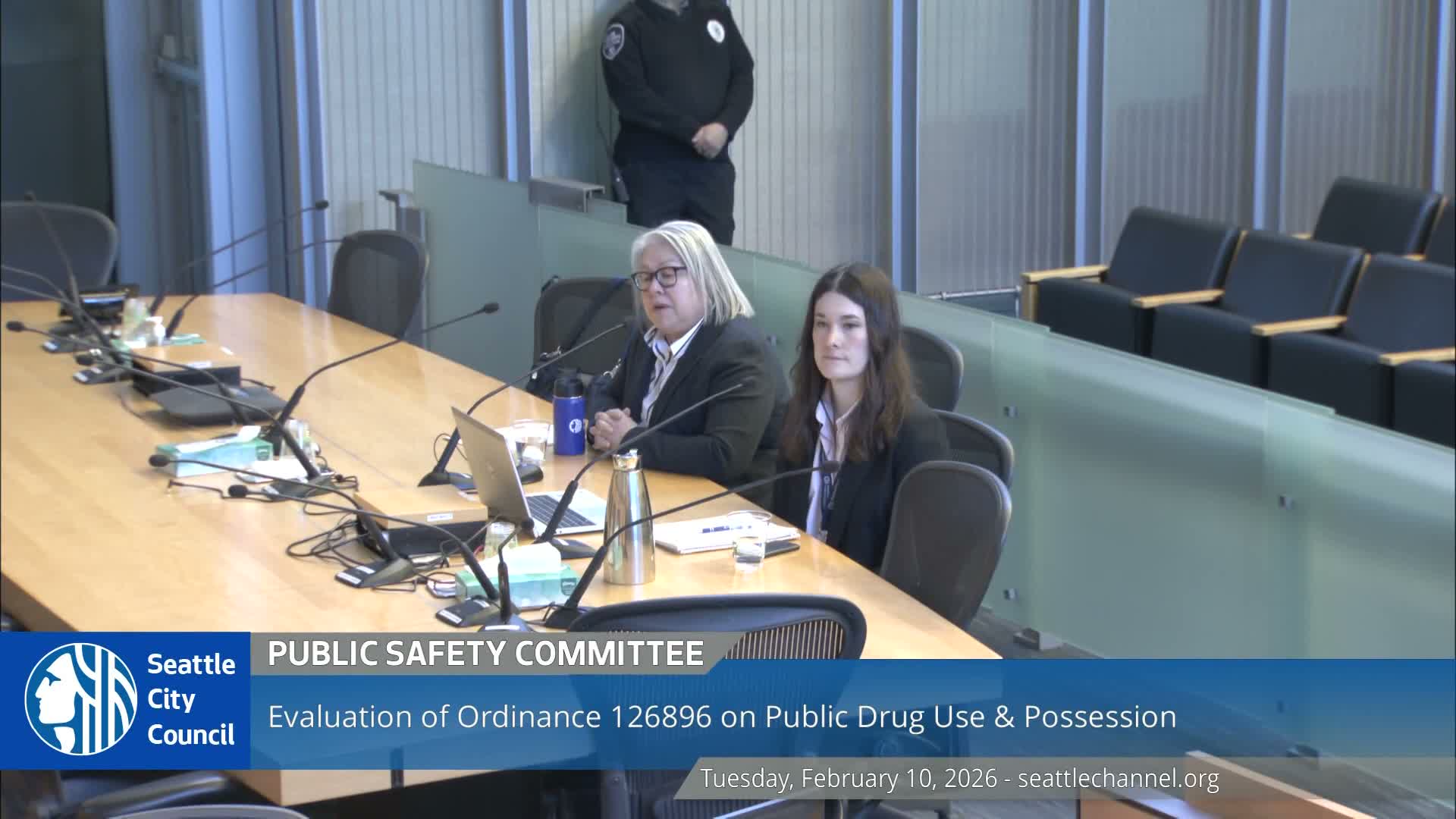
Summary
The city inspector general’s early evaluation of the 2023 public drug-use and possession ordinance finds important trends in overdoses and 911 calls but says missing and inconsistent diversion data between SPD and LEAD prevent firm conclusions about whether the ordinance caused an increase in prebooking diversions.
The Office of Inspector General told the Public Safety Committee on Feb. 10 that delays and gaps in law-enforcement and partner data have so far prevented a conclusive evaluation of the 2023 ordinance governing public use and possession of controlled substances.
"Over this period, there were 1,871 drug overdose deaths," Emily Morley, the performance auditor who led the technical analysis, told the committee, and the publicly available King County data showed a rise from roughly one overdose death every other day in 2019 to about two deaths per day by 2023. Morley and Inspector General Lisa Judge said OIG also reviewed 911 call counts related to controlled substances (12,270 calls across the five-year span) and other publicly available trend indicators.
The OIG report focused on how the ordinance’s "threat of harm" standard has been implemented in Seattle Police Department policy, including officer consideration of threats of violence, escalating demeanor, co-occurring crimes, location (near schools, parks, bus stops and rail stations), type of substance and the subject’s physical condition. Morley said the ordinance and SPD policy emphasize diversion and treatment as preferred outcomes when there is no threat to others.
But the auditors found the most significant limitation was inconsistent and incomplete diversion records. "When we received access to SPD data, we also worked with LEAD," Morley said. "We found discrepancies: roughly 160 diversions in SPD data we could not corroborate in LEAD data and about 100 diversions in LEAD not corroborated in SPD." Those mismatches, together with missing prosecution and booking fields, mean OIG cannot make a causal claim that passage of the ordinance increased prebooking diversions.
OIG staff told the committee that some datasets required time-consuming narrative reviews to extract outcomes such as transport to medical facilities or booking, and that approvals for officer interviews were delayed while SPD management and the Seattle Police Officers Guild vetted questions. The office said it had identified an academic partner (the University of Washington’s Addictions, Drug and Alcohol Institute) and renewed that contract to continue analyzing later years of data and pursue interviews and prosecution records in future annual reports.
Councilmembers asked whether community referrals had been included; Morley said the ordinance question OIG was required to answer concerned diversion efforts coordinated by officers, so community-referral counts were not the focus and in many cases were difficult to separate from officer-originated referrals in the available data. Council member Lynn and others pressed OIG to include 2024 and 2025 data in subsequent reports; OIG confirmed it will expand the timeframe and expects improved data accuracy as SPD and LEAD integrate systems.
The briefing concluded with committee members urging continued work on data integration, clear training guidance on how SPD interprets "near" (for example, near a transit stop), and further analysis of prosecution and dismissal outcomes once city attorney and municipal court data become available. OIG committed to return in later cycles with refined findings and recommendations. The presentation served as an initial, not final, evaluation required by the 2023 ordinance.