Public commenters press Seattle City Council to push ICE off city grounds, curb surveillance and fund services
Loading...
Summary
More than two dozen public speakers at the Feb. 10 Seattle City Council meeting urged the council to restrict ICE activity on city property, end surveillance practices (including ALPR/CCTV) they say are being weaponized against migrants, and redirect funding to accessible services.
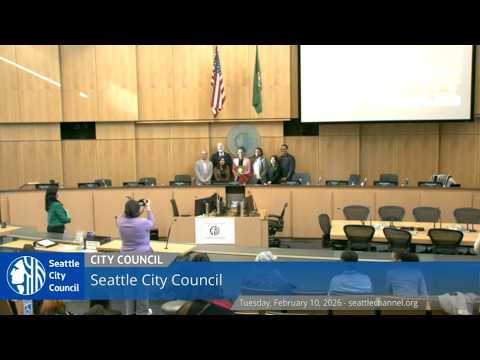
Dozens of people in person and online used the council’s public comment period on Feb. 10 to press Seattle leaders to take immediate action against ICE enforcement and to curb expanding surveillance systems.
Speakers repeatedly criticized a Jan. 27 presentation by the King County Prosecuting Attorney’s Office that, they said, included unredacted and graphic images of survivors. Amber, a volunteer with the Greenlight Project, said the presentation “featured unredacted, identifiable images of brutalized, bloodied, and tortured women” and accused prosecutors and some committee members of selectively using survivor stories to advance criminalization. ‘‘We believe that it was part of a larger pattern of instrumentalization and exploitation of survivors,’’ Amber said.
Madison Zakuyl of Strippers or Workers summarized five concrete demands: an acknowledgment that survivor stories have been selectively used for policy advocacy; review and revision of city and county policies, guidelines and trainings governing the use of survivor imagery; an independent, empirical analysis by the Office of Civil Rights of potential policy approaches; strategies to include diverse survivor perspectives in policymaking; and a dedicated public safety committee presentation on human-rights-based, noncarceral responses.
Several other speakers urged the council to limit ICE presence on city property. Elle, a student organizer with Onigweins South Seattle, asked the council to establish a two-mile buffer around schools to prevent ICE enforcement near children’s routes to and from school. Ruth and others called for coalition actions, including local prosecution of ICE when agents break the law and a state of emergency declaration for migrants and asylum seekers.
Multiple commenters raised surveillance as a cross-cutting concern. Daniel, speaking for the International League of People’s Struggle, linked growing deployment of ALPR (automatic license-plate readers), CCTV and other systems to corporate profit and said those systems can be “weaponized” by federal enforcement. Another commenter said $4,000,000 reportedly allocated to the migrant response lacked transparency and accessibility; Yvette Dynish urged accountability for nearly $40,000,000 the city devotes to its community-safety program and asked the council to show clearly which organizations receive those funds.
Not all remarks focused on enforcement and surveillance: callers also raised housing and land-use concerns, requested immediate funding for Black-led emergency preparedness and youth programming in Districts 2 and 3, and asked that the city’s passport initiative be expanded to protect vulnerable families.
The public comment period ended after the council closed registration; Council President Joy Hollingsworth later moved the agenda forward and the council proceeded to vote on its consent and legislative items.
What’s next: Public commenters requested specific follow-ups—an Office of Civil Rights review, a Public Safety Committee presentation on noncarceral responses, and clearer reporting on spending—and several said they will return until they see action.