
Lafayette council approves lot‑line adjustment but denies variance in contentious Spring Hill Lane appeal
Get AI-powered insights, summaries, and transcripts
Subscribe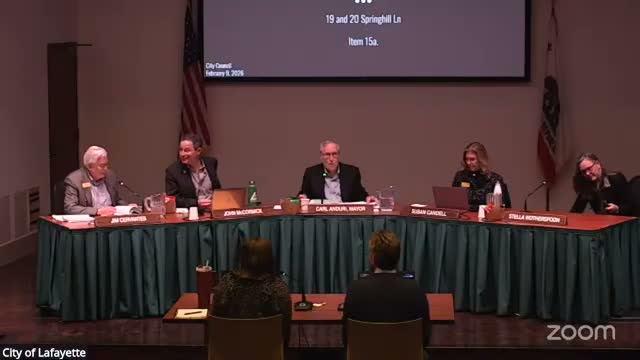
Summary
After a de novo hearing on an appeal of Planning Commission decisions at 19–20 Spring Hill Lane, the council voted 3–1 to approve a lot‑line adjustment bringing a parcel into compliance and denied a variance request for a 120‑sq‑ft structure that would reduce setback requirements.
Lafayette, Calif. — The City Council on Tuesday approved a lot‑line adjustment between two privately owned parcels at 19 and 20 Spring Hill Lane but denied a variance for a small accessory structure, concluding the statutory findings for a variance were not met.
Associate Planner Nicole Bridal summarized staff’s recommendation to approve the lot‑line adjustment — which would enlarge the undersized northern parcel to meet the five‑acre zoning minimum — and to deny a variance for a 120‑square‑foot garden shed that sits 25 feet from the northern property line where a 50‑foot setback is required under the LR‑5 zoning.
The applicant, Pete (Pete/Peter) Docter, and project designer Mark Becker described a multi‑year process that included demolition of an older house, revised grading and repositioning of structures and the installation of a small one‑story dwelling (described as a 440‑sq‑ft unit) and a separate 1,000‑sq‑ft barn. They said the lot‑line adjustment corrects a later‑identified nonconformity and that immediate neighbors provided letters of support for the potting‑shed location.
The appellant and several neighbors, led by Michael Hoffman, urged the council to deny the lot‑line adjustment and to investigate staff procedures. Hoffman alleged the city failed to enforce prior Design Review Commission (DRC) conditions (DRC resolution cited) and said staff and the applicant had improperly altered approved plans. Neighbors described heavy grading, damage to the roadway from construction traffic, and a permanent change to views and neighborhood character.
City staff and the city attorney told the council that a court challenge and civil complaints are pending and that some aspects of the dispute are the subject of separate litigation; they also advised the council on the governing code for lot‑line adjustments and the statutory standard for a variance, which requires special circumstances "applicable to the property" that deprive it of privileges enjoyed by other properties under the same zoning classification.
On the variance, staff said alternative conforming locations exist on the property and recommended denial; the Planning Commission had previously approved the variance after finding special circumstances. After deliberation the council found staff’s legal analysis persuasive and denied the variance.
On the lot‑line adjustment, council members who voted in favor said the change brings the parcels into compliance with minimum lot‑size rules and removes a nonconformity; Councilmember Candel dissented, calling the sequence of approvals and later staff actions "a trick" and expressing concern about process and fairness.
The council adopted the resolution effecting the lot‑line adjustment (final action) with a recorded vote of 3–1. The resolution also included the council’s action on the variance (denial). The city attorney and staff noted the litigation and recommended the council limit its review to the lot‑line and variance criteria rather than litigate earlier design‑review process questions.
Next steps: The council’s action was final at the meeting. The appellant has previously filed litigation and asserted other claims; the council’s oral record and staff reports will be part of the administrative record and any judicial review.
Key vote: motion to adopt the resolution (lot‑line approval; variance denied) passed with ayes from Mayor Anduri, Vice Mayor McCormack and Councilmember Cervantes and a no vote from Councilmember Candel.