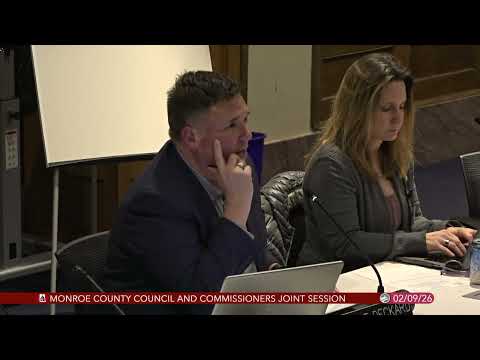
Monroe County leaders debate how to deliver a constitutionally compliant jail as funding, location and a potential lawsuit threaten timeline
Loading...
Summary
At a joint session, Monroe County commissioners, councilors, judges and jail officials discussed options to meet constitutional standards for the county jail, weighing bonding limits, phased construction, co-location with courts and the legal risk after the council rejected the North Park purchase; officials agreed to gather cost and risk estimates before April deadlines.
Monroe County elected officials and criminal justice leaders met in a joint session to press for a path to replace an aging county jail while wrestling with limited short‑term bonding capacity, competing priorities and a looming settlement deadline.
County officials heard from judges and jail staff who said the existing facility is unsafe and urged action to reach constitutional standards of care. "We have a jail that is unsafe for the inmates and unsafe for the jail staff, and that is unacceptable," Judge Catherine Stafford said, urging a plan that ensures constitutional care rather than delaying action.
The meeting focused on three decisions the bodies must resolve: funding (how much of local income tax the County Council will commit), location (whether courts and jail should be co‑located) and timing (whether to buy land now and delay construction or pursue a phased, jail‑first approach).
Why it matters: the county faces both operational risks in its current jail and legal pressure tied to a letter referenced in the meeting. Officials said a private settlement linked to the site selection could be jeopardized if the county does not produce a specific plan by an April deadline noted in correspondence distributed to jail residents. Councilors and commissioners said they want to avoid costly litigation while also limiting taxpayer burdens.
Funding and timing Mister Cockrell (role not specified in the transcript) told the joint session that current bonding capacity is constrained by a 25% cap that limits borrowing in the near term. He said the county currently spends roughly 0.61% of local income tax (LIT) receipts and collects about 0.8%; under pending state legislation he estimated LIT available to the county could grow to about 1.2% by 2028, which would create room to finance bond payments for a large project. On potential financing, officials discussed a planning figure of $225 million for the full project and an illustrative annual debt service in the neighborhood of $18 million if fully bond‑funded, while noting the county could use cash on hand to reduce borrowing.
Operational tradeoffs and co‑location Judges and court staff warned that splitting courts from the jail would impose recurring operational costs and procedural complications. Judge Bostick and others described the criminal case process—arrest reports, prosecutor review, pretrial assessment, public defender presence and coordination with clerks—and said separate sites would increase delays, staffing needs and transport risks. Judge Catherine Stafford said duplicating court administrative functions or recording equipment in two locations would be costly and operationally infeasible without careful planning.
Several presenters and commissioners discussed a phased approach: building a smaller, constitutionally compliant jail first while planning court facilities later, or purchasing land now and delaying construction until funding clarity. Chief deputies and jail commanders repeatedly urged co‑location and single‑floor design as priorities for safety and staff efficiency, but council members said fiscal limits and taxpayer impact must be part of any decision.
Legal risk and past council vote Officials said the County Council voted in October to decline the North Park purchase agreement, a decision some stakeholders described as unexpected; jail staff flagged a letter from attorney Ken Faulk that threatens to terminate a private settlement unless the county presents a plan by April 15. Jail leadership warned that without demonstrable progress the county could face federal litigation involving the facility, which would name some county actors as potential defendants.
Capacity and design assumptions Staff referenced a DLZ study that proposed a base design of about 404 beds (including an 80% capacity planning factor) and shell space to expand toward roughly 500 beds as needed. Officials discussed an approximate $150 million figure for a jail‑only portion of a larger $225 million scheme but said precise numbers depend on scope, whether medical and mental‑health spaces are included and how much cash the county applies versus bonded debt.
Next steps Participants agreed to produce a short list of concrete deliverables: (1) a council statement of the range of LIT or other funding it is willing to commit, (2) a risk and cost assessment comparing co‑located versus non‑co‑located court/jail models (including transport, vehicle and personnel costs), (3) a construction/retrofit estimate for the Zitlow Justice Center if needed (an estimate of $15,000 for a construction estimate was referenced), and (4) reconvening or reinstituting the Community Justice Response Committee for stakeholder discussion. Officials said additional information will be provided at an executive session next week; no formal motions or votes were taken at the joint meeting.
What remains unresolved: councilors have not announced a funding threshold; North Park remains off the table per the council's prior vote; and the April deadline tied to the settlement letter remains a near‑term constraint. The county’s ability to begin construction may be delayed until 2028 if state legislation preserving an expanded LIT collection is not finalized.
Ending: The meeting ended with agreement to gather the requested estimates and to reconvene; the bodies adjourned without a new vote or formal action to buy land or start construction.